THE ADVENTURE COLLECTIVE® · Independent discovery and booking for outdoor travel

A private minivan lets you trade London’s bustle for the open sweep of Salisbury Plain and an up-close look at Stonehenge. This full-day chauffeured option is practical for small groups who want a comfortable, flexible visit and the option of a licensed guide.
A private minivan lets you trade London’s bustle for the open sweep of Salisbury Plain and an up-close look at Stonehenge. This full-day chauffeured option is practical for small groups who want a comfortable, flexible visit and the option of a licensed guide.
You step out of the minivan onto the wide, wind-scoured plains where the stones stand like weathered sentries; the driver’s door closing behind you is the last London sound you’ll hear for hours.
Verified experiences and guided adventures in the surrounding area.
Operated by European Tours Limited · Amesbury, Wiltshire
You step out of the minivan onto the wide, wind-scoured plains where the stones stand like weathered sentries; the driver’s door closing behind you is the last London sound you’ll hear for hours.
Stonehenge sits on Salisbury Plain roughly 90 miles (145 km) west of central London, its ring of sarsens and bluestones erected in stages beginning around 3000–2000 BCE. Geologically, the massive sarsens are a remnant of periglacial processes and local sandstone, while the smaller bluestones originated in the Preseli Hills of Wales — a mystery that shaped millennia of local lore and modern archaeology. Culturally the site has served as a burial ground, solar calendar and pilgrimage focus; English Heritage now manages visitor access through a modern visitor center that interprets those layers.
On a private chauffeured tour you’ll have door-to-door transport in a minivan for up to six people, flexible stop times and the convenience of a vehicle base. Expect a short walk from the visitor center across grassy, occasionally uneven ground to the fenced circle — plan for 1–3 km of walking at the site depending on whether you explore nearby earthworks like the Cursus or Old Sarum.
Practical guidance: admission to Stonehenge is typically booked separately, and a Blue Badge guide can be added for an extra fee. Morning departures reduce traffic and crowds; wear sturdy shoes, bring windproof layers and allow time in Salisbury if you want pubs or cathedral visits. Traffic can vary — the tour’s eight-hour window includes drives, so plan pickups accordingly.
easy.
8 hours.
Suitable for most fitness levels; expect short flat walks up to a few kilometers on grass and gravel
Not always; many private chauffeured options require you to book English Heritage time-slot tickets separately — check the booking details and reserve ahead.
Yes — a licensed Blue Badge guide can usually be added for an extra fee (often charged separately), and they meet at the visitor center for the guided portion.
Expect 1–3 km of walking between the visitor center, car park and the monument across mostly flat grass and paved footpaths; mobility assistance is available if prearranged.
Pickup point is set at booking; private tours generally offer a central London pickup and return, but confirm exact location and any additional charges when you book.
Stonehenge was constructed in stages from around 3000–2000 BCE and served varied ritual, funerary and astronomical roles across prehistory and later eras.
English Heritage manages visitor flow via a modern visitor center and timed tickets to protect fragile archaeology; staying on paths and using official facilities reduces erosion and habitat impact.
European Tours Limited operates guided outdoor trips and adventures with an emphasis on safety, stewardship, and memorable experiences.
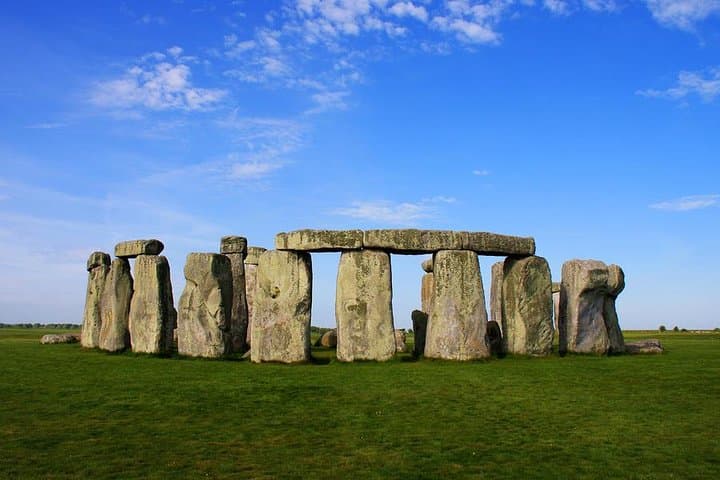



You step out of the minivan onto the wide, wind-scoured plains where the stones stand like weathered sentries; the driver’s door closing behind you is the last London sound you’ll hear for hours.
You step out of the minivan onto the wide, wind-scoured plains where the stones stand like weathered sentries; the driver’s door closing behind you is the last London sound you’ll hear for hours.
Stonehenge sits on Salisbury Plain roughly 90 miles (145 km) west of central London, its ring of sarsens and bluestones erected in stages beginning around 3000–2000 BCE. Geologically, the massive sarsens are a remnant of periglacial processes and local sandstone, while the smaller bluestones originated in the Preseli Hills of Wales — a mystery that shaped millennia of local lore and modern archaeology. Culturally the site has served as a burial ground, solar calendar and pilgrimage focus; English Heritage now manages visitor access through a modern visitor center that interprets those layers.
On a private chauffeured tour you’ll have door-to-door transport in a minivan for up to six people, flexible stop times and the convenience of a vehicle base. Expect a short walk from the visitor center across grassy, occasionally uneven ground to the fenced circle — plan for 1–3 km of walking at the site depending on whether you explore nearby earthworks like the Cursus or Old Sarum.
Practical guidance: admission to Stonehenge is typically booked separately, and a Blue Badge guide can be added for an extra fee. Morning departures reduce traffic and crowds; wear sturdy shoes, bring windproof layers and allow time in Salisbury if you want pubs or cathedral visits. Traffic can vary — the tour’s eight-hour window includes drives, so plan pickups accordingly.