THE ADVENTURE COLLECTIVE® · Independent discovery and booking for outdoor travel

Trade the bus timetable for a private car and a personal driver to My Son Sanctuary — a six-hour round-trip that pairs flexible stops with focused exploration of Champa ruins. Ideal for travelers who want cultural depth without the constraints of a group shuttle.
Trade the bus timetable for a private car and a personal driver to My Son Sanctuary — a six-hour round-trip that pairs flexible stops with focused exploration of Champa ruins. Ideal for travelers who want cultural depth without the constraints of a group shuttle.
You leave the coastal bustle of Hoi An and the rice paddies begin to breathe; the road narrows, palms lean in, and the hills of central Vietnam push the horizon into focus. The private car eases through villages where children wave and water buffalo graze, delivering you to My Son — a hush of red brick ruins tucked into a green valley, where carved lintels and broken columns still hold the presence of a lost kingdom.
Verified experiences and guided adventures in the surrounding area.
Operated by Local guide in Da Nang city, Vietnam · Duy Phu, Quang Nam
You leave the coastal bustle of Hoi An and the rice paddies begin to breathe; the road narrows, palms lean in, and the hills of central Vietnam push the horizon into focus. The private car eases through villages where children wave and water buffalo graze, delivering you to My Son — a hush of red brick ruins tucked into a green valley, where carved lintels and broken columns still hold the presence of a lost kingdom.
My Son was the religious heart of the Champa civilization from the 4th to the 13th centuries, its temples built of fired brick without mortar and oriented toward Hindu cosmology. The valley sits between low volcanic ridges that once supplied stone and fertile soil, shaping settlement patterns and the agricultural rhythms you’ll pass on the drive.
Culturally the site reads like an open-air chronicle: inscriptions, royal burial mounds, and elephant motifs that hint at trade links across Southeast Asia. Local guides can detail Champa kings and the French and wartime damage that scarred the complex — but the cadence of wind and the slow river give the ruins their human scale.
Practical guidance: bring sun protection, sturdy shoes for uneven brick and trails, and a bottle of water; the site involves moderate walking on loose surfaces. Plan morning or late-afternoon visits to avoid midday heat and crowds. If you opt for a guide or a Marble Mountains stop on the return, confirm timing with your driver — the private car model gives flexibility to linger, photograph, and move at your own pace.
easy.
6 hours.
Light to moderate mobility is fine; ability to walk short uneven stretches for up to 90–120 minutes during the visit is helpful
The drive is approximately 50 km and typically takes around 1–1.5 hours each way, depending on traffic and stops.
Entrance fees and guides are not included by default; you can usually add a licensed local guide as an optional extra.
Yes — infant seats are available and the private car model is family-friendly, though infants must sit on an adult’s lap per operator notes.
Yes — the itinerary is flexible and the return trip can include optional stops like the Marble Mountains, subject to scheduling with your driver.
My Son served as the spiritual and political center of the Champa kingdom; many temples were built between the 4th and 13th centuries and later damaged during wars.
Ongoing conservation balances visitor access with fragile brickwork; stick to marked paths and support local conservation fees when available.
Local guide in Da Nang city, Vietnam operates guided outdoor trips and adventures with an emphasis on safety, stewardship, and memorable experiences.


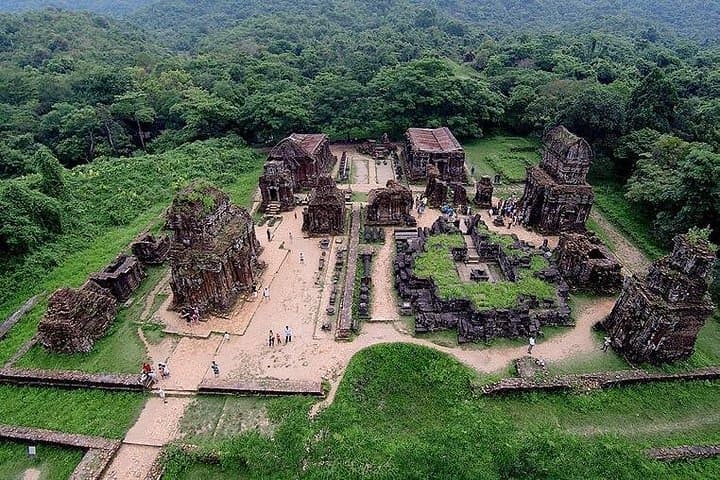

You leave the coastal bustle of Hoi An and the rice paddies begin to breathe; the road narrows, palms lean in, and the hills of central Vietnam push the horizon into focus. The private car eases through villages where children wave and water buffalo graze, delivering you to My Son — a hush of red brick ruins tucked into a green valley, where carved lintels and broken columns still hold the presence of a lost kingdom.
You leave the coastal bustle of Hoi An and the rice paddies begin to breathe; the road narrows, palms lean in, and the hills of central Vietnam push the horizon into focus. The private car eases through villages where children wave and water buffalo graze, delivering you to My Son — a hush of red brick ruins tucked into a green valley, where carved lintels and broken columns still hold the presence of a lost kingdom.
My Son was the religious heart of the Champa civilization from the 4th to the 13th centuries, its temples built of fired brick without mortar and oriented toward Hindu cosmology. The valley sits between low volcanic ridges that once supplied stone and fertile soil, shaping settlement patterns and the agricultural rhythms you’ll pass on the drive.
Culturally the site reads like an open-air chronicle: inscriptions, royal burial mounds, and elephant motifs that hint at trade links across Southeast Asia. Local guides can detail Champa kings and the French and wartime damage that scarred the complex — but the cadence of wind and the slow river give the ruins their human scale.
Practical guidance: bring sun protection, sturdy shoes for uneven brick and trails, and a bottle of water; the site involves moderate walking on loose surfaces. Plan morning or late-afternoon visits to avoid midday heat and crowds. If you opt for a guide or a Marble Mountains stop on the return, confirm timing with your driver — the private car model gives flexibility to linger, photograph, and move at your own pace.