THE ADVENTURE COLLECTIVE® · Independent discovery and booking for outdoor travel

A private, air-conditioned day trip from Aswan to the monumental Abu Simbel temples. Expect a 7–8 hour excursion with expert transfers, a guided visit of the relocated rock-cut temples, and practical tips for timing, sun protection, and photography.
A private, air-conditioned day trip from Aswan to the monumental Abu Simbel temples. Expect a 7–8 hour excursion with expert transfers, a guided visit of the relocated rock-cut temples, and practical tips for timing, sun protection, and photography.
You arrive before the desert heat has fully risen: a low sun brushes the sandstone, and the road to Abu Simbel stretches like an invitation across gold and ochre. The drive from Aswan follows a wide, open corridor where the river’s life has long given way to arid plain; when the temple facades appear, their four colossal Ramses II statues dominate the horizon with an almost theatrical clarity.
Verified experiences and guided adventures in the surrounding area.
Operated by Fares Egypt Tours · Abu Simbel, Aswan Governorate
You arrive before the desert heat has fully risen: a low sun brushes the sandstone, and the road to Abu Simbel stretches like an invitation across gold and ochre. The drive from Aswan follows a wide, open corridor where the river’s life has long given way to arid plain; when the temple facades appear, their four colossal Ramses II statues dominate the horizon with an almost theatrical clarity.
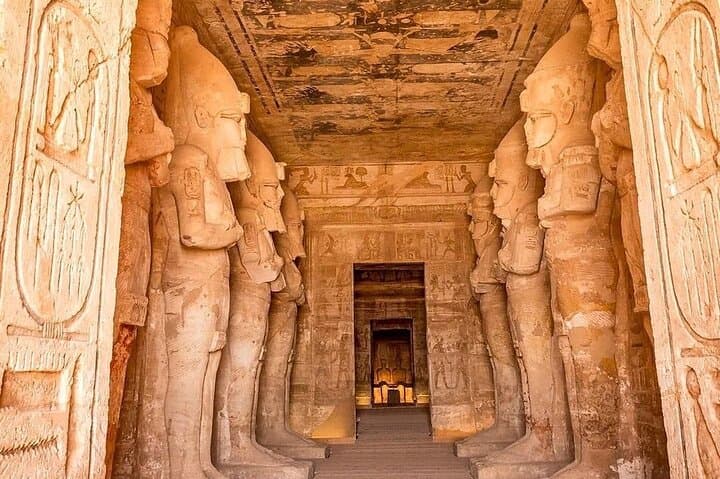
The temples at Abu Simbel date to the 13th century BCE and celebrate Ramses II and Queen Nefertari. Carved directly from the mountain, their hieroglyphs and reliefs record campaigns, solar alignments and royal ritual. In the 1960s the entire complex was relocated—block by block—to higher ground to escape Lake Nasser’s rising waters, an engineering milestone that preserved this chapter of pharaonic architecture.
Culturally the site still functions as a place of encounter between past and present: local guides add context on ancient rituals while the surrounding desert keeps a quiet, unhurried rhythm. Photographic windows open at different angles; light and shadow reveal details on stone that a single glance can miss.
Practical guidance: plan for a 7–8 hour round trip with private, air-conditioned transfers; carry sun protection and plenty of water; wear comfortable walking shoes with good traction for uneven stone surfaces; and aim for early arrival to avoid the busiest hours and strongest sun. Respect photography restrictions inside temple chambers and follow your guide’s directions to protect fragile carvings. With a calm itinerary and a knowledgeable driver, the day becomes less about the logistics and more about standing beneath four royal gazes that have endured millennia.
easy.
7–8 hours.
Suitable for all fitness levels; requires basic mobility to walk short distances on uneven stone.
The one-way drive is about 3 hours by road each way; expect a full-day excursion of roughly 7–8 hours including visits and breaks.
Entry fees vary by operator—confirm at booking; many private transfers include guidance but not national park tickets unless specified.
Photography is generally allowed in exterior areas; flash and handheld photography inside some chambers can be restricted—follow the guide and signage.
The forecourt and main temple approaches are walkable but involve steps and uneven surfaces; notify the operator in advance for assistance options.
Constructed under Ramses II in the 13th century BCE and moved in the 1960s to prevent submersion by Lake Nasser, Abu Simbel illustrates both ancient imperial ambition and modern engineering preservation.
Visitor management and controlled access protect fragile reliefs; stick to marked paths, avoid touching carvings, and follow guide instructions to minimize impact.
Fares Egypt Tours operates guided outdoor trips and adventures with an emphasis on safety, stewardship, and memorable experiences.



You arrive before the desert heat has fully risen: a low sun brushes the sandstone, and the road to Abu Simbel stretches like an invitation across gold and ochre. The drive from Aswan follows a wide, open corridor where the river’s life has long given way to arid plain; when the temple facades appear, their four colossal Ramses II statues dominate the horizon with an almost theatrical clarity.
You arrive before the desert heat has fully risen: a low sun brushes the sandstone, and the road to Abu Simbel stretches like an invitation across gold and ochre. The drive from Aswan follows a wide, open corridor where the river’s life has long given way to arid plain; when the temple facades appear, their four colossal Ramses II statues dominate the horizon with an almost theatrical clarity.
The temples at Abu Simbel date to the 13th century BCE and celebrate Ramses II and Queen Nefertari. Carved directly from the mountain, their hieroglyphs and reliefs record campaigns, solar alignments and royal ritual. In the 1960s the entire complex was relocated—block by block—to higher ground to escape Lake Nasser’s rising waters, an engineering milestone that preserved this chapter of pharaonic architecture.
Culturally the site still functions as a place of encounter between past and present: local guides add context on ancient rituals while the surrounding desert keeps a quiet, unhurried rhythm. Photographic windows open at different angles; light and shadow reveal details on stone that a single glance can miss.
Practical guidance: plan for a 7–8 hour round trip with private, air-conditioned transfers; carry sun protection and plenty of water; wear comfortable walking shoes with good traction for uneven stone surfaces; and aim for early arrival to avoid the busiest hours and strongest sun. Respect photography restrictions inside temple chambers and follow your guide’s directions to protect fragile carvings. With a calm itinerary and a knowledgeable driver, the day becomes less about the logistics and more about standing beneath four royal gazes that have endured millennia.