THE ADVENTURE COLLECTIVE® · Independent discovery and booking for outdoor travel

Explore Angkor’s major temples across three private days with a local English-speaking guide. This guided circuit balances the big icons—Angkor Wat, Bayon, Ta Prohm—with quieter temples and cultural stops for an informed, paced visit.
Explore Angkor’s major temples across three private days with a local English-speaking guide. This guided circuit balances the big icons—Angkor Wat, Bayon, Ta Prohm—with quieter temples and cultural stops for an informed, paced visit.
You step from the hotel lobby into humid morning air as tuk-tuk dust lifts and the road unfurls toward stone silhouettes—towers and galleries waiting under a low tropical sun. Over three days a private guide moves you through carved doorways and tree-choked causeways, narrating the rise of a capital once larger than any city in the region.
Verified experiences and guided adventures in the surrounding area.
Operated by Private Tour Guide-Cambodia · Siem Reap, Siem Reap
You step from the hotel lobby into humid morning air as tuk-tuk dust lifts and the road unfurls toward stone silhouettes—towers and galleries waiting under a low tropical sun. Over three days a private guide moves you through carved doorways and tree-choked causeways, narrating the rise of a capital once larger than any city in the region.
The stones here are limestone and sandstone quarried and raised by Khmer engineers between the 9th and 13th centuries; Angkor Wat (12th century) was conceived as both state temple and mausoleum. You’ll see the faces of Bayon, the root-claimed galleries of Ta Prohm, and the pink sandstone reliefs at Banteay Srey—each structure reflecting shifts from Hindu to Buddhist patronage and imperial ambition.
Geology is subtle: low-lying basins and barays (ancient reservoirs) shaped settlement patterns and the hydraulic systems that fed the city. Local life threads through temple precincts—rice paddies, roadside artisans, lacquer workshops—offering cultural contrast to the stones.
Practical edge: expect 3–6 km of walking per day on mixed packed-earth paths and uneven temple stones with minimal elevation gain. Start early to avoid midday heat, carry a refillable water bottle (water is included on the tour), and wear lightweight long sleeves and a hat for respectful sun protection. Many temple zones are fragile—follow your guide, avoid climbing unrestored ruins, and take time to visit lesser-known sites like Banteay Samre and Neak Pean when crowds thin. With a private vehicle and guide, timing and pacing are yours—use them to see both iconic courtyards and quiet corners.
moderate.
3 days (approx. 8–9 hours/day).
Moderate fitness—comfortable walking for several hours each day with frequent stops; minimal elevation gain.
Yes—Angkor Archaeological Park requires an Angkor Pass (single, 3-day, or 7-day options) purchased at the official ticket center; keep your pass on you for inspections.
Some main areas around Angkor Wat and large temple courtyards have flat approaches, but many temples have steps and uneven surfaces; accessibility varies—check specific site access in advance.
The dry cool season (November–February) offers milder temperatures and clearer skies; early morning visits year-round are best to avoid heat and crowds.
Tipping is customary for private guides and drivers; amounts vary with service quality—small daily tips or a larger sum at trip end are common.
Angkor was the seat of the Khmer Empire from the 9th to 15th centuries; Angkor Wat, built by Suryavarman II in the early 12th century, is the best-preserved of the complex.
Visitor pressure and tropical weather stress the stonework—follow marked paths, avoid touching fragile carvings, and support local conservation efforts and artisan programs when possible.
Private Tour Guide-Cambodia operates guided outdoor trips and adventures with an emphasis on safety, stewardship, and memorable experiences.


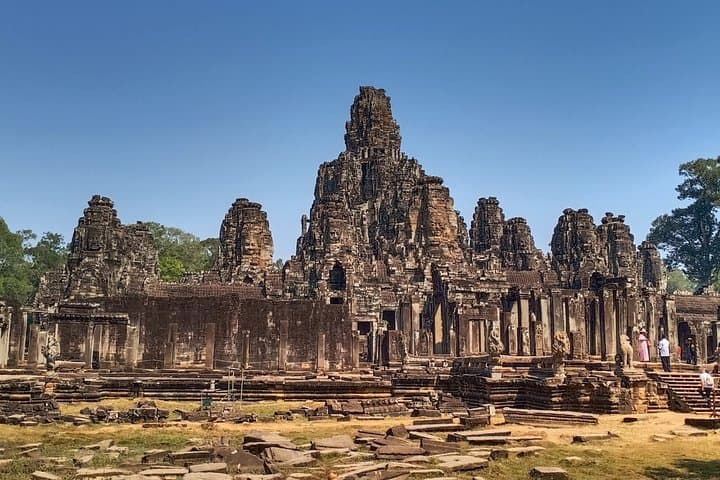

You step from the hotel lobby into humid morning air as tuk-tuk dust lifts and the road unfurls toward stone silhouettes—towers and galleries waiting under a low tropical sun. Over three days a private guide moves you through carved doorways and tree-choked causeways, narrating the rise of a capital once larger than any city in the region.
You step from the hotel lobby into humid morning air as tuk-tuk dust lifts and the road unfurls toward stone silhouettes—towers and galleries waiting under a low tropical sun. Over three days a private guide moves you through carved doorways and tree-choked causeways, narrating the rise of a capital once larger than any city in the region.
The stones here are limestone and sandstone quarried and raised by Khmer engineers between the 9th and 13th centuries; Angkor Wat (12th century) was conceived as both state temple and mausoleum. You’ll see the faces of Bayon, the root-claimed galleries of Ta Prohm, and the pink sandstone reliefs at Banteay Srey—each structure reflecting shifts from Hindu to Buddhist patronage and imperial ambition.
Geology is subtle: low-lying basins and barays (ancient reservoirs) shaped settlement patterns and the hydraulic systems that fed the city. Local life threads through temple precincts—rice paddies, roadside artisans, lacquer workshops—offering cultural contrast to the stones.
Practical edge: expect 3–6 km of walking per day on mixed packed-earth paths and uneven temple stones with minimal elevation gain. Start early to avoid midday heat, carry a refillable water bottle (water is included on the tour), and wear lightweight long sleeves and a hat for respectful sun protection. Many temple zones are fragile—follow your guide, avoid climbing unrestored ruins, and take time to visit lesser-known sites like Banteay Samre and Neak Pean when crowds thin. With a private vehicle and guide, timing and pacing are yours—use them to see both iconic courtyards and quiet corners.