THE ADVENTURE COLLECTIVE® · Independent discovery and booking for outdoor travel

Explore Angkor’s key temples and the floating villages of Tonle Sap over three private days from Siem Reap. This tour pairs close-up temple walks with insight into Khmer history and local livelihoods.
Explore Angkor’s key temples and the floating villages of Tonle Sap over three private days from Siem Reap. This tour pairs close-up temple walks with insight into Khmer history and local livelihoods.
Morning heat rises off laterite walls as a private van eases toward the temple causeway; columns throw long shadows and the first stone faces of Angkor peer down like watchful guides. On day one the group moves deliberately—Angkor Wat’s bas-reliefs invite close study and Bayon’s smiling towers reorient your sense of scale; Ta Prohm’s roots tug at masonry and memory in equal measure.
Verified experiences and guided adventures in the surrounding area.
Operated by ASEAN Adventure · Siem Reap, Siem Reap Province
Morning heat rises off laterite walls as a private van eases toward the temple causeway; columns throw long shadows and the first stone faces of Angkor peer down like watchful guides. On day one the group moves deliberately—Angkor Wat’s bas-reliefs invite close study and Bayon’s smiling towers reorient your sense of scale; Ta Prohm’s roots tug at masonry and memory in equal measure.
The Angkor complex is the remnant of the Khmer Empire (9th–15th centuries), built on a floodplain shaped by sandstone and laterite with a network of barays (man-made reservoirs) that altered local hydrology and supported a dense urban population. Khmer devotion and hydraulic engineering meet in the temples’ orientation, carving, and layered galleries; villages around Tonle Sap still depend on seasonal flooding and fish migrations.
Culturally, the route threads through active religious life—Buddhist monks, local vendors, and rice paddies frame the ruins. Geology is tactile here: sandstone that flakes, laterite that dries to a bricklike hardness.
Practical guidance: travel in light, respectful clothing that covers shoulders and knees for temple access; start days before 9am to avoid heat and crowds, and carry 2–3 liters of water per person. Expect steady walking on uneven stone, brief climbs of temple terraces, and a calm boat ride on Tonle Sap to observe floating villages and migratory waterbirds. Guides will handle permits and logistics—bring cash for local purchases, a hat, sunscreen, and insect repellent. With thoughtful pacing, the three-day loop balances iconic sights with quieter corners and a direct look at how Cambodia’s landscape and livelihoods are still intertwined.
moderate.
3 days.
Moderately fit: able to walk 3–6 miles per day on uneven ground and climb short temple staircases repeatedly.
Yes—visitors require an Angkor Archaeological Park pass (1-, 3-, or 7-day) that your operator typically arranges or instructs you how to purchase.
Some sites have steep, narrow steps and uneven ground; access varies by temple—ask the operator which sites have easier approaches if mobility is a concern.
Boats on Tonle Sap are basic but stable; lifejackets are commonly available—check the boat condition and operator safety brief before boarding.
US dollars are widely accepted; small Cambodian riel coins are used locally. Tipping guides and drivers is customary—roughly $5–$10 per day for guides depending on service quality.
Angkor was the administrative and religious heart of the Khmer Empire; its temples evolved from Hindu foundations to Mahayana and Theravada Buddhist influences over centuries.
High visitor numbers and climate pressures stress stonework and local ecosystems—follow marked paths, avoid touching carvings, and support community-led conservation initiatives.
ASEAN Adventure operates guided outdoor trips and adventures with an emphasis on safety, stewardship, and memorable experiences.
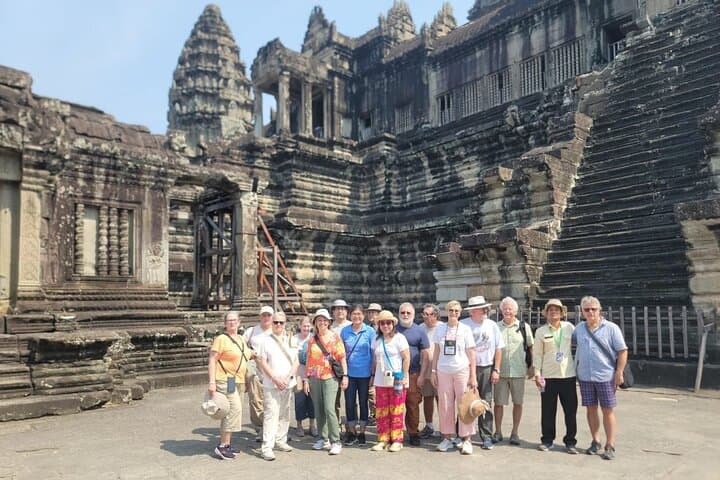
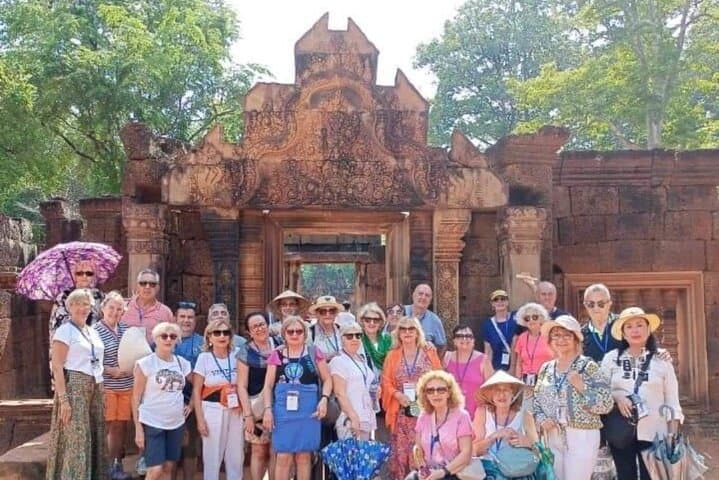
Morning heat rises off laterite walls as a private van eases toward the temple causeway; columns throw long shadows and the first stone faces of Angkor peer down like watchful guides. On day one the group moves deliberately—Angkor Wat’s bas-reliefs invite close study and Bayon’s smiling towers reorient your sense of scale; Ta Prohm’s roots tug at masonry and memory in equal measure.
Morning heat rises off laterite walls as a private van eases toward the temple causeway; columns throw long shadows and the first stone faces of Angkor peer down like watchful guides. On day one the group moves deliberately—Angkor Wat’s bas-reliefs invite close study and Bayon’s smiling towers reorient your sense of scale; Ta Prohm’s roots tug at masonry and memory in equal measure.
The Angkor complex is the remnant of the Khmer Empire (9th–15th centuries), built on a floodplain shaped by sandstone and laterite with a network of barays (man-made reservoirs) that altered local hydrology and supported a dense urban population. Khmer devotion and hydraulic engineering meet in the temples’ orientation, carving, and layered galleries; villages around Tonle Sap still depend on seasonal flooding and fish migrations.
Culturally, the route threads through active religious life—Buddhist monks, local vendors, and rice paddies frame the ruins. Geology is tactile here: sandstone that flakes, laterite that dries to a bricklike hardness.
Practical guidance: travel in light, respectful clothing that covers shoulders and knees for temple access; start days before 9am to avoid heat and crowds, and carry 2–3 liters of water per person. Expect steady walking on uneven stone, brief climbs of temple terraces, and a calm boat ride on Tonle Sap to observe floating villages and migratory waterbirds. Guides will handle permits and logistics—bring cash for local purchases, a hat, sunscreen, and insect repellent. With thoughtful pacing, the three-day loop balances iconic sights with quieter corners and a direct look at how Cambodia’s landscape and livelihoods are still intertwined.