THE ADVENTURE COLLECTIVE® · Independent discovery and booking for outdoor travel

Cross the High Atlas at sunrise, walk the hilltop of Ait Benhaddou, then ride camels into Zagora’s dunes for a night in a nomad tent. This private 2-day tour compresses the Atlas, kasbahs and Sahara atmosphere into an accessible overnight adventure.
Cross the High Atlas at sunrise, walk the hilltop of Ait Benhaddou, then ride camels into Zagora’s dunes for a night in a nomad tent. This private 2-day tour compresses the Atlas, kasbahs and Sahara atmosphere into an accessible overnight adventure.
The sun sits low behind a smear of ochre as a convoy of 4x4s drops from the High Atlas into a corridor of palms and kasbahs. Travelers begin in Marrakech at dawn, climb the Tizi n’Tichka (about 2,260 m), and slide past the clay towers of Ait Benhaddou before the road opens to the Draa Valley and the rolling Zagora dunes.
Verified experiences and guided adventures in the surrounding area.
Operated by Argania Travel · Zagora, Drâa-Tafilalet
The sun sits low behind a smear of ochre as a convoy of 4x4s drops from the High Atlas into a corridor of palms and kasbahs. Travelers begin in Marrakech at dawn, climb the Tizi n’Tichka (about 2,260 m), and slide past the clay towers of Ait Benhaddou before the road opens to the Draa Valley and the rolling Zagora dunes.
This route follows ancient caravan roads—once arteries for salt and gold—through geology that shifts from metamorphic peaks to wind-sculpted sand. Ait Benhaddou is a fortified ksar that doubled as a film backlot and a reminder of the region’s trade and tribal history. The Draa River palm groves mark a sudden green ribbon in an otherwise arid sweep; beyond them the pre-Sahara swells into soft dunes where nomadic tents still host travelers.
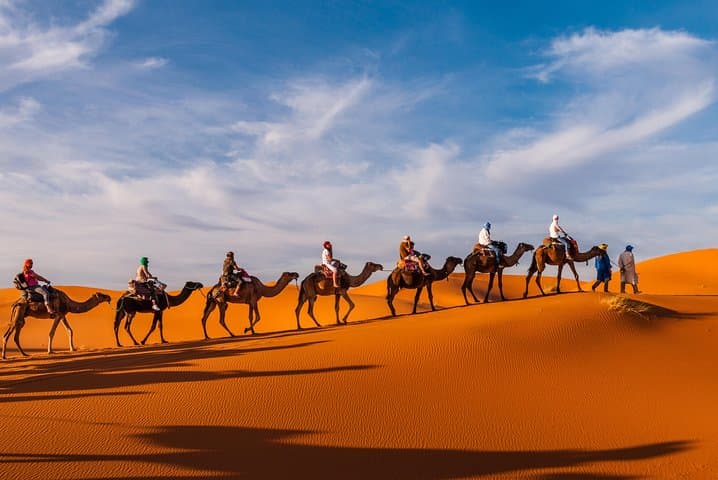
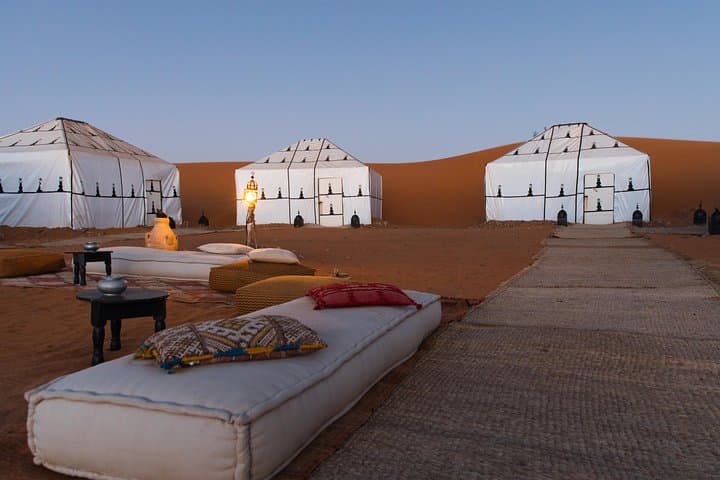
Expect long road stretches (Marrakech to Zagora is roughly a 6–8 hour drive with stops, ~360 km one-way), short guided walks, and a sunset camel ride of roughly 45–90 minutes to reach the bivouac. Nights are cold and clear; the tents are traditional nomad-style with basic bedding. The included 4WD Toyota Land Cruiser handles gravel and washboard roads, and multilingual drivers usually add local context.
Practical notes: bring layered clothing for hot days and crisp nights, ample water, sunscreen and a headlamp; rides and short hikes require only moderate fitness. Respect local customs around camps, pack out waste, and know that phone service can drop outside major towns. This two-day loop delivers geology, history and a hands-on desert night—all within a compact, do-able itinerary.
moderate.
2 days (approx. 48 hours).
Moderate fitness: able to manage several hours of travel, a short camel trek and short uphill walks at stops.
Sunset camel treks typically last 45–90 minutes to reach the bivouac; sunrise rides are shorter, then you return to the vehicle.
Bivouac tents are traditional nomad-style with basic bedding and blankets; expect simple facilities rather than hotel-level amenities.
Yes—minimum age is generally 6 years; parents should assess tolerance for long drives and sleeping in tents.
Dinner and breakfast at the bivouac are usually included, and bottled water is provided, but bring extra water for daytime drives and snacks.
The route follows former trans-Saharan caravan roads; Ait Benhaddou is a UNESCO-listed ksar that long served as a trading and defensive hub and later as a film location.
The Sahara’s fragile soils and sparse vegetation recover slowly—stick to existing tracks, avoid off-track driving on dunes, and pack out all waste to reduce impact.
Argania Travel operates guided outdoor trips and adventures with an emphasis on safety, stewardship, and memorable experiences.
The sun sits low behind a smear of ochre as a convoy of 4x4s drops from the High Atlas into a corridor of palms and kasbahs. Travelers begin in Marrakech at dawn, climb the Tizi n’Tichka (about 2,260 m), and slide past the clay towers of Ait Benhaddou before the road opens to the Draa Valley and the rolling Zagora dunes.
The sun sits low behind a smear of ochre as a convoy of 4x4s drops from the High Atlas into a corridor of palms and kasbahs. Travelers begin in Marrakech at dawn, climb the Tizi n’Tichka (about 2,260 m), and slide past the clay towers of Ait Benhaddou before the road opens to the Draa Valley and the rolling Zagora dunes.
This route follows ancient caravan roads—once arteries for salt and gold—through geology that shifts from metamorphic peaks to wind-sculpted sand. Ait Benhaddou is a fortified ksar that doubled as a film backlot and a reminder of the region’s trade and tribal history. The Draa River palm groves mark a sudden green ribbon in an otherwise arid sweep; beyond them the pre-Sahara swells into soft dunes where nomadic tents still host travelers.
Expect long road stretches (Marrakech to Zagora is roughly a 6–8 hour drive with stops, ~360 km one-way), short guided walks, and a sunset camel ride of roughly 45–90 minutes to reach the bivouac. Nights are cold and clear; the tents are traditional nomad-style with basic bedding. The included 4WD Toyota Land Cruiser handles gravel and washboard roads, and multilingual drivers usually add local context.
Practical notes: bring layered clothing for hot days and crisp nights, ample water, sunscreen and a headlamp; rides and short hikes require only moderate fitness. Respect local customs around camps, pack out waste, and know that phone service can drop outside major towns. This two-day loop delivers geology, history and a hands-on desert night—all within a compact, do-able itinerary.