THE ADVENTURE COLLECTIVE® · Independent discovery and booking for outdoor travel

Experience Prambanan’s towering Hindu temples in the soft light of morning or the glow of sunset. This practical guide covers history, timing, and what to pack so you can make the most of a 3–5 hour visit to one of Indonesia’s greatest archaeological sites.
Experience Prambanan’s towering Hindu temples in the soft light of morning or the glow of sunset. This practical guide covers history, timing, and what to pack so you can make the most of a 3–5 hour visit to one of Indonesia’s greatest archaeological sites.
Dawn light slices across carved stone as the towers of Prambanan silhouette against a pale sky — the temple’s reliefs come alive in the quiet hours when text and myth feel close enough to touch.
Verified experiences and guided adventures in the surrounding area.
Operated by GlobalTix Pte Ltd · Yogyakarta, Special Region of Yogyakarta
Dawn light slices across carved stone as the towers of Prambanan silhouette against a pale sky — the temple’s reliefs come alive in the quiet hours when text and myth feel close enough to touch.
Built in the 9th century by the Sanjaya dynasty, Prambanan is Indonesia’s largest Hindu temple compound, dedicated chiefly to Shiva, Vishnu and Brahma. The complex sits on the volcanic plain east of Yogyakarta, formed from centuries of alluvial and volcanic deposits from nearby Merapi and Merbabu; the soft volcanic stone and dense masonry are why restoration and seismic reinforcement have been ongoing since the 20th century.
Culturally, Prambanan is as much performance space as ruin: the Ramayana Ballet staged on select nights animates the stone reliefs and local legends under the stars. Nearby sites — Ratu Boko, Sewu and Plaosan — reveal a layered Hindu-Buddhist past and make a half-day loop for curious travelers.
Practical guidance: operating hours run roughly 07:00–17:00 with last admission around 16:00; Mondays limit access to the park. Expect uneven steps, shallow thresholds and open courtyards; comfortable shoes and sun protection are essential. Buy the entrance ticket in advance to secure preferred arrival times, and consider a short guided tour to interpret the Ramayana panels and architecture. Photography is welcome, but refrain from climbing on reliefs or entering closed sanctums. Plan for 3–5 hours to explore the main temples and nearby ruins and to catch sunset colors when the sandstone warms and the complex takes on a quieter, amber hush.
easy.
3–5 hours.
Low fitness required; expect walking on mostly flat grounds with occasional stairs and uneven stone.
Prambanan typically opens from 07:00 to 17:00 with last ticket scans around 16:00; hours can vary for special events.
Yes — the Ramayana Ballet is performed on select evenings near the main temple; it requires a separate ticket and often needs advance booking.
Major grounds are relatively flat, but many temple interiors and steps are not wheelchair-friendly; check with the ticket office for specific access routes.
Local guides offer short interpretive tours at the entrance and can be booked ahead to explain the Ramayana reliefs and architectural details.
Prambanan was constructed in the 9th century under the Mataram polity (Sanjaya line) and reflects Hindu influence during a period of regional religious interplay with nearby Buddhist sites.
The complex has undergone extensive restoration after earthquake damage; visitors should stay on paths, avoid touching reliefs, and follow signage to protect fragile stonework.
GlobalTix Pte Ltd operates guided outdoor trips and adventures with an emphasis on safety, stewardship, and memorable experiences.


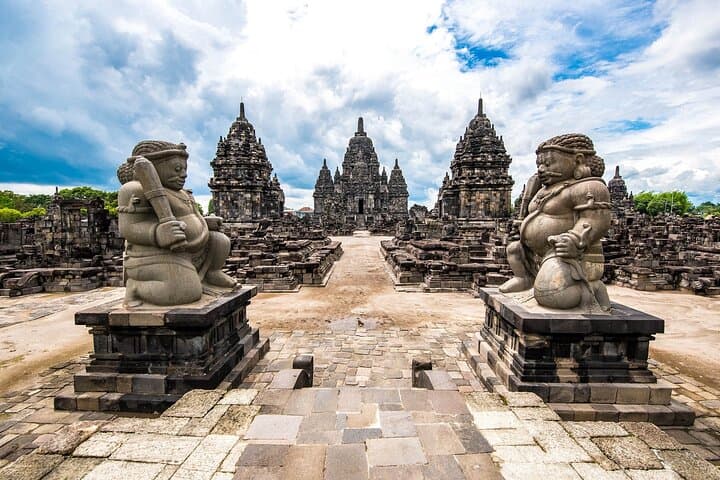
Dawn light slices across carved stone as the towers of Prambanan silhouette against a pale sky — the temple’s reliefs come alive in the quiet hours when text and myth feel close enough to touch.
Dawn light slices across carved stone as the towers of Prambanan silhouette against a pale sky — the temple’s reliefs come alive in the quiet hours when text and myth feel close enough to touch.
Built in the 9th century by the Sanjaya dynasty, Prambanan is Indonesia’s largest Hindu temple compound, dedicated chiefly to Shiva, Vishnu and Brahma. The complex sits on the volcanic plain east of Yogyakarta, formed from centuries of alluvial and volcanic deposits from nearby Merapi and Merbabu; the soft volcanic stone and dense masonry are why restoration and seismic reinforcement have been ongoing since the 20th century.
Culturally, Prambanan is as much performance space as ruin: the Ramayana Ballet staged on select nights animates the stone reliefs and local legends under the stars. Nearby sites — Ratu Boko, Sewu and Plaosan — reveal a layered Hindu-Buddhist past and make a half-day loop for curious travelers.
Practical guidance: operating hours run roughly 07:00–17:00 with last admission around 16:00; Mondays limit access to the park. Expect uneven steps, shallow thresholds and open courtyards; comfortable shoes and sun protection are essential. Buy the entrance ticket in advance to secure preferred arrival times, and consider a short guided tour to interpret the Ramayana panels and architecture. Photography is welcome, but refrain from climbing on reliefs or entering closed sanctums. Plan for 3–5 hours to explore the main temples and nearby ruins and to catch sunset colors when the sandstone warms and the complex takes on a quieter, amber hush.