THE ADVENTURE COLLECTIVE® · Independent discovery and booking for outdoor travel

Walk Vitkov Hill with an historian to explore Prague’s Cold War legacy: Soviet halls, sealed bomb‑shelter corridors, and the former mausoleum of Klement Gottwald. This private 3‑hour tour mixes street stories with steep climbs and transportable local insights.
Walk Vitkov Hill with an historian to explore Prague’s Cold War legacy: Soviet halls, sealed bomb‑shelter corridors, and the former mausoleum of Klement Gottwald. This private 3‑hour tour mixes street stories with steep climbs and transportable local insights.
A cold wind pushes up Vitkov Hill as the group rounds the base of Jan Žižka’s bronze horse, the city spread below like a map of regimes and revolutions.
Verified experiences and guided adventures in the surrounding area.
Operated by Insight Cities · Prague, Prague
A cold wind pushes up Vitkov Hill as the group rounds the base of Jan Žižka’s bronze horse, the city spread below like a map of regimes and revolutions.
On this three‑hour private walk an historian leads visitors through concrete monuments, sealed nuclear corridors and squares that watched empires arrive and fall. The route stops at the National Monument on Vítkov—home to the Hall of the Soviet Soldier and the former mausoleum that once displayed Klement Gottwald’s body—then follows to city squares where military parades, Prague Spring protests and the Velvet Revolution left visible marks.
Prague’s geology is gentle—rolling schist and loam that allowed strategic hilltop placements—while the architecture tells the 20th‑century story: austere interwar memorials, war‑scarred plazas, and the angular Brutalism of the Zizkov Television Tower peering nearby.
Beyond facts, the tour reveals quiet cultural threads: how monuments were repurposed, the hush around preserved bomb‑shelter corridors, and how public memory is curated in stone and steel.
Practical details: expect approximately 3 hours of walking with a 20‑minute steep climb up Vitkov. Public transport options make meeting easy; tram tickets are typically provided but confirm with the operator. Wear grippy shoes for stairs and cobbles, carry water, and plan for variable weather—Prague’s hilltop can be noticeably windier.
This itinerary suits travelers interested in 20th‑century European history who can manage moderate urban climbs and want a focused, scholarly view of Prague’s Cold War footprint.
moderate.
3 hours.
Moderate urban fitness—comfortable walking for 3 hours with one sustained steep climb.
The tour is moderate: about 3 hours of walking with a 15–20 minute steep climb up Vitkov Hill; guests with mobility issues can request an adjusted route that avoids the hill.
This private tour is provided with a historian guide—confirm language availability at booking as English is commonly offered but other languages depend on guide assignment.
The tour includes tram tickets and the historian guide; most exterior sites are free to view, but any paid museum entries would be noted by the operator in advance.
Meeting points are typically near central tram or metro stops in Prague; public transportation is widely available and mentioned in the booking confirmation.
The National Monument on Vítkov was built to honor Czechoslovak legionnaires and later repurposed during the communist era to house a mausoleum for Klement Gottwald; layers of political history are visible across the sites.
Many Cold War structures and shelter corridors are maintained for historical preservation—respect barriers and follow guide instructions to limit wear and protect sensitive interiors.
Insight Cities operates guided outdoor trips and adventures with an emphasis on safety, stewardship, and memorable experiences.
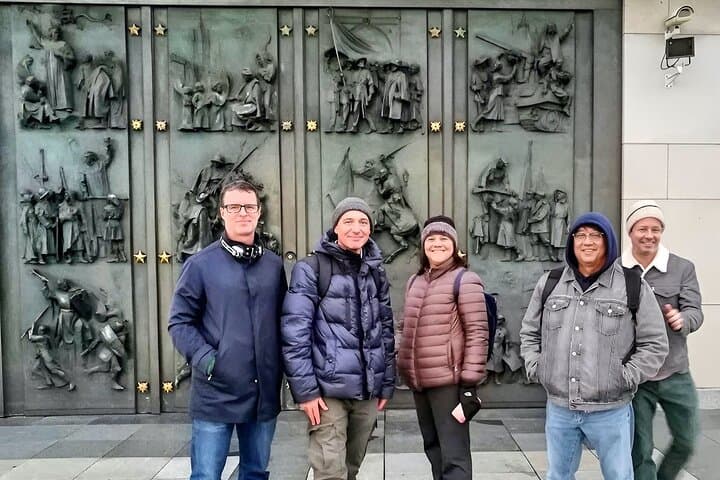
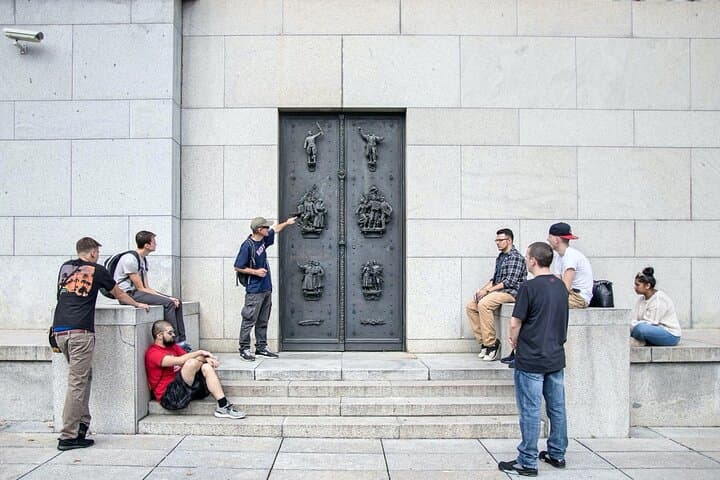
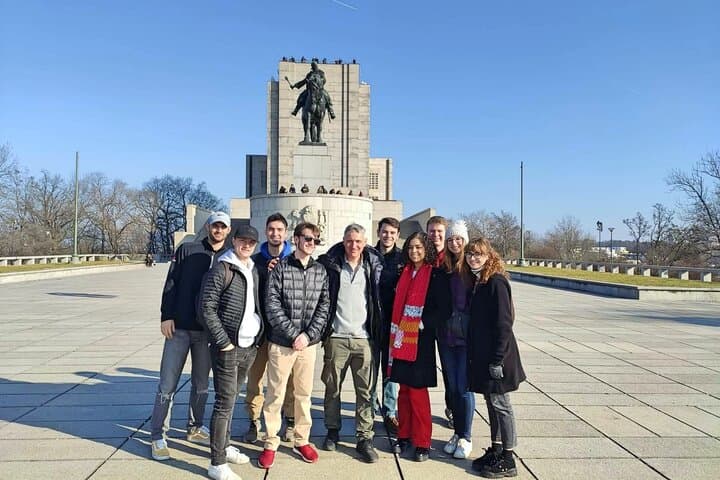

A cold wind pushes up Vitkov Hill as the group rounds the base of Jan Žižka’s bronze horse, the city spread below like a map of regimes and revolutions.
A cold wind pushes up Vitkov Hill as the group rounds the base of Jan Žižka’s bronze horse, the city spread below like a map of regimes and revolutions.
On this three‑hour private walk an historian leads visitors through concrete monuments, sealed nuclear corridors and squares that watched empires arrive and fall. The route stops at the National Monument on Vítkov—home to the Hall of the Soviet Soldier and the former mausoleum that once displayed Klement Gottwald’s body—then follows to city squares where military parades, Prague Spring protests and the Velvet Revolution left visible marks.
Prague’s geology is gentle—rolling schist and loam that allowed strategic hilltop placements—while the architecture tells the 20th‑century story: austere interwar memorials, war‑scarred plazas, and the angular Brutalism of the Zizkov Television Tower peering nearby.
Beyond facts, the tour reveals quiet cultural threads: how monuments were repurposed, the hush around preserved bomb‑shelter corridors, and how public memory is curated in stone and steel.
Practical details: expect approximately 3 hours of walking with a 20‑minute steep climb up Vitkov. Public transport options make meeting easy; tram tickets are typically provided but confirm with the operator. Wear grippy shoes for stairs and cobbles, carry water, and plan for variable weather—Prague’s hilltop can be noticeably windier.
This itinerary suits travelers interested in 20th‑century European history who can manage moderate urban climbs and want a focused, scholarly view of Prague’s Cold War footprint.