THE ADVENTURE COLLECTIVE® · Independent discovery and booking for outdoor travel

Explore Warsaw’s Praga district on a 2-hour walking tour that traces industrial brick streets, backyard chapels, and surviving Jewish heritage. Expect flat, urban terrain, rich local stories, and stops at converted factories and street-art sites.
Explore Warsaw’s Praga district on a 2-hour walking tour that traces industrial brick streets, backyard chapels, and surviving Jewish heritage. Expect flat, urban terrain, rich local stories, and stops at converted factories and street-art sites.
The walk begins on Ząbkowska Street where brick façades lean like old friends and the Vistula’s wide shoulder glints a few blocks away.
You step between courtyards whose gates still bear names from another century, past small chapels and factory smokestacks repurposed into galleries; the district moves with a practiced, unrushed energy.
Verified experiences and guided adventures in the surrounding area.
Operated by PolinTours · Warsaw, Masovian Voivodeship
The walk begins on Ząbkowska Street where brick façades lean like old friends and the Vistula’s wide shoulder glints a few blocks away.
You step between courtyards whose gates still bear names from another century, past small chapels and factory smokestacks repurposed into galleries; the district moves with a practiced, unrushed energy.
Praga’s story is visible in its architecture and street plan: an industrial right bank that survived much of World War II’s destruction and kept an older urban fabric than Warsaw’s rebuilt west. Historically a melting pot of Christians, Jews and Orthodox communities, Praga preserves pre-war housing, wooden shops and traces of Jewish life — a living snapshot of the city before modernist rebuilding.
Geology and the Vistula shaped this shore: higher alluvial terraces made for workshops and brickworks, while the river’s floodplain defined transport routes that fed local industry. In recent decades, former factories became cultural centers — the Koneser vodka complex and Neon Museum are part of the narrative you’ll hear on this 2-hour tour.
Practical guidance: the route is mostly flat paved streets and short cobblestone stretches — comfortable walking shoes matter more than technical gear. Public transit serves the area well; tours run rain or shine but bring a light rain layer. Expect stops at historic façades, backyard chapels, and street art spots with a licensed guide explaining social history and local anecdotes.
This is a short, informative urban walk for curious travelers who want context as much as scenery — an approachable way to read Warsaw’s right-bank past and present.
easy.
2 hours.
Suitable for most fitness levels; requires standing and walking on paved and cobbled streets for the full duration.
Meeting and end points are typically on Ząbkowska Street in Praga; exact meeting instructions are provided on your booking confirmation.
Yes—routes are stroller-accessible but expect some cobbled sections; infants may need to sit on laps during transit between stops.
Check the booking page for available languages; many private tours are offered in English and Polish on request.
Full refund if canceled at least 24 hours before the scheduled departure; no refund within 24 hours.
Praga was historically a working-class, multicultural district on the right bank of the Vistula that escaped much wartime destruction, preserving pre-war buildings and street patterns.
Adaptive reuse is a local priority—many brick factories are now cultural spaces; visitors are asked to respect private courtyards and avoid graffiti or litter.
PolinTours operates guided outdoor trips and adventures with an emphasis on safety, stewardship, and memorable experiences.
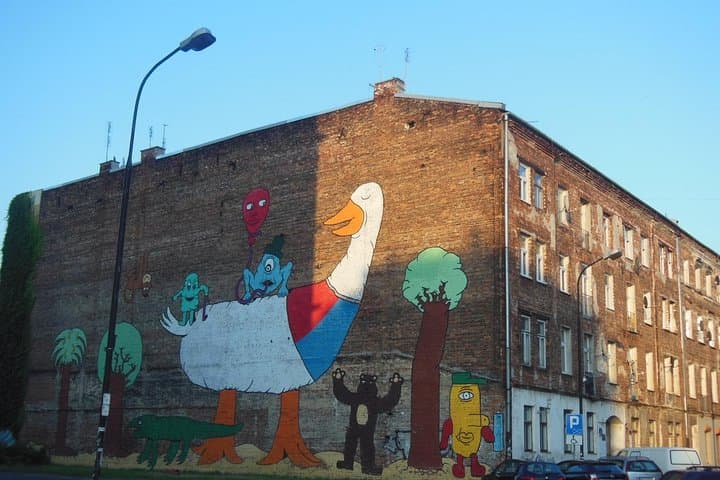


The walk begins on Ząbkowska Street where brick façades lean like old friends and the Vistula’s wide shoulder glints a few blocks away.
You step between courtyards whose gates still bear names from another century, past small chapels and factory smokestacks repurposed into galleries; the district moves with a practiced, unrushed energy.
Praga’s story is visible in its architecture and street plan: an industrial right bank that survived much of World War II’s destruction and kept an older urban fabric than Warsaw’s rebuilt west. Historically a melting pot of Christians, Jews and Orthodox communities, Praga preserves pre-war housing, wooden shops and traces of Jewish life — a living snapshot of the city before modernist rebuilding.
Geology and the Vistula shaped this shore: higher alluvial terraces made for workshops and brickworks, while the river’s floodplain defined transport routes that fed local industry. In recent decades, former factories became cultural centers — the Koneser vodka complex and Neon Museum are part of the narrative you’ll hear on this 2-hour tour.
Practical guidance: the route is mostly flat paved streets and short cobblestone stretches — comfortable walking shoes matter more than technical gear. Public transit serves the area well; tours run rain or shine but bring a light rain layer. Expect stops at historic façades, backyard chapels, and street art spots with a licensed guide explaining social history and local anecdotes.
This is a short, informative urban walk for curious travelers who want context as much as scenery — an approachable way to read Warsaw’s right-bank past and present.