THE ADVENTURE COLLECTIVE® · Independent discovery and booking for outdoor travel

Stand on the Giza Plateau beneath towering stone and weathered faces: a practical, sensory guide to visiting the Great Pyramid, Khafre’s complex and the Sphinx. Find essential timing, ticketing and onsite tips to plan a smooth visit.
Stand on the Giza Plateau beneath towering stone and weathered faces: a practical, sensory guide to visiting the Great Pyramid, Khafre’s complex and the Sphinx. Find essential timing, ticketing and onsite tips to plan a smooth visit.
You arrive at the Giza Plateau with dust under your shoes and the Great Pyramid rising like a tilted horizon—blunt blocks of limestone stacked into silence. The wind off the desert pushes heat and the cries of merchants toward you; the Sphinx watches, half-buried for centuries, its face a weathered challenge.
Verified experiences and guided adventures in the surrounding area.
Operated by Emo Tours Egypt · Giza, Giza Governorate
You arrive at the Giza Plateau with dust under your shoes and the Great Pyramid rising like a tilted horizon—blunt blocks of limestone stacked into silence. The wind off the desert pushes heat and the cries of merchants toward you; the Sphinx watches, half-buried for centuries, its face a weathered challenge.
The monuments here date to Egypt’s Fourth Dynasty (c. 2600–2500 BCE). The Great Pyramid of Khufu began as a gleaming casing of Tura limestone; what you see now is its core mass. Khafre’s pyramid keeps the visual line with the Sphinx, which was carved from the bedrock and reworked across millennia. The plateau sits on Eocene limestone and ancient man-made fills—geology that preserved these massive forms but also makes them vulnerable to erosion and urban encroachment.
Culturally the site remains a living place: vendors, guided storytellers, and nearby necropolises and workers’ village ruins that hint at daily life behind the monuments.
Practical guidance: plan for 3–4 hours to see the three main pyramids and the Sphinx; arrive early to avoid peak heat and crowds and to photograph soft morning light. Entry typically covers the exterior areas; entering a pyramid requires a separate ticket and tighter mobility. Wear sturdy shoes for uneven stone and sand, bring at least 2 liters of water, sun protection, and a photocopy of your ID for purchases or permits. Respect ropes and signage—walking on the monuments is prohibited and enforced. If using a private vehicle pickup, confirm exact pickup time and meeting point in Cairo or Giza. A clear itinerary and small cash for tips and toilets make the visit smoother.
easy.
3–4 hours.
Low to moderate fitness required—mostly walking on uneven packed sand and stone; minimal elevation change
No—standard entry usually covers the exterior plateau and Sphinx; access inside Khufu or Khafre requires a separate, limited ticket and may not be available every day.
Partial access exists via paved paths and vehicle drop-offs but many areas are uneven; check with the operator about wheelchair assistance and vehicle proximity to key viewpoints.
Photography for personal use is allowed across most of the plateau; tripods may be restricted in crowded areas—ask staff if unsure and avoid blocking walkways.
October to April offers cooler temperatures and more comfortable walking; summers can be extremely hot and intense for midday touring.
The Giza complex was constructed during Egypt’s Old Kingdom (Fourth Dynasty); Khufu, Khafre and Menkaure built the three main pyramids and associated mortuary complexes.
Erosion, rising groundwater and urban pollution threaten the limestone; stick to paths, avoid touching carved surfaces and support licensed guides and conservation fees when offered.
Emo Tours Egypt operates guided outdoor trips and adventures with an emphasis on safety, stewardship, and memorable experiences.
You arrive at the Giza Plateau with dust under your shoes and the Great Pyramid rising like a tilted horizon—blunt blocks of limestone stacked into silence. The wind off the desert pushes heat and the cries of merchants toward you; the Sphinx watches, half-buried for centuries, its face a weathered challenge.
You arrive at the Giza Plateau with dust under your shoes and the Great Pyramid rising like a tilted horizon—blunt blocks of limestone stacked into silence. The wind off the desert pushes heat and the cries of merchants toward you; the Sphinx watches, half-buried for centuries, its face a weathered challenge.
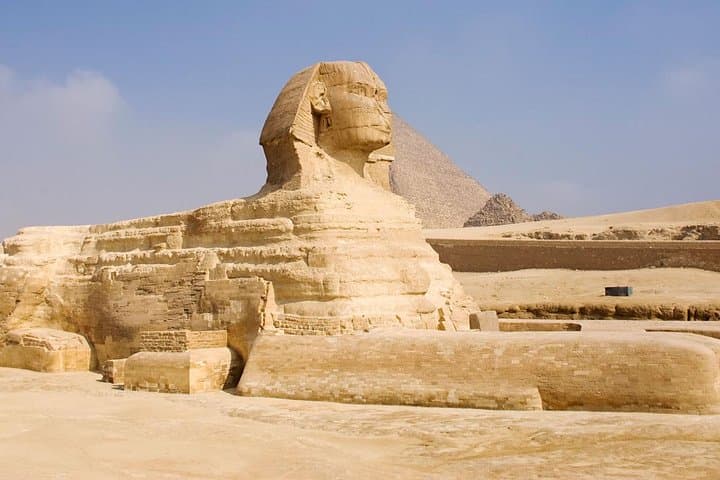
The monuments here date to Egypt’s Fourth Dynasty (c. 2600–2500 BCE). The Great Pyramid of Khufu began as a gleaming casing of Tura limestone; what you see now is its core mass. Khafre’s pyramid keeps the visual line with the Sphinx, which was carved from the bedrock and reworked across millennia. The plateau sits on Eocene limestone and ancient man-made fills—geology that preserved these massive forms but also makes them vulnerable to erosion and urban encroachment.
Culturally the site remains a living place: vendors, guided storytellers, and nearby necropolises and workers’ village ruins that hint at daily life behind the monuments.
Practical guidance: plan for 3–4 hours to see the three main pyramids and the Sphinx; arrive early to avoid peak heat and crowds and to photograph soft morning light. Entry typically covers the exterior areas; entering a pyramid requires a separate ticket and tighter mobility. Wear sturdy shoes for uneven stone and sand, bring at least 2 liters of water, sun protection, and a photocopy of your ID for purchases or permits. Respect ropes and signage—walking on the monuments is prohibited and enforced. If using a private vehicle pickup, confirm exact pickup time and meeting point in Cairo or Giza. A clear itinerary and small cash for tips and toilets make the visit smoother.