THE ADVENTURE COLLECTIVE® · Independent discovery and booking for outdoor travel

Dive into Portugal’s Ocean Revival Park off Portimão and explore four scuttled Portuguese Navy vessels turned artificial reef. Guided trips suit mixed groups with options from shallow wreck access to 30m deep deck explorations.
Dive into Portugal’s Ocean Revival Park off Portimão and explore four scuttled Portuguese Navy vessels turned artificial reef. Guided trips suit mixed groups with options from shallow wreck access to 30m deep deck explorations.
The boat slips from Portimão harbor and the Algarve shoreline recedes: wind and salt press at your face as the dive master outlines the plan. By the time the hull slows over the Ocean Revival Park, sunlight filters through blue water and the silhouettes of four decommissioned Portuguese Navy warships sit like sleeping giants on the sand, their hulls already colonized by corals and fish.
Verified experiences and guided adventures in the surrounding area.
The boat slips from Portimão harbor and the Algarve shoreline recedes: wind and salt press at your face as the dive master outlines the plan. By the time the hull slows over the Ocean Revival Park, sunlight filters through blue water and the silhouettes of four decommissioned Portuguese Navy warships sit like sleeping giants on the sand, their hulls already colonized by corals and fish.
The park is a recent chapter in Portugal’s maritime story — a deliberate scuttling project that converted retired frigates and corvettes into an artificial reef. Geologically, the wrecks rest on a gently sloping shelf off Praia da Rocha where currents bring nutrients and visibility varies with season and swell. Culturally the site is part conservation, part dive tourism, drawing photographers, sport divers and marine biologists.
Practically speaking: guided dives open to groups at mixed levels, depths range from about 10–12 m for shallower sections to 29–31 m for the deeper decks. Operators include cylinders, weights and surface support; reef and night dives are options. Expect swim-throughs, narrow corridors around superstructures and large marine life holding near structure—groupers, octopus and schooling jacks are common.
Prepare with an up-to-date certification (Advanced recommended for deeper profiles), a dive computer, and careful gas planning. Equalize early and often; currents can push you along the hull. Bring a compact surface marker buoy, reef-safe sunscreen and a sturdy bag for wet gear. Timed correctly, a port-to-wreck run is efficient—plan for boat transfers, a thorough briefing and a calm ascent with a safety stop to finish the day.
challenging.
4 hours.
Moderate to fit; you should be comfortable swimming in open water, performing controlled ascents, and carrying/handling your kit
Open Water is the minimum; Advanced Open Water (or equivalent) is recommended for dives beyond 18–20 m and for complex wreck navigation.
Planned depths range from about 10–12 m up to 29–31 m; guided dives follow no-decompression limits, but a dive computer and conservative planning are essential.
Yes—operators commonly run reef and night dives; expect a different experience with nocturnal species and bioluminescence on some nights.
No guarantees, but the park’s artificial structures regularly host groupers, octopus, moray eels and diverse schooling fish thanks to nutrient-rich currents.
The Ocean Revival Park was created by scuttling decommissioned Portuguese Navy ships to form an artificial reef and boost local marine habitat and dive tourism.
The site operates with managed visits and no-take expectations; divers are urged not to touch or remove organisms and to use reef-safe products to minimize impact.
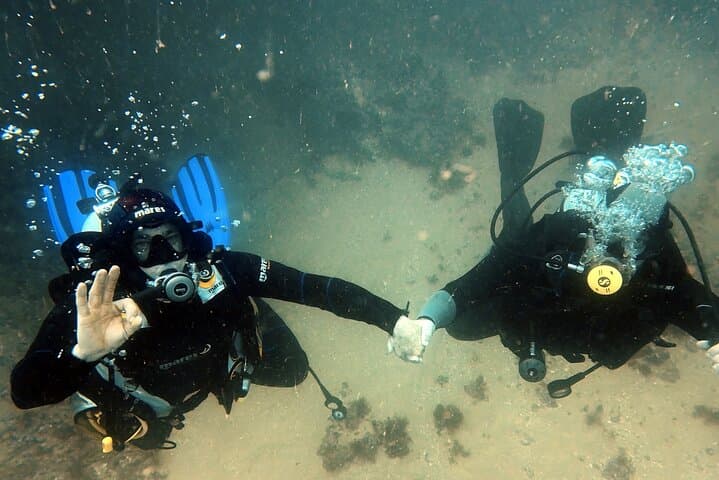
The boat slips from Portimão harbor and the Algarve shoreline recedes: wind and salt press at your face as the dive master outlines the plan. By the time the hull slows over the Ocean Revival Park, sunlight filters through blue water and the silhouettes of four decommissioned Portuguese Navy warships sit like sleeping giants on the sand, their hulls already colonized by corals and fish.
The boat slips from Portimão harbor and the Algarve shoreline recedes: wind and salt press at your face as the dive master outlines the plan. By the time the hull slows over the Ocean Revival Park, sunlight filters through blue water and the silhouettes of four decommissioned Portuguese Navy warships sit like sleeping giants on the sand, their hulls already colonized by corals and fish.
The park is a recent chapter in Portugal’s maritime story — a deliberate scuttling project that converted retired frigates and corvettes into an artificial reef. Geologically, the wrecks rest on a gently sloping shelf off Praia da Rocha where currents bring nutrients and visibility varies with season and swell. Culturally the site is part conservation, part dive tourism, drawing photographers, sport divers and marine biologists.
Practically speaking: guided dives open to groups at mixed levels, depths range from about 10–12 m for shallower sections to 29–31 m for the deeper decks. Operators include cylinders, weights and surface support; reef and night dives are options. Expect swim-throughs, narrow corridors around superstructures and large marine life holding near structure—groupers, octopus and schooling jacks are common.
Prepare with an up-to-date certification (Advanced recommended for deeper profiles), a dive computer, and careful gas planning. Equalize early and often; currents can push you along the hull. Bring a compact surface marker buoy, reef-safe sunscreen and a sturdy bag for wet gear. Timed correctly, a port-to-wreck run is efficient—plan for boat transfers, a thorough briefing and a calm ascent with a safety stop to finish the day.