THE ADVENTURE COLLECTIVE® · Independent discovery and booking for outdoor travel

Hover above 4 Mile Beach and watch reef flats, rainforest mouths and Cape Tribulation roll beneath you. Choose 30–60 minute scenic flights from Port Douglas for a compact, high-impact way to see the Great Barrier Reef and Daintree Rainforest.
Hover above 4 Mile Beach and watch reef flats, rainforest mouths and Cape Tribulation roll beneath you. Choose 30–60 minute scenic flights from Port Douglas for a compact, high-impact way to see the Great Barrier Reef and Daintree Rainforest.
You taxi up to the Sheraton strip, the helicopter's rotor already stirring the salt air above 4 Mile Beach. In thirty minutes the coastline falls away and the reef unspools beneath you — reef bommies, pale sand cays and the Daintree's dark green where rainforest meets sea. The machine hums; your headset makes the pilot's commentary intimate, the landscape speaking in shape rather than sound.
Verified experiences and guided adventures in the surrounding area.
Operated by Nautilus Aviation · Port Douglas, Queensland
You taxi up to the Sheraton strip, the helicopter's rotor already stirring the salt air above 4 Mile Beach. In thirty minutes the coastline falls away and the reef unspools beneath you — reef bommies, pale sand cays and the Daintree's dark green where rainforest meets sea. The machine hums; your headset makes the pilot's commentary intimate, the landscape speaking in shape rather than sound.
Geology here reads like a slow-motion ledger: coral growth stacked over millennia to form the Great Barrier Reef, juxtaposed with the Daintree Rainforest — one of the oldest surviving rainforests on Earth. Indigenous Kuku Yalanji country edges these routes; Cape Tribulation and the river mouths you pass hold cultural and ecological stories that predate European mapping.
On the 30–45–60 minute options the flightlines vary — 4 Mile Beach, Snapper Island, Low Isles, Batt Reef, Daintree River mouth, Mossman Gorge and Cape Tribulation — each offering different angles for wildlife spotting. Dugongs and turtles frequent the flats; manta rays and, in winter, migrating whales punctuate the water.
Practically: advise exact passenger weights at booking (operators enforce strict limits), arrive early for the safety briefing, and choose a window seat for photography. Pack polarized sunglasses, a small camera and a windproof layer — the open-cabin noise and sun make light protection essential. Flights are weather-dependent; tropical storms in summer can cancel, while winter often delivers the clearest reef visibility and the best chance to see whales. Expect informative commentary, short walking access at check-in, and shared flights with a minimum passenger requirement — book refundable slots where possible and allow extra time on transfer days.
easy.
30–60 minutes.
Suitable for people of most fitness levels; must be able to climb into a helicopter seat and follow safety briefings.
Common sightings include sea turtles, rays, dolphins and reef sharks; dugongs and manta rays are seen around Batt Reef and whales are possible in winter months (June–August).
Yes — accurate passenger and carry-on weights must be provided at booking; a maximum single-seat payload of 130kg applies and additional-seat rules may apply for heavier passengers.
Flights are weather-dependent; operators will offer rebooking where availability allows or refunds per the cancellation policy — allow 48+ hours for best refund terms.
No—these scenic flights are classified easy and suitable for most people; infants may sit on laps under specific conditions and children three and over require their own seat.
This coastline sits on Kuku Yalanji traditional lands; many headlands and river mouths have long-standing cultural significance and stories tied to seasonal movements and resource use.
The area is protected by Great Barrier Reef Marine Park zoning and Daintree conservation measures — avoid touching coral, do not feed wildlife, and choose operators committed to low-impact practices.
Nautilus Aviation operates guided outdoor trips and adventures with an emphasis on safety, stewardship, and memorable experiences.

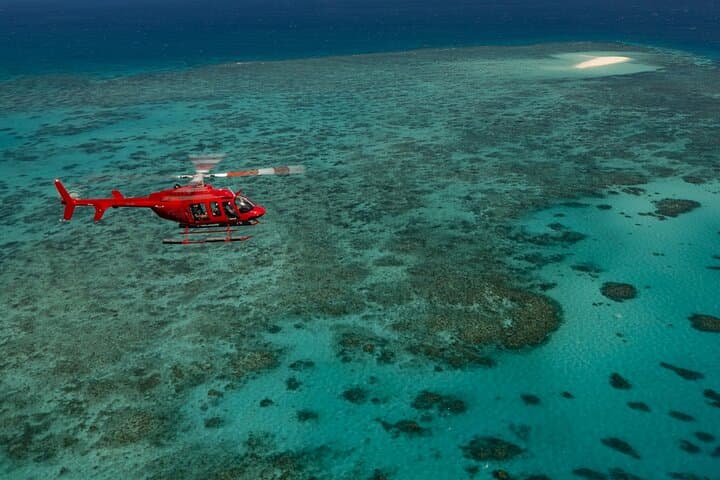

You taxi up to the Sheraton strip, the helicopter's rotor already stirring the salt air above 4 Mile Beach. In thirty minutes the coastline falls away and the reef unspools beneath you — reef bommies, pale sand cays and the Daintree's dark green where rainforest meets sea. The machine hums; your headset makes the pilot's commentary intimate, the landscape speaking in shape rather than sound.
You taxi up to the Sheraton strip, the helicopter's rotor already stirring the salt air above 4 Mile Beach. In thirty minutes the coastline falls away and the reef unspools beneath you — reef bommies, pale sand cays and the Daintree's dark green where rainforest meets sea. The machine hums; your headset makes the pilot's commentary intimate, the landscape speaking in shape rather than sound.
Geology here reads like a slow-motion ledger: coral growth stacked over millennia to form the Great Barrier Reef, juxtaposed with the Daintree Rainforest — one of the oldest surviving rainforests on Earth. Indigenous Kuku Yalanji country edges these routes; Cape Tribulation and the river mouths you pass hold cultural and ecological stories that predate European mapping.
On the 30–45–60 minute options the flightlines vary — 4 Mile Beach, Snapper Island, Low Isles, Batt Reef, Daintree River mouth, Mossman Gorge and Cape Tribulation — each offering different angles for wildlife spotting. Dugongs and turtles frequent the flats; manta rays and, in winter, migrating whales punctuate the water.
Practically: advise exact passenger weights at booking (operators enforce strict limits), arrive early for the safety briefing, and choose a window seat for photography. Pack polarized sunglasses, a small camera and a windproof layer — the open-cabin noise and sun make light protection essential. Flights are weather-dependent; tropical storms in summer can cancel, while winter often delivers the clearest reef visibility and the best chance to see whales. Expect informative commentary, short walking access at check-in, and shared flights with a minimum passenger requirement — book refundable slots where possible and allow extra time on transfer days.