THE ADVENTURE COLLECTIVE® · Independent discovery and booking for outdoor travel

Walk the streets frozen by Vesuvius with a private native guide and skip-the-line access. This five-hour tour pairs Pompeii’s public life with Herculaneum’s preserved interiors for a focused, ground-level view of ancient Roman daily life.
Walk the streets frozen by Vesuvius with a private native guide and skip-the-line access. This five-hour tour pairs Pompeii’s public life with Herculaneum’s preserved interiors for a focused, ground-level view of ancient Roman daily life.
You step through a low stone arch and the present tilts toward the past: sun-bleached paving stones, blackened plaster, and the hollowed frames of shops where merchants once counted coins. A native guide leads the way, voice low against the amphitheater’s acoustics as the Teatro Grande seems to hold its breath.
Verified experiences and guided adventures in the surrounding area.
Operated by Tours of Pompeii with Lello & Co. · Pompeii, Campania
You step through a low stone arch and the present tilts toward the past: sun-bleached paving stones, blackened plaster, and the hollowed frames of shops where merchants once counted coins. A native guide leads the way, voice low against the amphitheater’s acoustics as the Teatro Grande seems to hold its breath.
Pompeii and Herculaneum sit on the flanks of Vesuvius, two portraits of a single eruption. Pompeii’s broad streets and public squares reveal civic life — forums, baths, and theaters — frozen in 79 AD by volcanic ash that preserved frescoes and mosaics. Herculaneum, buried under denser pyroclastic flows, offers an intimate look: original wooden doors, roof beams and household fittings survive where heat carbonized rather than pulverized materials.
Geology is the quiet author here: layers of pumice and tufa tell the eruption’s timeline; you can see how ash settled in alleys and filled basements. Culturally, these towns speak to Roman domestic routines — markets, thermal rituals, and the suddenness of catastrophe.
Practical guidance: the combined private tour runs roughly five hours, usually starting in the morning to avoid peak heat and crowds. Wear sturdy walking shoes—ancient stones are uneven—and bring sun protection, water, and a light layer for shaded areas. The sites require several moderate walks and some steps; expect a paced route of archaeological highlights, not a sprint.
Transport between sites is straightforward: the Circumvesuviana train connects Pompeii and Ercolano (Herculaneum), or you can drive. A guide’s skip-the-line entry saves time; plan for security checks and carry ID for ticket validation. Move deliberately — the ruins reward slow attention.
moderate.
5 hours.
Moderate fitness — includes several hours of walking on uneven ground and short flights of steps; pause when needed.
The private experience lasts about five hours and includes a guided tour of Pompeii’s highlights (forum, theaters, baths) and a two-hour guided visit to Herculaneum’s preserved houses and baths.
Yes — the Circumvesuviana regional train connects Pompeii (Pompei Scavi - Villa dei Misteri station) and Ercolano (Herculaneum) with frequent service; travel time is roughly 20–30 minutes.
Children who can handle several hours of walking will enjoy it, but the sites have uneven surfaces and steps; visitors with limited mobility should check accessibility in advance and may need assistance.
Yes — admission tickets and skip-the-line entry are included, and the private guide typically handles access and security screening for a smoother visit.
Pompeii and Herculaneum were Roman towns catastrophically buried by Vesuvius in 79 AD; their preservation gives detailed evidence of urban planning, commerce and domestic life in the Roman Empire.
Both sites are fragile; follow marked paths, avoid touching frescoes, and support conservation by using certified guides and official entrances.
Tours of Pompeii with Lello & Co. operates guided outdoor trips and adventures with an emphasis on safety, stewardship, and memorable experiences.


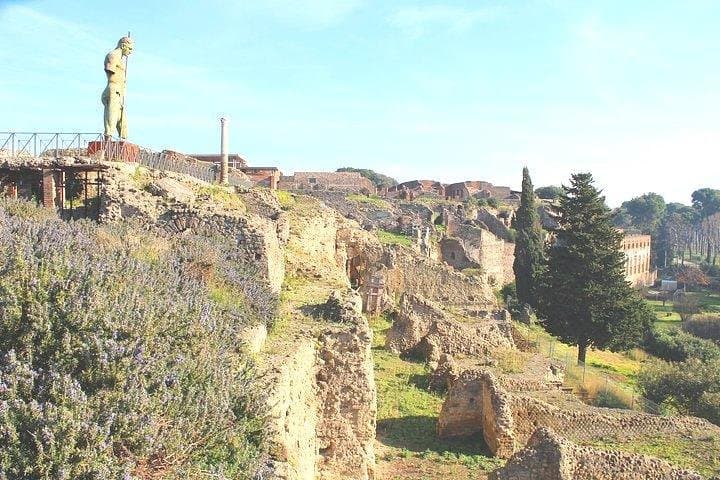

You step through a low stone arch and the present tilts toward the past: sun-bleached paving stones, blackened plaster, and the hollowed frames of shops where merchants once counted coins. A native guide leads the way, voice low against the amphitheater’s acoustics as the Teatro Grande seems to hold its breath.
You step through a low stone arch and the present tilts toward the past: sun-bleached paving stones, blackened plaster, and the hollowed frames of shops where merchants once counted coins. A native guide leads the way, voice low against the amphitheater’s acoustics as the Teatro Grande seems to hold its breath.
Pompeii and Herculaneum sit on the flanks of Vesuvius, two portraits of a single eruption. Pompeii’s broad streets and public squares reveal civic life — forums, baths, and theaters — frozen in 79 AD by volcanic ash that preserved frescoes and mosaics. Herculaneum, buried under denser pyroclastic flows, offers an intimate look: original wooden doors, roof beams and household fittings survive where heat carbonized rather than pulverized materials.
Geology is the quiet author here: layers of pumice and tufa tell the eruption’s timeline; you can see how ash settled in alleys and filled basements. Culturally, these towns speak to Roman domestic routines — markets, thermal rituals, and the suddenness of catastrophe.
Practical guidance: the combined private tour runs roughly five hours, usually starting in the morning to avoid peak heat and crowds. Wear sturdy walking shoes—ancient stones are uneven—and bring sun protection, water, and a light layer for shaded areas. The sites require several moderate walks and some steps; expect a paced route of archaeological highlights, not a sprint.
Transport between sites is straightforward: the Circumvesuviana train connects Pompeii and Ercolano (Herculaneum), or you can drive. A guide’s skip-the-line entry saves time; plan for security checks and carry ID for ticket validation. Move deliberately — the ruins reward slow attention.