THE ADVENTURE COLLECTIVE® · Independent discovery and booking for outdoor travel

Head out of Phnom Penh for a private day exploring Phnom Prasith’s hilltop shrines and the modern Angkor‑style Prasat Vihear Suor. This 8‑hour tour blends village scenery, Buddhist ritual, and accessible temple architecture.
Head out of Phnom Penh for a private day exploring Phnom Prasith’s hilltop shrines and the modern Angkor‑style Prasat Vihear Suor. This 8‑hour tour blends village scenery, Buddhist ritual, and accessible temple architecture.
A low, green horizon slides past the window as a tuk‑tuk or private car cuts through rice paddies and stilt houses on a 90‑minute ride out of Phnom Penh. You arrive first at Phnom Prasith, a hilltop complex perched on the eastern summit of twin knolls; the wind pushes across carved stucco and a reclining Buddha that seems to stretch toward the plains.
Verified experiences and guided adventures in the surrounding area.
Operated by Green Cultural Travel · Phnom Penh, Phnom Penh
A low, green horizon slides past the window as a tuk‑tuk or private car cuts through rice paddies and stilt houses on a 90‑minute ride out of Phnom Penh. You arrive first at Phnom Prasith, a hilltop complex perched on the eastern summit of twin knolls; the wind pushes across carved stucco and a reclining Buddha that seems to stretch toward the plains.
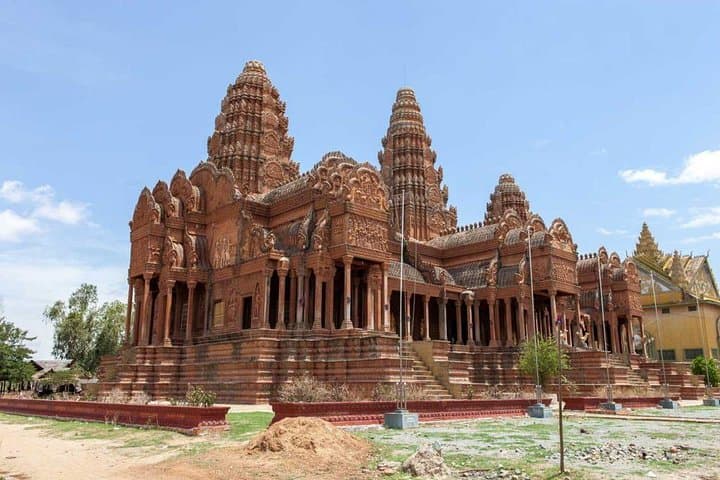
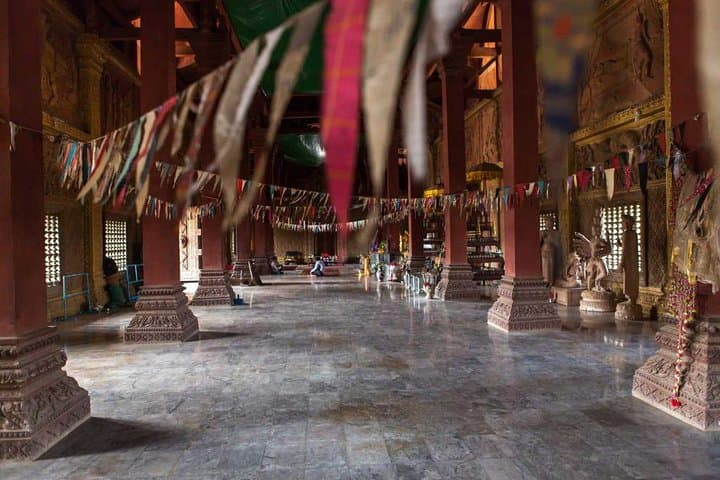
These sites sit within living Khmer landscapes—seasonal lakes, tilled fields and villages where morning alms are still offered. Phnom Prasith’s masonry and stupas trace local devotional practice more than imperial scale; Prasat Vihear Suor (often called Phnom Reap) is a modern temple completed in 1998 but modeled in the Angkorian idiom, its bas‑reliefs and images of kings and Buddhas echoing older styles.
Geology here is gentle: eroded low hills of sandstone and laterite, riceflat floodplains, and a high water table that turns fields mirror‑flat in the wet season. Cultural moments—monks receiving offerings, families pausing to light incense—are as much the point of the visit as the stonework.
Practical guidance: this private, roughly 8‑hour outing includes hotel pickup, bottled water, lunch and a local guide; expect moderate walking on uneven steps and shaded paths. Wear sun‑protective, modest clothing for temple entry, sturdy shoes for stairs, and carry cash for small donations or souvenirs. Plan mornings for cooler light and afternoons for returning through rural scenery—the trip is equal parts landscape, living culture and quiet architecture.
moderate.
6–8 hours.
Suitable for travelers in moderate fitness; involves short uphill walks and steps at temple sites.
The drive is about 75–90 minutes each way depending on traffic and weather; the full activity is roughly 8 hours including stops.
Yes—both sites are used by local worshippers; dress and behavior should be respectful, and photography may be restricted inside certain halls.
Yes if moderately fit; there are steps and short uphill segments—inform the operator of mobility concerns for adapted pacing and transport.
Private guides typically speak English; tipping is appreciated for good service, and small offerings at temples are customary but optional.
The temples reflect local Buddhist practice and late‑20th century revival; Prasat Vihear Suor was completed in 1998 using Angkor‑inspired motifs, while Phnom Prasith functions as a longstanding hilltop monastery site.
Tourism can strain small rural sites—stay on paths, avoid disturbing offerings, and limit single‑use plastics; using a local guide funnels income to village economies and supports conservation.
Green Cultural Travel operates guided outdoor trips and adventures with an emphasis on safety, stewardship, and memorable experiences.
A low, green horizon slides past the window as a tuk‑tuk or private car cuts through rice paddies and stilt houses on a 90‑minute ride out of Phnom Penh. You arrive first at Phnom Prasith, a hilltop complex perched on the eastern summit of twin knolls; the wind pushes across carved stucco and a reclining Buddha that seems to stretch toward the plains.
A low, green horizon slides past the window as a tuk‑tuk or private car cuts through rice paddies and stilt houses on a 90‑minute ride out of Phnom Penh. You arrive first at Phnom Prasith, a hilltop complex perched on the eastern summit of twin knolls; the wind pushes across carved stucco and a reclining Buddha that seems to stretch toward the plains.
These sites sit within living Khmer landscapes—seasonal lakes, tilled fields and villages where morning alms are still offered. Phnom Prasith’s masonry and stupas trace local devotional practice more than imperial scale; Prasat Vihear Suor (often called Phnom Reap) is a modern temple completed in 1998 but modeled in the Angkorian idiom, its bas‑reliefs and images of kings and Buddhas echoing older styles.
Geology here is gentle: eroded low hills of sandstone and laterite, riceflat floodplains, and a high water table that turns fields mirror‑flat in the wet season. Cultural moments—monks receiving offerings, families pausing to light incense—are as much the point of the visit as the stonework.
Practical guidance: this private, roughly 8‑hour outing includes hotel pickup, bottled water, lunch and a local guide; expect moderate walking on uneven steps and shaded paths. Wear sun‑protective, modest clothing for temple entry, sturdy shoes for stairs, and carry cash for small donations or souvenirs. Plan mornings for cooler light and afternoons for returning through rural scenery—the trip is equal parts landscape, living culture and quiet architecture.