THE ADVENTURE COLLECTIVE® · Independent discovery and booking for outdoor travel

A four-hour guided via ferrata near Saint-Paul-de-Fenouillet that threads suspension bridges, iron rungs and exposed traverses above the Agly Valley. Ideal for adventurous groups, this route combines vertical challenge with sweeping mountain views.
A four-hour guided via ferrata near Saint-Paul-de-Fenouillet that threads suspension bridges, iron rungs and exposed traverses above the Agly Valley. Ideal for adventurous groups, this route combines vertical challenge with sweeping mountain views.
You clip in, hear the wind move through limestone ribs, and the Agly Valley opens beneath you—patchwork vineyards giving way to scrub and ragged ridgelines. The Panoramic Via Ferrata near Saint-Paul-de-Fenouillet trades flat hiking for vertical choreography: iron rungs, suspension bridges, and exposed traverses that demand focus while delivering wide, raw views of the eastern Pyrenees.
Verified experiences and guided adventures in the surrounding area.
Operated by Oxygen Aventure · Saint-Paul-de-Fenouillet, Pyrénées-Orientales
You clip in, hear the wind move through limestone ribs, and the Agly Valley opens beneath you—patchwork vineyards giving way to scrub and ragged ridgelines. The Panoramic Via Ferrata near Saint-Paul-de-Fenouillet trades flat hiking for vertical choreography: iron rungs, suspension bridges, and exposed traverses that demand focus while delivering wide, raw views of the eastern Pyrenees.
The route sits in a landscape shaped by marine limestone folded and carved over millions of years; nearby ridges host Cathar-era castles perched on the same cliffs that once marked medieval borders. Culturally, the Fenouillèdes region mixes Occitan traditions with Pyrenean mountain life—small villages, stone farmhouses, and seasonal shepherding.
Expect roughly three to four hours on the route including briefing, with sustained vertical sections rather than long approaches. Terrain is steep limestone with fixed safety lines; footing can be sharp and exposed. Guides provide helmets, harnesses and lanyards, and instructors coach techniques like efficient clipped movement and body positioning on ladders and bridges.
Practically, arrive with layered clothing, sturdy footwear, and 1–2 liters of water. Morning departures avoid heat and thermals that can stir strong winds on exposed ridges. If you have a fear of heights or cardiovascular concerns, discuss these with the operator in advance; instructors can often pace groups and offer alternate lines for beginners.
This is a social route—teams help each other across gaps—so bring a camera, light gloves, and a readiness to move deliberately. Respect nesting birds and stay on the fixed route; the cliffs are fragile and the views are best preserved when everyone leaves no trace.
challenging.
3–4 hours.
Requires good cardiovascular fitness, leg strength, and comfort with exposure; suitable for active beginners under guide supervision.
No technical climbing experience is required; guides teach via-ferrata technique, but participants should be in good physical shape and comfortable with exposure.
Qualified instructors supply helmets, via-ferrata harnesses and energy-absorbing lanyards; bring your own gloves and footwear.
Operators typically set minimum age and maximum weight limits for safety—confirm specific limits when booking as they vary by provider.
The route is closed in high winds, heavy rain, or thunderstorms; the operator will reschedule or refund if conditions force cancellation.
The route crosses terrain long shaped by limestone karst and sits near medieval borderlands with visible Cathar-era castles like Quéribus and Peyrepertuse.
Stay on fixed routes to protect nesting birds and fragile rock vegetation; pack out all waste and follow your guide's instructions to minimize impact.
Oxygen Aventure operates guided outdoor trips and adventures with an emphasis on safety, stewardship, and memorable experiences.
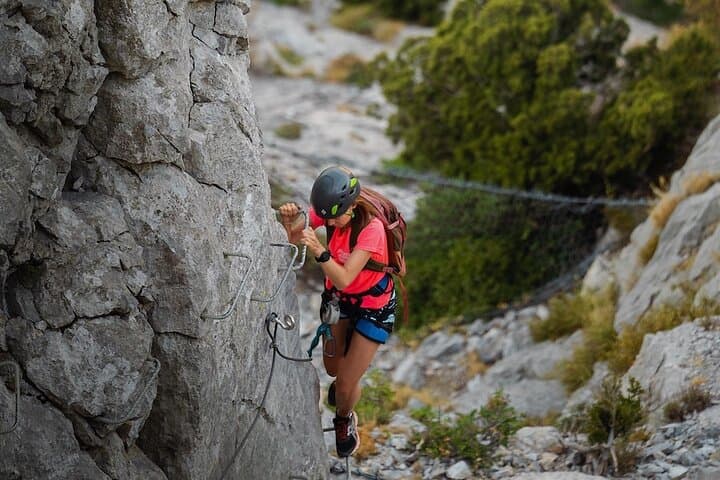


You clip in, hear the wind move through limestone ribs, and the Agly Valley opens beneath you—patchwork vineyards giving way to scrub and ragged ridgelines. The Panoramic Via Ferrata near Saint-Paul-de-Fenouillet trades flat hiking for vertical choreography: iron rungs, suspension bridges, and exposed traverses that demand focus while delivering wide, raw views of the eastern Pyrenees.
You clip in, hear the wind move through limestone ribs, and the Agly Valley opens beneath you—patchwork vineyards giving way to scrub and ragged ridgelines. The Panoramic Via Ferrata near Saint-Paul-de-Fenouillet trades flat hiking for vertical choreography: iron rungs, suspension bridges, and exposed traverses that demand focus while delivering wide, raw views of the eastern Pyrenees.
The route sits in a landscape shaped by marine limestone folded and carved over millions of years; nearby ridges host Cathar-era castles perched on the same cliffs that once marked medieval borders. Culturally, the Fenouillèdes region mixes Occitan traditions with Pyrenean mountain life—small villages, stone farmhouses, and seasonal shepherding.
Expect roughly three to four hours on the route including briefing, with sustained vertical sections rather than long approaches. Terrain is steep limestone with fixed safety lines; footing can be sharp and exposed. Guides provide helmets, harnesses and lanyards, and instructors coach techniques like efficient clipped movement and body positioning on ladders and bridges.
Practically, arrive with layered clothing, sturdy footwear, and 1–2 liters of water. Morning departures avoid heat and thermals that can stir strong winds on exposed ridges. If you have a fear of heights or cardiovascular concerns, discuss these with the operator in advance; instructors can often pace groups and offer alternate lines for beginners.
This is a social route—teams help each other across gaps—so bring a camera, light gloves, and a readiness to move deliberately. Respect nesting birds and stay on the fixed route; the cliffs are fragile and the views are best preserved when everyone leaves no trace.