THE ADVENTURE COLLECTIVE® · Independent discovery and booking for outdoor travel

Explore Oxford’s dreaming spires on an official two‑hour walking tour that moves from Broad Street to the Radcliffe Camera, revealing college lore, film locations and riverside paths. Ideal for first‑time visitors who want history, practical insights and local routes.
Explore Oxford’s dreaming spires on an official two‑hour walking tour that moves from Broad Street to the Radcliffe Camera, revealing college lore, film locations and riverside paths. Ideal for first‑time visitors who want history, practical insights and local routes.
Morning light slices between stone spires as a small group gathers on Broad Street, the guide’s voice cutting through the hum of cyclists and river traffic. On this two‑hour official walking tour, the city reveals itself in layers: cobbled alleys that once echoed with academic disputes, ceremonial squares where scholars marched in robes, and riverbanks where the Thames (locally the Isis) curves as if daring you to follow.
Verified experiences and guided adventures in the surrounding area.
Operated by Experience Oxfordshire · Oxford, Oxfordshire
Morning light slices between stone spires as a small group gathers on Broad Street, the guide’s voice cutting through the hum of cyclists and river traffic. On this two‑hour official walking tour, the city reveals itself in layers: cobbled alleys that once echoed with academic disputes, ceremonial squares where scholars marched in robes, and riverbanks where the Thames (locally the Isis) curves as if daring you to follow.
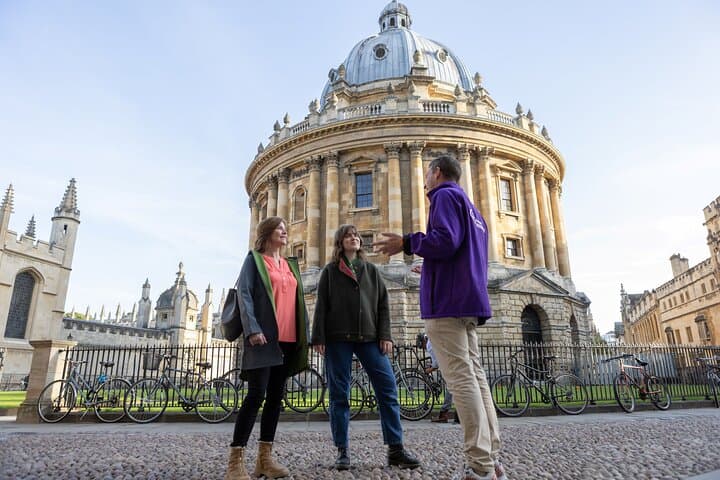
Oxford’s architecture records centuries: Norman towers, Gothic colleges, and the circular Radcliffe Camera—an 18th‑century reading room that anchors the city visually and historically. The walk threads past the Bodleian Library and Sheldonian Theatre, touching on Oxford’s role in medieval learning, the Renaissance sciences, and modern film locations from Harry Potter to Inspector Morse.
Cultural notes surface naturally: college rivalries, the town‑and‑gown skirmishes of the past, and the rhythms of modern student life. Geology shows in the honeyed limestone facades quarried locally; the River Thames and nearby chalk hills shaped the settlement pattern and green corridors.
Practical guidance: wear supportive shoes for uneven cobbles, layer for unpredictable British weather, and bring a small daypack—college interiors are sometimes accessible on afternoon tours but not guaranteed. Tours cover roughly 1.5–2 miles at a steady walking pace with plenty of stops for stories and photos. For quieter moments, linger along Christ Church Meadow or the riverside paths after the tour. With clear directions and local context from an expert guide, the walk is both an introduction and a prompt to return with more time.
easy.
2 hours.
Suitable for most fitness levels; requires standing and walking on uneven ground for up to two hours.
The official tour runs about two hours and covers roughly 1.5–2 miles at a moderate walking pace with multiple stops for commentary and photos.
Some afternoon tours include college visits subject to availability; morning tours generally view exteriors only—your booking will note any included college access.
The operator lists accessibility options and can adapt where possible, but some historic buildings and cobbled streets may limit full access—contact the tour office ahead for specific needs.
Tours usually run in normal rain; in severe or dangerous weather (e.g., official Yellow warnings) tours may be postponed or rescheduled—check with the operator.
Oxford grew around a medieval university; many colleges date from the 13th–18th centuries and the city’s town‑and‑gown history shaped its narrow lanes and public squares.
Visitors are asked to stay on public paths, avoid entering private college gardens without permission, and carry out any litter to help protect historic fabric and riverside habitats.
Experience Oxfordshire operates guided outdoor trips and adventures with an emphasis on safety, stewardship, and memorable experiences.

Morning light slices between stone spires as a small group gathers on Broad Street, the guide’s voice cutting through the hum of cyclists and river traffic. On this two‑hour official walking tour, the city reveals itself in layers: cobbled alleys that once echoed with academic disputes, ceremonial squares where scholars marched in robes, and riverbanks where the Thames (locally the Isis) curves as if daring you to follow.
Morning light slices between stone spires as a small group gathers on Broad Street, the guide’s voice cutting through the hum of cyclists and river traffic. On this two‑hour official walking tour, the city reveals itself in layers: cobbled alleys that once echoed with academic disputes, ceremonial squares where scholars marched in robes, and riverbanks where the Thames (locally the Isis) curves as if daring you to follow.
Oxford’s architecture records centuries: Norman towers, Gothic colleges, and the circular Radcliffe Camera—an 18th‑century reading room that anchors the city visually and historically. The walk threads past the Bodleian Library and Sheldonian Theatre, touching on Oxford’s role in medieval learning, the Renaissance sciences, and modern film locations from Harry Potter to Inspector Morse.
Cultural notes surface naturally: college rivalries, the town‑and‑gown skirmishes of the past, and the rhythms of modern student life. Geology shows in the honeyed limestone facades quarried locally; the River Thames and nearby chalk hills shaped the settlement pattern and green corridors.
Practical guidance: wear supportive shoes for uneven cobbles, layer for unpredictable British weather, and bring a small daypack—college interiors are sometimes accessible on afternoon tours but not guaranteed. Tours cover roughly 1.5–2 miles at a steady walking pace with plenty of stops for stories and photos. For quieter moments, linger along Christ Church Meadow or the riverside paths after the tour. With clear directions and local context from an expert guide, the walk is both an introduction and a prompt to return with more time.