THE ADVENTURE COLLECTIVE® · Independent discovery and booking for outdoor travel

Walk 2.8 km through Oxford’s university heart at your own pace using audio guides and interactive quizzes. Perfect for solo explorers or groups who want history, shortcuts, and local stories without a scheduled guide.
Walk 2.8 km through Oxford’s university heart at your own pace using audio guides and interactive quizzes. Perfect for solo explorers or groups who want history, shortcuts, and local stories without a scheduled guide.
The city opens like a well-thumbed book: stone stairways worn smooth, a clock tower catching afternoon light, and a narrow alley that funnels students and secrets alike.
Verified experiences and guided adventures in the surrounding area.
Operated by Ciceru · Oxford, Oxfordshire
The city opens like a well-thumbed book: stone stairways worn smooth, a clock tower catching afternoon light, and a narrow alley that funnels students and secrets alike.
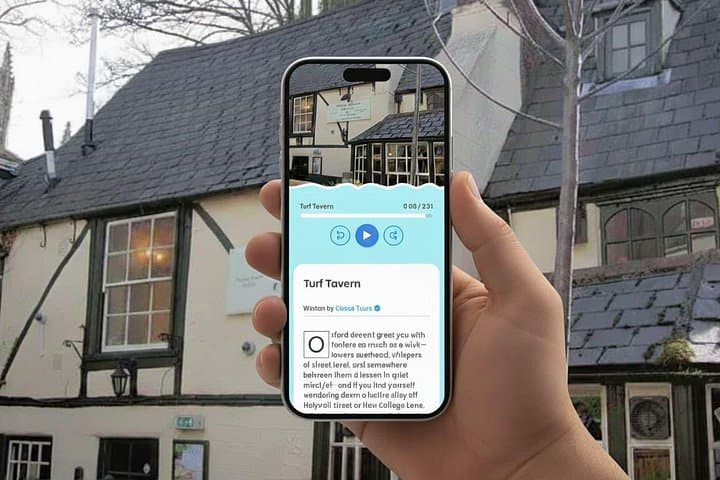
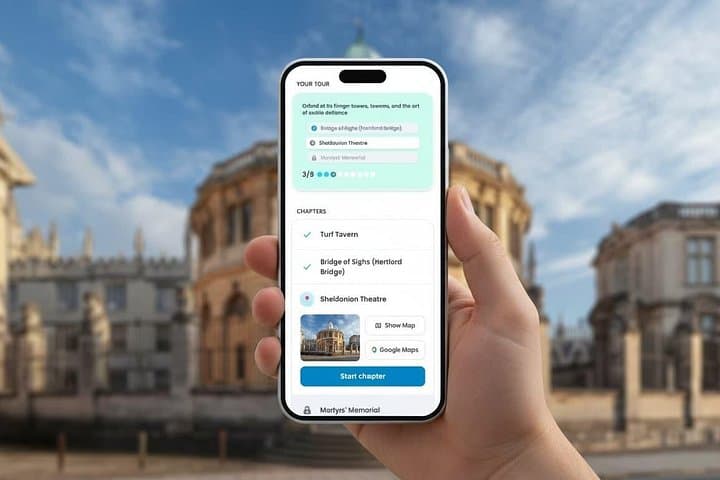
This self-guided Oxford walking tour threads roughly 2.8 km through the university quarter in about 90 minutes, using smartphone audio and interactive quizzes to point out landmarks from the Radcliffe Camera to the Sheldonian Theatre. The route favors paved streets, historic quadrangles and low-traffic pedestrian alleys, so expect mostly flat, urban terrain with intermittent steps at college gates.
Oxford’s fabric is layered—medieval colleges growing into Georgian and Baroque civic buildings. The Sheldonian (Wren’s 1660s design) and the Radcliffe Camera (mid-18th century) reflect the city’s architectural pivots, while signs and plaques mark Reformation-era events and later Victorian expansions. Geologically, the city sits on Oxford Clay and Corallian limestone, the latter visible in many older facades.
Culturally, you’ll pass student haunts, market stalls, and small chapels that still host services; the audio guides add local anecdotes and short quizzes to keep momentum. Practicalities: download or open the map on your phone, carry a charged power bank, and wear supportive shoes—the streets can be deceptively uneven. Start early to avoid midday crowds and allow extra time for photo stops or a detour to the Botanic Garden.
This is an easy, flexible way to claim a slice of Oxford independently—educational, social-media friendly, and timed to suit your pace.
easy.
1–2 hours.
Suitable for most fitness levels; a baseline of walking endurance for 90 minutes is helpful.
No app required—audio and smart maps work via mobile browser, but downloading route files or audio can save data.
Yes; the tour includes family-friendly quizzes, though some historical details suit older children and teens.
Some colleges allow public access during set hours; check each college’s signage or the audio guide for access notes.
This product is self-guided and time-flexible; check the vendor’s cancellation policy for refunds if you booked a timed slot.
Oxford’s collegiate core developed from the 12th century onward; notable landmarks include the 17th-century Sheldonian and the 18th-century Radcliffe Camera, reflecting shifts in architectural taste and university life.
High foot traffic requires etiquette—stay on marked paths, avoid climbing on historic features, and carry out any litter to preserve delicate stonework and gardens.
Ciceru operates guided outdoor trips and adventures with an emphasis on safety, stewardship, and memorable experiences.


The city opens like a well-thumbed book: stone stairways worn smooth, a clock tower catching afternoon light, and a narrow alley that funnels students and secrets alike.
The city opens like a well-thumbed book: stone stairways worn smooth, a clock tower catching afternoon light, and a narrow alley that funnels students and secrets alike.
This self-guided Oxford walking tour threads roughly 2.8 km through the university quarter in about 90 minutes, using smartphone audio and interactive quizzes to point out landmarks from the Radcliffe Camera to the Sheldonian Theatre. The route favors paved streets, historic quadrangles and low-traffic pedestrian alleys, so expect mostly flat, urban terrain with intermittent steps at college gates.
Oxford’s fabric is layered—medieval colleges growing into Georgian and Baroque civic buildings. The Sheldonian (Wren’s 1660s design) and the Radcliffe Camera (mid-18th century) reflect the city’s architectural pivots, while signs and plaques mark Reformation-era events and later Victorian expansions. Geologically, the city sits on Oxford Clay and Corallian limestone, the latter visible in many older facades.
Culturally, you’ll pass student haunts, market stalls, and small chapels that still host services; the audio guides add local anecdotes and short quizzes to keep momentum. Practicalities: download or open the map on your phone, carry a charged power bank, and wear supportive shoes—the streets can be deceptively uneven. Start early to avoid midday crowds and allow extra time for photo stops or a detour to the Botanic Garden.
This is an easy, flexible way to claim a slice of Oxford independently—educational, social-media friendly, and timed to suit your pace.