THE ADVENTURE COLLECTIVE® · Independent discovery and booking for outdoor travel

A compact 48-hour route from Marrakech to the Zagora dunes—ride a camel to a luxury bivouac, watch sunset over the Draa Valley and visit UNESCO-listed Ait Ben Haddou. Practical, scenic, and rich in culture.
A compact 48-hour route from Marrakech to the Zagora dunes—ride a camel to a luxury bivouac, watch sunset over the Draa Valley and visit UNESCO-listed Ait Ben Haddou. Practical, scenic, and rich in culture.
You step out of the minibus as the desert unfolds: an ocean of ochre dunes, a sky so sharply blue it seems to push the horizon away. The caravan of camels waits like patient ships; the wind sculpts small ridges in the sand and tugs at your scarf.
Verified experiences and guided adventures in the surrounding area.
Operated by Morocco City Breaks · Zagora, Drâa-Tafilalet
You step out of the minibus as the desert unfolds: an ocean of ochre dunes, a sky so sharply blue it seems to push the horizon away. The caravan of camels waits like patient ships; the wind sculpts small ridges in the sand and tugs at your scarf.
This two-day excursion threads Marrakech with the High Atlas and the Draa Valley. Expect roughly 350–380 km of driving, including the Tizi n'Tichka pass (about 2,260 m), rolling down to the palm-lined oases around Zagora (~500 m). Along the way you’ll pass Ait Ben Haddou, a 15th-century clay ksar that grew wealthy on trans-Saharan trade and later doubled as a film set for global productions.
Geology here is visible in strata: the High Atlas’ folded, ancient rocks give way to alluvial fans and wind-built dunes. Culturally, the route traces Amazigh (Berber) and Arab influences—kasbahs, palm groves, and caravan tracks that once guided traders to Timbuktu.
On arrival you’ll ride a 1.5-hour camel trek to a luxury bivouac where a cook prepares tagine and the dunes become your night sky. Practical notes: bring sun protection, layers for cold desert nights, and cash for small purchases; travel time includes long drives and multiple stops.
Expect well-paced driving with guided stops at Ait Ben Haddou and Ouarzazate studios, a moderate camel ride, and a comfortable tent stay with dinner and breakfast included. Hydrate before the camel trek, keep electronics charged, and allow time to watch the desert shift color at sunset—this is where silence and star fields do the heavy lifting.
moderate.
2 days.
Suitable for travelers with basic mobility; expect long vehicle transfers plus a 1.5-hour camel ride—no special fitness required but be prepared for uneven terrain.
Expect roughly 6–8 hours of total driving with scheduled stops; distance is about 350–380 km depending on route and traffic.
The 1.5-hour camel trek is gentle and suitable for beginners; follow guides’ instructions when mounting and dismounting to avoid strain.
Luxury bivouacs typically provide shared tented ablutions and basic hot-water showers, but amenities are simpler than hotels—plan accordingly.
This tour is not recommended for travelers with serious spinal or cardiovascular conditions; consult the operator before booking.
The route follows historic trans-Saharan corridors; Ait Ben Haddou grew wealthy in the 15th century as a caravan stop and later found new life as a film location.
The Sahara environment is fragile—stick to established tracks near camps, minimize campfire use, and avoid disturbing plants and wildlife.
Morocco City Breaks operates guided outdoor trips and adventures with an emphasis on safety, stewardship, and memorable experiences.

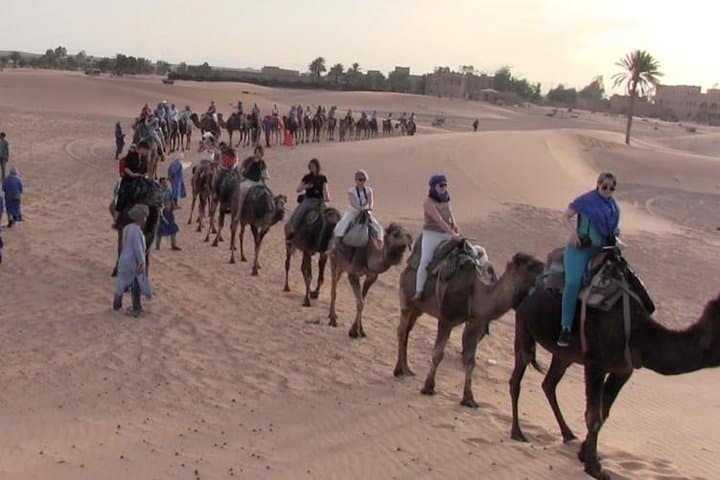


You step out of the minibus as the desert unfolds: an ocean of ochre dunes, a sky so sharply blue it seems to push the horizon away. The caravan of camels waits like patient ships; the wind sculpts small ridges in the sand and tugs at your scarf.
You step out of the minibus as the desert unfolds: an ocean of ochre dunes, a sky so sharply blue it seems to push the horizon away. The caravan of camels waits like patient ships; the wind sculpts small ridges in the sand and tugs at your scarf.
This two-day excursion threads Marrakech with the High Atlas and the Draa Valley. Expect roughly 350–380 km of driving, including the Tizi n'Tichka pass (about 2,260 m), rolling down to the palm-lined oases around Zagora (~500 m). Along the way you’ll pass Ait Ben Haddou, a 15th-century clay ksar that grew wealthy on trans-Saharan trade and later doubled as a film set for global productions.
Geology here is visible in strata: the High Atlas’ folded, ancient rocks give way to alluvial fans and wind-built dunes. Culturally, the route traces Amazigh (Berber) and Arab influences—kasbahs, palm groves, and caravan tracks that once guided traders to Timbuktu.
On arrival you’ll ride a 1.5-hour camel trek to a luxury bivouac where a cook prepares tagine and the dunes become your night sky. Practical notes: bring sun protection, layers for cold desert nights, and cash for small purchases; travel time includes long drives and multiple stops.
Expect well-paced driving with guided stops at Ait Ben Haddou and Ouarzazate studios, a moderate camel ride, and a comfortable tent stay with dinner and breakfast included. Hydrate before the camel trek, keep electronics charged, and allow time to watch the desert shift color at sunset—this is where silence and star fields do the heavy lifting.