THE ADVENTURE COLLECTIVE® · Independent discovery and booking for outdoor travel

A focused 48-hour loop from Marrakech to Zagora that pairs Atlas Pass panoramas and historic Aït Ben Haddou with a classic Sahara bivouac night. Expect long drives, a 1.5-hour camel transfer to camp, and bright desert skies.
A focused 48-hour loop from Marrakech to Zagora that pairs Atlas Pass panoramas and historic Aït Ben Haddou with a classic Sahara bivouac night. Expect long drives, a 1.5-hour camel transfer to camp, and bright desert skies.
You leave Marrakech before dawn, the city’s bustle shrinking behind you as the road climbs into the High Atlas. Tizi n’Tichka cuts a ragged spine across the horizon; switchbacks open into terraces and then the ochre folds of the Draa Valley. By late afternoon the road softens into dunes, and a caravan of camels waits like a low-slung promise against the sky.
Verified experiences and guided adventures in the surrounding area.
Operated by Morocco City Breaks · Zagora, Drâa-Tafilalet
You leave Marrakech before dawn, the city’s bustle shrinking behind you as the road climbs into the High Atlas. Tizi n’Tichka cuts a ragged spine across the horizon; switchbacks open into terraces and then the ochre folds of the Draa Valley. By late afternoon the road softens into dunes, and a caravan of camels waits like a low-slung promise against the sky.
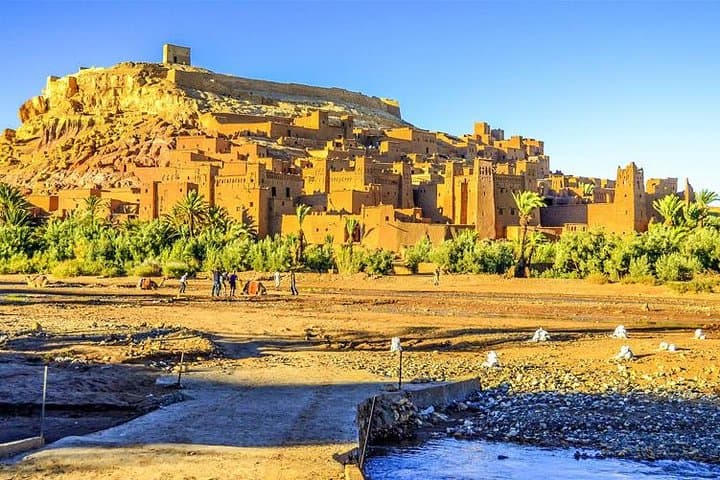
Aït Ben Haddou, the fortified ksar built along medieval trans-Saharan trade routes, punctuates the route—its mud-brick towers recalling caravan traffic that connected Timbuktu and Andalusia. Geologically, the High Atlas is young and uplifted, giving way southward to the ancient alluvial plains of the Draa; cultural layers shift from Berber villages to oasis farms and film-studio façades at Ouarzazate.
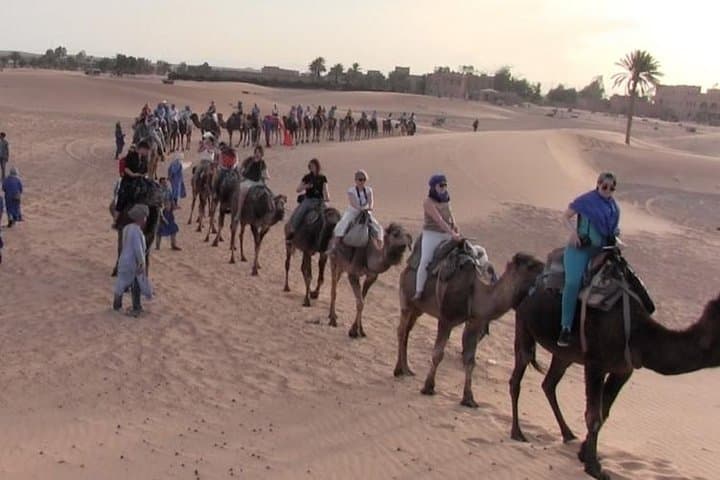
The experience focuses on two simple stages: the road journey with short cultural stops, and the desert night in a traditional bivouac accessed by a roughly 1.5-hour camel ride. Expect wide horizons, a desert sunset that cools quickly, and a clear star field punctuated by campfire warmth and simple music.
Practical guidance: travel time is long—plan for 7–9 hours of combined driving split over two days. Bring layered clothing for large diurnal swings, sun protection, and cash for studio admissions or market purchases. If you have back or heart issues, note the camel ride and travel fatigue; the tour is designed for general fitness but involves mounting camels and walking short distances. Start early and carry a refillable water bottle—hydration makes the desert night more comfortable.
easy.
2 days / 1 night (approx. 48 hours).
Suitable for travelers in basic physical condition — able to mount a camel and walk short distances.
The guided camel transfer is approximately 1 to 1.5 hours each way depending on camp location and pace.
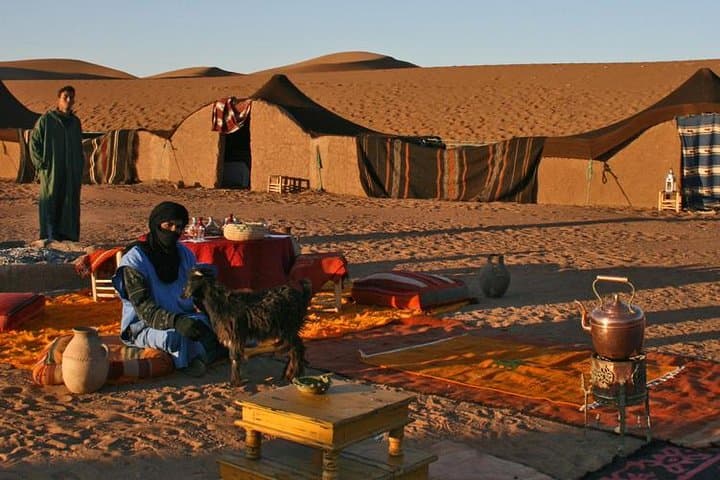
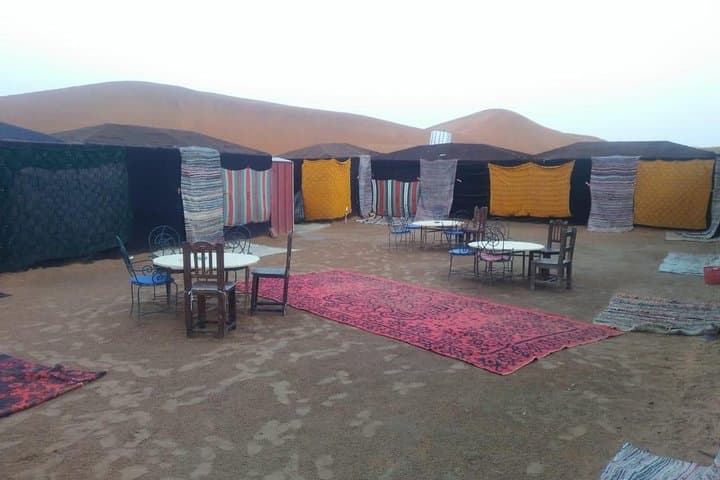
Yes — bivouacs are traditional tents with simple bedding and communal dining; expect rustic comfort rather than hotel amenities.
The tour notes it’s suitable for most fitness levels, but children and those with mobility or heart/back issues should assess camel mounting and long vehicle travel.
Yes — the itinerary typically includes a stop at Aït Ben Haddou and a visit to Ouarzazate studios time-permitting and weather permitting.
The route follows ancient caravan corridors; Aït Ben Haddou was a 15th-century caravan stop connecting sub-Saharan trade routes with coastal cities.
Stick to established paths around fragile palm groves and dunes; water is scarce—use refillable bottles and minimize single-use plastics.
Morocco City Breaks operates guided outdoor trips and adventures with an emphasis on safety, stewardship, and memorable experiences.
You leave Marrakech before dawn, the city’s bustle shrinking behind you as the road climbs into the High Atlas. Tizi n’Tichka cuts a ragged spine across the horizon; switchbacks open into terraces and then the ochre folds of the Draa Valley. By late afternoon the road softens into dunes, and a caravan of camels waits like a low-slung promise against the sky.
You leave Marrakech before dawn, the city’s bustle shrinking behind you as the road climbs into the High Atlas. Tizi n’Tichka cuts a ragged spine across the horizon; switchbacks open into terraces and then the ochre folds of the Draa Valley. By late afternoon the road softens into dunes, and a caravan of camels waits like a low-slung promise against the sky.
Aït Ben Haddou, the fortified ksar built along medieval trans-Saharan trade routes, punctuates the route—its mud-brick towers recalling caravan traffic that connected Timbuktu and Andalusia. Geologically, the High Atlas is young and uplifted, giving way southward to the ancient alluvial plains of the Draa; cultural layers shift from Berber villages to oasis farms and film-studio façades at Ouarzazate.
The experience focuses on two simple stages: the road journey with short cultural stops, and the desert night in a traditional bivouac accessed by a roughly 1.5-hour camel ride. Expect wide horizons, a desert sunset that cools quickly, and a clear star field punctuated by campfire warmth and simple music.
Practical guidance: travel time is long—plan for 7–9 hours of combined driving split over two days. Bring layered clothing for large diurnal swings, sun protection, and cash for studio admissions or market purchases. If you have back or heart issues, note the camel ride and travel fatigue; the tour is designed for general fitness but involves mounting camels and walking short distances. Start early and carry a refillable water bottle—hydration makes the desert night more comfortable.