THE ADVENTURE COLLECTIVE® · Independent discovery and booking for outdoor travel

A full-day escape from Marrakech to the Ouzoud waterfalls offers dramatic 100m cascades, riverside tagines and curious monkey troops. This guide walks you through what to expect — from travel time and fees to the best viewpoints and practical packing tips.
A full-day escape from Marrakech to the Ouzoud waterfalls offers dramatic 100m cascades, riverside tagines and curious monkey troops. This guide walks you through what to expect — from travel time and fees to the best viewpoints and practical packing tips.
A ribbon of water breaks the Atlas foothills and, for a moment, the world rearranges itself around the sound of falling. You arrive at the Ouzoud waterfalls with spray on your face and the canyon below opening like a green throat. The falls plunge roughly 100 meters (about 330 feet) in stepped tiers, sending a constant, drifting rainbow into the gorge. Local cafés sit on the cliff edge, knives and tagines clinking, and a troop of curious monkeys patrols the terraces, darting between olive trees and startled tourists.
Verified experiences and guided adventures in the surrounding area.
Operated by Arwa-Travel · Ouzoud, Azilal
A ribbon of water breaks the Atlas foothills and, for a moment, the world rearranges itself around the sound of falling. You arrive at the Ouzoud waterfalls with spray on your face and the canyon below opening like a green throat. The falls plunge roughly 100 meters (about 330 feet) in stepped tiers, sending a constant, drifting rainbow into the gorge. Local cafés sit on the cliff edge, knives and tagines clinking, and a troop of curious monkeys patrols the terraces, darting between olive trees and startled tourists.
The falls sit in the High Atlas’s foothills near the village of Ouzoud, an area shaped by Miocene and Pliocene uplift and millennia of terraced agriculture. Berber families have farmed these slopes for generations; their mud-brick houses and groves of olive and almond give the valley a lived-in, working feel rather than a pristine park. Historically, the site has been a local pilgrimage of sorts — a place for seasonal picnics, communal celebrations and hospitality to travelers heading between Marrakech and the Middle Atlas.
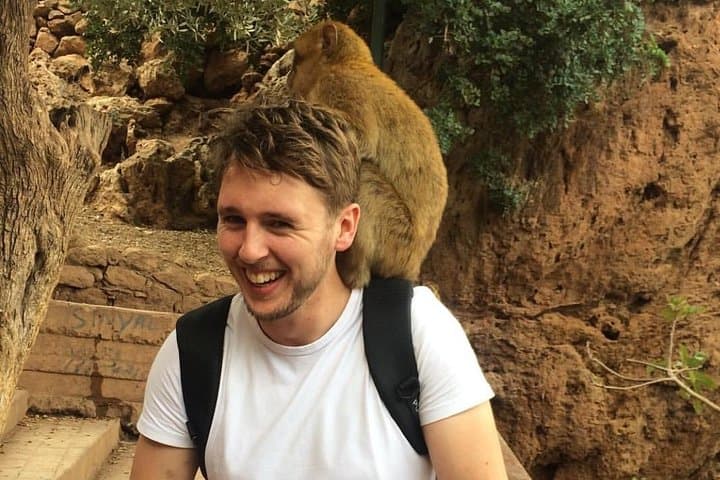
Geology shows in the stepped basins: harder caps of dolomite and weaker layers beneath have allowed the cascade to carve a staircase rather than a single drop. Birds exploit the verticality — herons and kingfishers quarter the pools while raptors ride thermal updrafts above the canyon. The monkeys you meet are habituated to people; they’ll photobomb a selfie in seconds but should be treated as wild animals, not pets.
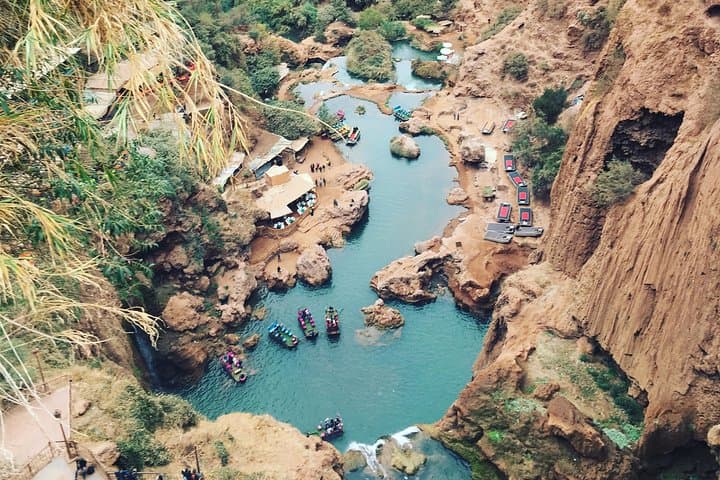
On a practical note, plan for a long day: the round trip from Marrakech is about 2.5–3 hours by road depending on traffic, and the experience itself runs 6–8 hours. The tour includes air-conditioned transport and bottled water; guided hikes to the canyon rim and a traditional boat at the base are often available locally for a small additional fee (expect to pay roughly 100–200 MAD depending on the service). Lunch on a terrace overlooking the falls is the natural reward — tagine, fresh salad, and mint tea framed by spray.
Wear sturdy hiking shoes for the uneven paths and stone steps; bring a waterproof layer if you want to stand near the plunge pools. Carry cash — many small vendors and guides don’t accept cards — and keep a respectful distance from the monkeys. If you want photos with fewer people, aim for early morning or late afternoon; the light softens and the rainbows deepen.
This day trip is an accessible slice of Atlas life: a kinetic landscape that pushes and invites you at once, a place where geology, culture and wildlife meet over one unmistakable fall.
moderate.
6–8 hours.
Moderate fitness for uneven trails and stairs; able to handle a 1–2 hour guided hike and several flights of stone steps.
Expect about 2.5–3 hours each way by road; travel time varies with traffic and exact pickup location.
They are wild and habituated — observe from a distance, do not feed them, and secure loose items to avoid theft.
Basic transport and bottled water are included; local expert guides and boat rides are typically extra (around 100–200 MAD).
Comfortable layered clothing and grippy shoes; bring a hat and sunscreen in summer and a waterproof layer in cooler months.
Lunch is not always included in basic tour fares — most itineraries stop at a terrace restaurant where you can choose a tagine; check the listing for specifics.
The trip is suitable for most ages, but there are many steps and rough paths — travelers with mobility concerns should plan accordingly.
The Ouzoud valley has long been home to Berber farming communities who shaped the terraces and maintained the olive groves that frame the falls.
Visitors are urged not to feed wildlife, to stick to marked paths, and to support local businesses that practice low-impact tourism.
Arwa-Travel operates guided outdoor trips and adventures with an emphasis on safety, stewardship, and memorable experiences.
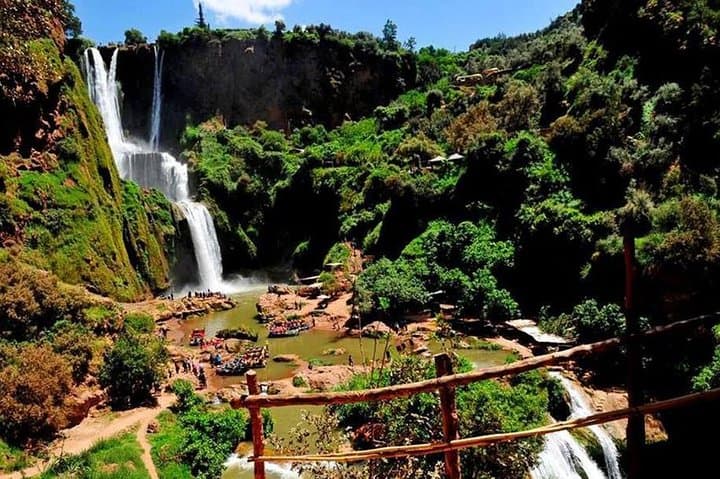
A ribbon of water breaks the Atlas foothills and, for a moment, the world rearranges itself around the sound of falling. You arrive at the Ouzoud waterfalls with spray on your face and the canyon below opening like a green throat. The falls plunge roughly 100 meters (about 330 feet) in stepped tiers, sending a constant, drifting rainbow into the gorge. Local cafés sit on the cliff edge, knives and tagines clinking, and a troop of curious monkeys patrols the terraces, darting between olive trees and startled tourists.
A ribbon of water breaks the Atlas foothills and, for a moment, the world rearranges itself around the sound of falling. You arrive at the Ouzoud waterfalls with spray on your face and the canyon below opening like a green throat. The falls plunge roughly 100 meters (about 330 feet) in stepped tiers, sending a constant, drifting rainbow into the gorge. Local cafés sit on the cliff edge, knives and tagines clinking, and a troop of curious monkeys patrols the terraces, darting between olive trees and startled tourists.
The falls sit in the High Atlas’s foothills near the village of Ouzoud, an area shaped by Miocene and Pliocene uplift and millennia of terraced agriculture. Berber families have farmed these slopes for generations; their mud-brick houses and groves of olive and almond give the valley a lived-in, working feel rather than a pristine park. Historically, the site has been a local pilgrimage of sorts — a place for seasonal picnics, communal celebrations and hospitality to travelers heading between Marrakech and the Middle Atlas.
Geology shows in the stepped basins: harder caps of dolomite and weaker layers beneath have allowed the cascade to carve a staircase rather than a single drop. Birds exploit the verticality — herons and kingfishers quarter the pools while raptors ride thermal updrafts above the canyon. The monkeys you meet are habituated to people; they’ll photobomb a selfie in seconds but should be treated as wild animals, not pets.
On a practical note, plan for a long day: the round trip from Marrakech is about 2.5–3 hours by road depending on traffic, and the experience itself runs 6–8 hours. The tour includes air-conditioned transport and bottled water; guided hikes to the canyon rim and a traditional boat at the base are often available locally for a small additional fee (expect to pay roughly 100–200 MAD depending on the service). Lunch on a terrace overlooking the falls is the natural reward — tagine, fresh salad, and mint tea framed by spray.
Wear sturdy hiking shoes for the uneven paths and stone steps; bring a waterproof layer if you want to stand near the plunge pools. Carry cash — many small vendors and guides don’t accept cards — and keep a respectful distance from the monkeys. If you want photos with fewer people, aim for early morning or late afternoon; the light softens and the rainbows deepen.
This day trip is an accessible slice of Atlas life: a kinetic landscape that pushes and invites you at once, a place where geology, culture and wildlife meet over one unmistakable fall.