THE ADVENTURE COLLECTIVE® · Independent discovery and booking for outdoor travel

A private day trip from Marrakech brings you to Ouzoud’s multi-tiered cascades—110 meters of drops, olive terraces, and close-up encounters with Barbary macaques. This practical guide covers what to expect, when to visit, and how to make the most of the walk and boat ride.
A private day trip from Marrakech brings you to Ouzoud’s multi-tiered cascades—110 meters of drops, olive terraces, and close-up encounters with Barbary macaques. This practical guide covers what to expect, when to visit, and how to make the most of the walk and boat ride.
You turn a corner on the track and the world changes: a roar deep as a held breath, a wall of mist catching light into a quick ribbon of rainbow. From the upper terraces the Ouzoud falls drop in stepped curtains—the El Abid River unspooling over jagged rock—while terraces of olive trees and stone mills cling to the slopes. The air here smells of wet stone and frying dough from small cafés cut into the cliffside.
Verified experiences and guided adventures in the surrounding area.
You turn a corner on the track and the world changes: a roar deep as a held breath, a wall of mist catching light into a quick ribbon of rainbow. From the upper terraces the Ouzoud falls drop in stepped curtains—the El Abid River unspooling over jagged rock—while terraces of olive trees and stone mills cling to the slopes. The air here smells of wet stone and frying dough from small cafés cut into the cliffside.
Ouzoud sits in Azilal province, where the High Atlas spills into folded plateaus. The falls themselves plunge roughly 110 meters in a series of cascades, carved over millennia out of Mesozoic limestone and marls. Local Berber communities have worked these slopes for centuries; you’ll still see traditional olive presses and pebble-flagged mule tracks leading to hamlets like Tanaghmeilt. Geologically, the site is a readable cross-section: fracture lines direct the water, while softer strata have worn back to create the ledges that make Ouzoud’s tiered drops.
A private day tour from Marrakech is straightforward: expect a 2.5–3 hour drive each way along the N8 and mountain roads, with the full outing taking about 8–10 hours door-to-door. On arrival, a guided loop runs roughly 2–3 km if you take the upper viewpoint, descend to the base, and return via the opposite trail; cumulative elevation change is modest—about 100–150 m of descent and ascent on steps and packed earth.
Along the path village life is on display: goats picking over terraced crops, olive harvests in season, and small cafés where tajine and mint tea are served to visitors and farmers alike. Barbary macaques patrol the shade trees; they’re photogenic but opportunistic—do not feed them. Local guides can point out working mills and secure a short boat ride to the pool at the base for a close-up of the lowest curtain.
Practical advice: wear sturdy shoes with good grip—the stone steps get slick from spray—and bring 2 liters of water, sun protection, and cash for cafés, tips, and the boat operator. Mornings are quieter and offer cleaner light for photos; midday rainbows form when the sun is high and the spray is strong. If you’re travelling in spring or after heavy rains, flows are dramatic but trails can be muddy; in summer expect more tourists and less volume.
A private transfer tour reduces stress on logistics, letting a local driver navigate narrow switchbacks while your guide tailors the walking pace. Respect the village spaces you pass through, pack out non-organic waste, and consider buying olive oil or a meal locally—small purchases make a big difference to mountain communities. Ouzoud is a place where water still shapes lives; come prepared to listen to it.
moderate.
8–10 hours (including transfer).
Moderate fitness for walking short steep sections and returning up ~100–150 m of elevation change
Plan for about 2.5–3 hours each way by car, depending on traffic and stops along the N8 route through the Atlas foothills.
Yes—local boat operators offer short rides from the pool at the bottom; negotiate price beforehand and wear non-slip shoes for boarding.
Swimming is possible in calmer pools near the base but conditions change with flow; check with your guide and avoid strong current areas.
The main viewpoints are accessible to most ages, but the descent to the base is steep with many steps; measure routes against mobility levels before committing.
Barbary macaques are common around the picnic areas and trees; watch for local birds such as kingfishers and wagtails along the river.
Tipping is customary—plan on a modest tip for both if service meets expectations; small purchases and meals are a key income source for local families.
Local Berber villages have farmed these terraces and operated olive presses for centuries; the mills visible today reflect a long tradition of small-scale mountain agriculture.
Increased tourism strains paths and water resources; stick to marked trails, avoid single-use plastics, and support local businesses to help sustain the landscape.
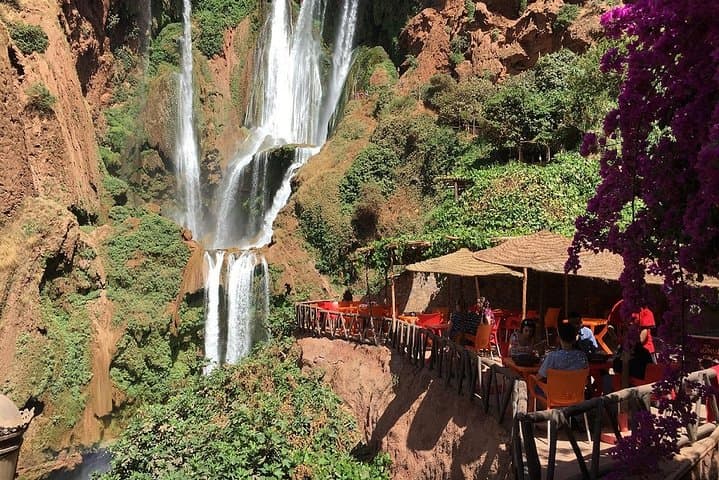
You turn a corner on the track and the world changes: a roar deep as a held breath, a wall of mist catching light into a quick ribbon of rainbow. From the upper terraces the Ouzoud falls drop in stepped curtains—the El Abid River unspooling over jagged rock—while terraces of olive trees and stone mills cling to the slopes. The air here smells of wet stone and frying dough from small cafés cut into the cliffside.
You turn a corner on the track and the world changes: a roar deep as a held breath, a wall of mist catching light into a quick ribbon of rainbow. From the upper terraces the Ouzoud falls drop in stepped curtains—the El Abid River unspooling over jagged rock—while terraces of olive trees and stone mills cling to the slopes. The air here smells of wet stone and frying dough from small cafés cut into the cliffside.
Ouzoud sits in Azilal province, where the High Atlas spills into folded plateaus. The falls themselves plunge roughly 110 meters in a series of cascades, carved over millennia out of Mesozoic limestone and marls. Local Berber communities have worked these slopes for centuries; you’ll still see traditional olive presses and pebble-flagged mule tracks leading to hamlets like Tanaghmeilt. Geologically, the site is a readable cross-section: fracture lines direct the water, while softer strata have worn back to create the ledges that make Ouzoud’s tiered drops.
A private day tour from Marrakech is straightforward: expect a 2.5–3 hour drive each way along the N8 and mountain roads, with the full outing taking about 8–10 hours door-to-door. On arrival, a guided loop runs roughly 2–3 km if you take the upper viewpoint, descend to the base, and return via the opposite trail; cumulative elevation change is modest—about 100–150 m of descent and ascent on steps and packed earth.
Along the path village life is on display: goats picking over terraced crops, olive harvests in season, and small cafés where tajine and mint tea are served to visitors and farmers alike. Barbary macaques patrol the shade trees; they’re photogenic but opportunistic—do not feed them. Local guides can point out working mills and secure a short boat ride to the pool at the base for a close-up of the lowest curtain.
Practical advice: wear sturdy shoes with good grip—the stone steps get slick from spray—and bring 2 liters of water, sun protection, and cash for cafés, tips, and the boat operator. Mornings are quieter and offer cleaner light for photos; midday rainbows form when the sun is high and the spray is strong. If you’re travelling in spring or after heavy rains, flows are dramatic but trails can be muddy; in summer expect more tourists and less volume.
A private transfer tour reduces stress on logistics, letting a local driver navigate narrow switchbacks while your guide tailors the walking pace. Respect the village spaces you pass through, pack out non-organic waste, and consider buying olive oil or a meal locally—small purchases make a big difference to mountain communities. Ouzoud is a place where water still shapes lives; come prepared to listen to it.