THE ADVENTURE COLLECTIVE® · Independent discovery and booking for outdoor travel

A day trip from Marrakech that pairs a guided hike with a boat ride at North Africa’s dramatic Ouzoud Waterfalls. Expect steep viewpoints, a chance to spot Berber macaques, and a traditional Moroccan lunch with views of the falls.
A day trip from Marrakech that pairs a guided hike with a boat ride at North Africa’s dramatic Ouzoud Waterfalls. Expect steep viewpoints, a chance to spot Berber macaques, and a traditional Moroccan lunch with views of the falls.
The first view arrives before you reach it: a column of spray rising above olive terraces, sunlight caught in a thousand droplets. On the narrow approach path, the guide pauses to point toward distant cliffs where the El Abid River gathers itself and then commits—three clear cascades plunging into deep green pools. The air tastes of wet stone and citrus; Berber monkeys appear on cliff ledges as if they, too, had appointments to keep.
Verified experiences and guided adventures in the surrounding area.
Operated by morocco all excursions · Ouzoud, Azilal Province
The first view arrives before you reach it: a column of spray rising above olive terraces, sunlight caught in a thousand droplets. On the narrow approach path, the guide pauses to point toward distant cliffs where the El Abid River gathers itself and then commits—three clear cascades plunging into deep green pools. The air tastes of wet stone and citrus; Berber monkeys appear on cliff ledges as if they, too, had appointments to keep.
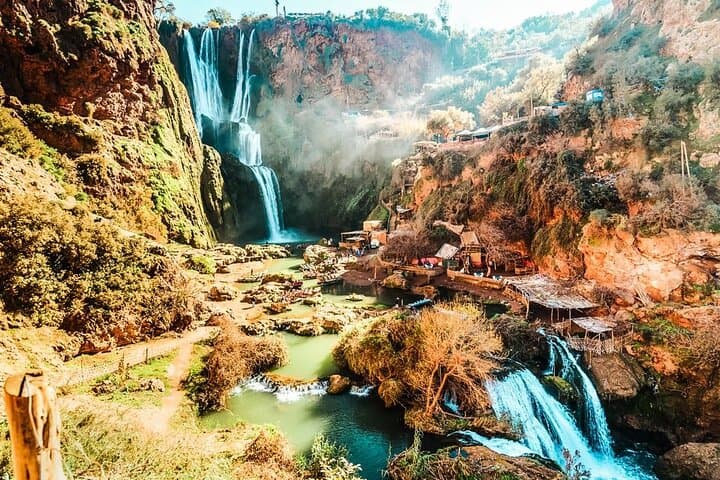
Ouzoud is the most visited waterfall in Morocco, roughly three hours by road from Marrakech across plains that give way to the western foothills of the High Atlas. The falls are fed by the Oued el Abid and have carved their drop into layered rock and softer sediments over millennia, creating terraces and plunge pools that locals have long used for mills and olive presses. The area is strongly linked to Berber villages on the plateau; local families run the guest restaurants and the small boats that ply the base of the falls, so tourism and traditional life coexist in a pragmatic rhythm.
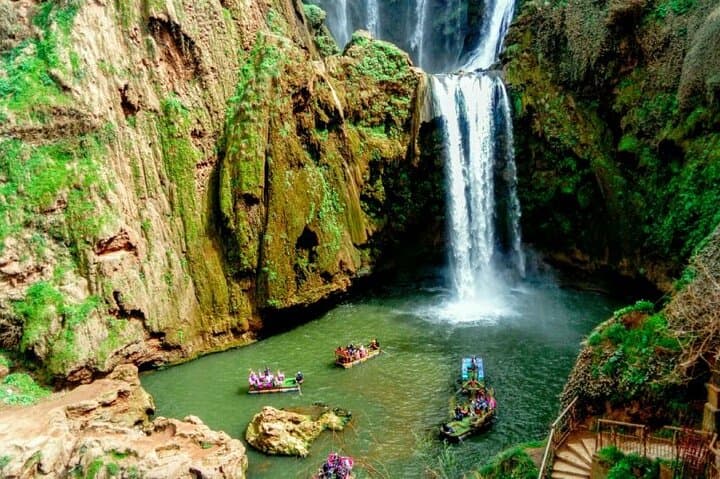
On the trail, nature has personality: the river insists on finding a new path around boulders, and the current teases swimmers into cooler, alert silence. The guided loop covers mixed terrain—stone steps, packed dirt, and short stretches of loose scree—rewarding hikers with viewpoints that telescope the falls and reveal the valley beyond. After the walk, a flat-bottomed boat takes visitors into the mist, where lenses fog and laughter rings out. Lunch is typically a tagine or grilled trout served at a terrace restaurant overlooking the curtain of water, a simple way to taste local hospitality.
Practicalities matter. The full excursion is a long day—expect 9–10 hours from Marrakech, including about 3 hours each way. Trails around the falls amount to a 3–5 km loop with roughly 150–250 m of elevation change; footwear with good grip and a steady step are recommended. Water flow is highest in spring after rains and lower in late summer, but even in drier months the river cuts impressive drops.
Timing and respect sharpen the experience: arrive early to avoid coach crowds, keep to marked paths to limit erosion, and do not feed the macaques; they are charismatic but wild. Bring cash—the best restaurants and local sellers are often cash-only—and a lightweight waterproof layer for the boat ride.
For travelers based in Marrakech, Ouzoud is a runnable day escape that balances vigorous walking, photographic payoff, and a slice of rural Moroccan life. It’s an invitation to slow down: to stand under spray, listen to the river pushing forward, and leave with a clearer sense of why this landscape keeps drawing people back.
moderate.
9–10 hours.
You should be comfortable walking 3–5 km on uneven terrain and managing short elevation changes; basic stamina required for a full-day outing.
The drive is about 2.5–3 hours each way depending on traffic and your pickup point in Marrakech.
Yes—paths are well-trodden and the tour is rated moderate; however, there are steps and uneven sections so mobility limitations should be discussed with the operator ahead of booking.
Swimming is possible in designated natural pools near the base of the falls when conditions are safe; always check with your guide first.
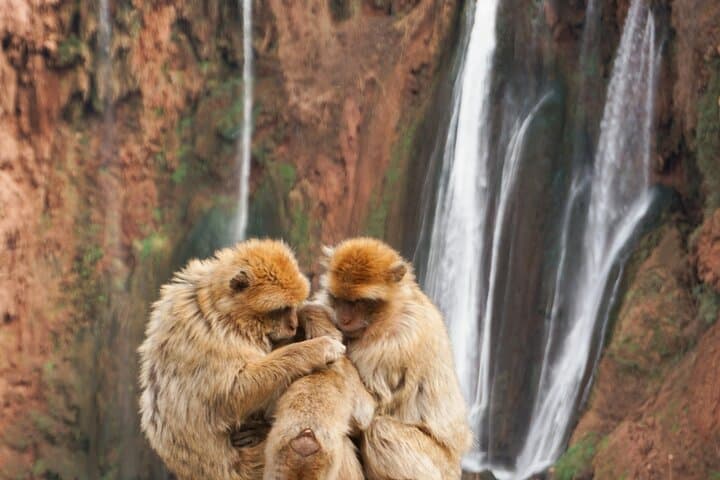
Berber macaques are commonly seen on the cliffs around the falls; they are wild animals—observe without feeding or approaching too closely.
Most operators include hotel pickup and drop-off from accessible Marrakech locations; pick-up within the medina is often not possible due to limited vehicle access.
Local Berber communities have used the valley’s terraces and mills for centuries; the falls and nearby olive groves remain central to rural life and small-scale agriculture.
Erosion and litter are local concerns—stick to marked paths, avoid single-use plastics, and choose restaurants that source food locally to support sustainable tourism.
morocco all excursions operates guided outdoor trips and adventures with an emphasis on safety, stewardship, and memorable experiences.
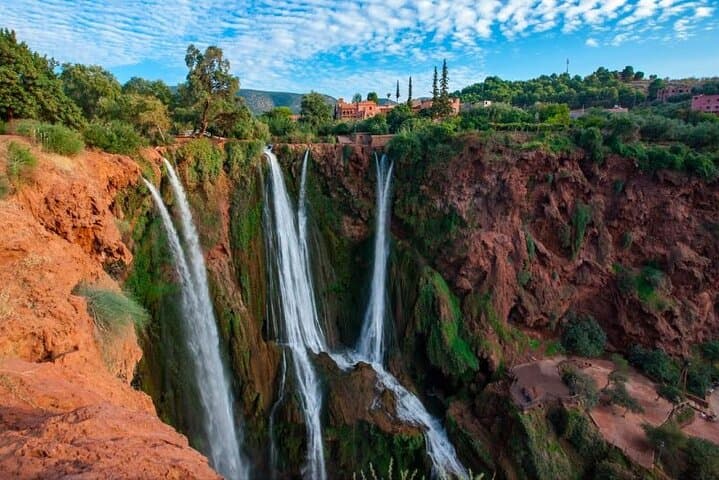
The first view arrives before you reach it: a column of spray rising above olive terraces, sunlight caught in a thousand droplets. On the narrow approach path, the guide pauses to point toward distant cliffs where the El Abid River gathers itself and then commits—three clear cascades plunging into deep green pools. The air tastes of wet stone and citrus; Berber monkeys appear on cliff ledges as if they, too, had appointments to keep.
The first view arrives before you reach it: a column of spray rising above olive terraces, sunlight caught in a thousand droplets. On the narrow approach path, the guide pauses to point toward distant cliffs where the El Abid River gathers itself and then commits—three clear cascades plunging into deep green pools. The air tastes of wet stone and citrus; Berber monkeys appear on cliff ledges as if they, too, had appointments to keep.
Ouzoud is the most visited waterfall in Morocco, roughly three hours by road from Marrakech across plains that give way to the western foothills of the High Atlas. The falls are fed by the Oued el Abid and have carved their drop into layered rock and softer sediments over millennia, creating terraces and plunge pools that locals have long used for mills and olive presses. The area is strongly linked to Berber villages on the plateau; local families run the guest restaurants and the small boats that ply the base of the falls, so tourism and traditional life coexist in a pragmatic rhythm.
On the trail, nature has personality: the river insists on finding a new path around boulders, and the current teases swimmers into cooler, alert silence. The guided loop covers mixed terrain—stone steps, packed dirt, and short stretches of loose scree—rewarding hikers with viewpoints that telescope the falls and reveal the valley beyond. After the walk, a flat-bottomed boat takes visitors into the mist, where lenses fog and laughter rings out. Lunch is typically a tagine or grilled trout served at a terrace restaurant overlooking the curtain of water, a simple way to taste local hospitality.
Practicalities matter. The full excursion is a long day—expect 9–10 hours from Marrakech, including about 3 hours each way. Trails around the falls amount to a 3–5 km loop with roughly 150–250 m of elevation change; footwear with good grip and a steady step are recommended. Water flow is highest in spring after rains and lower in late summer, but even in drier months the river cuts impressive drops.
Timing and respect sharpen the experience: arrive early to avoid coach crowds, keep to marked paths to limit erosion, and do not feed the macaques; they are charismatic but wild. Bring cash—the best restaurants and local sellers are often cash-only—and a lightweight waterproof layer for the boat ride.
For travelers based in Marrakech, Ouzoud is a runnable day escape that balances vigorous walking, photographic payoff, and a slice of rural Moroccan life. It’s an invitation to slow down: to stand under spray, listen to the river pushing forward, and leave with a clearer sense of why this landscape keeps drawing people back.