THE ADVENTURE COLLECTIVE® · Independent discovery and booking for outdoor travel

Spend a long day tracing the Draa Valley from Ouarzazate to Zagora: palm groves, kasbah visits, a pottery stop and a camel ride across the Tinfou dunes. This one-day route mixes easy walking, cultural stops and wide desert views.
Spend a long day tracing the Draa Valley from Ouarzazate to Zagora: palm groves, kasbah visits, a pottery stop and a camel ride across the Tinfou dunes. This one-day route mixes easy walking, cultural stops and wide desert views.
Morning light strips the mud-brick kasbahs bare, and the road out of Ouarzazate unfolds through a ribbon of date palms and low red slopes. You’ll move from high-plateau townscape to the Draa Valley’s green shaft, then into the wind-sculpted Tinfou dunes where a line of dromedaries offers a slow, swaying passage across sand that seems to dare you onward.
Verified experiences and guided adventures in the surrounding area.
Operated by Easy Sahara · Ouarzazate, Drâa-Tafilalet
Morning light strips the mud-brick kasbahs bare, and the road out of Ouarzazate unfolds through a ribbon of date palms and low red slopes. You’ll move from high-plateau townscape to the Draa Valley’s green shaft, then into the wind-sculpted Tinfou dunes where a line of dromedaries offers a slow, swaying passage across sand that seems to dare you onward.
This corridor between Ouarzazate and Zagora carries history: former caravan routes that linked sub-Saharan trade to southern Morocco, dotted with fortified kasbahs and small ksour built from rammed earth and sun-baked brick. Geologically the route shifts from high, rocky outcrops to alluvial terraces and finally to aeolian sand—each landscape shaping local life, pottery traditions and the compact libraries of Koranic scholars in the towns you’ll pass.
Culturally you’ll meet Berber hospitality: pottery workshops, a Koranic library visit, and brief stops for photos at a kasbah that anchors local memory. Practically, expect a full day (about 10–12 hours), roughly 200 km round-trip with multiple short stops, a 60-minute camel ride, and mostly easy walking on flat paths and dunes. Transport is in an air-conditioned vehicle; bring 2–3 liters of water, sun protection, sturdy shoes, and a light layer for early/late desert breezes. Start early to avoid midday heat, carry cash for small purchases, and respect conservative dress around villages. The day blends landscape, hands-on culture and a measured desert encounter—satisfying for travelers seeking photographic variety without technical hiking.
easy.
10–12 hours.
Suitable for most travelers who can sit in a vehicle for extended periods and handle short flat walks and a camel ride.
The tour typically includes a camel ride of about 60 minutes on the Tinfou dunes, guided and with safety briefings.
Yes—it's labeled easy and suitable for most fitness levels; children and seniors should be able to handle short walks and the camel saddle with assistance.
Lunch is provided; restrooms are available at select stops and local establishments but can be basic—carry hand sanitizer and tissues.
Full refund is available if canceled at least 24 hours before departure; tours may cancel for bad weather.
The Draa corridor was part of trans-Saharan caravan routes; many kasbahs began as fortified merchant houses protecting trade in salt, dates and goods.
The Draa’s palm oases are fragile—avoid trampling palms and leave no waste; support local artisans to help sustain traditional livelihoods.
Easy Sahara operates guided outdoor trips and adventures with an emphasis on safety, stewardship, and memorable experiences.

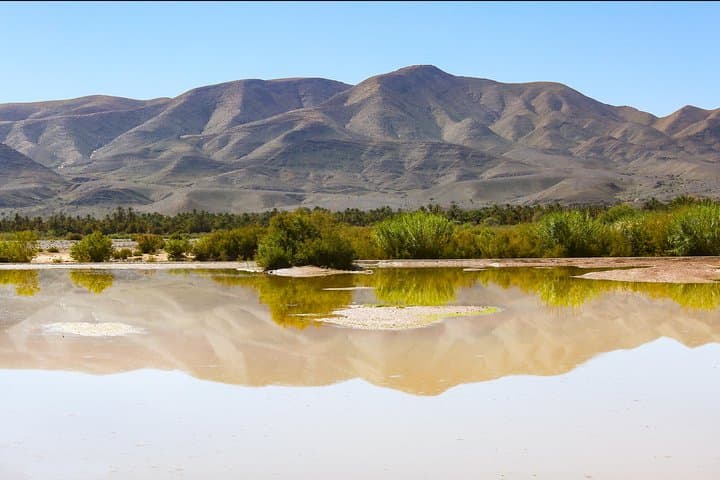


Morning light strips the mud-brick kasbahs bare, and the road out of Ouarzazate unfolds through a ribbon of date palms and low red slopes. You’ll move from high-plateau townscape to the Draa Valley’s green shaft, then into the wind-sculpted Tinfou dunes where a line of dromedaries offers a slow, swaying passage across sand that seems to dare you onward.
Morning light strips the mud-brick kasbahs bare, and the road out of Ouarzazate unfolds through a ribbon of date palms and low red slopes. You’ll move from high-plateau townscape to the Draa Valley’s green shaft, then into the wind-sculpted Tinfou dunes where a line of dromedaries offers a slow, swaying passage across sand that seems to dare you onward.
This corridor between Ouarzazate and Zagora carries history: former caravan routes that linked sub-Saharan trade to southern Morocco, dotted with fortified kasbahs and small ksour built from rammed earth and sun-baked brick. Geologically the route shifts from high, rocky outcrops to alluvial terraces and finally to aeolian sand—each landscape shaping local life, pottery traditions and the compact libraries of Koranic scholars in the towns you’ll pass.
Culturally you’ll meet Berber hospitality: pottery workshops, a Koranic library visit, and brief stops for photos at a kasbah that anchors local memory. Practically, expect a full day (about 10–12 hours), roughly 200 km round-trip with multiple short stops, a 60-minute camel ride, and mostly easy walking on flat paths and dunes. Transport is in an air-conditioned vehicle; bring 2–3 liters of water, sun protection, sturdy shoes, and a light layer for early/late desert breezes. Start early to avoid midday heat, carry cash for small purchases, and respect conservative dress around villages. The day blends landscape, hands-on culture and a measured desert encounter—satisfying for travelers seeking photographic variety without technical hiking.