THE ADVENTURE COLLECTIVE® · Independent discovery and booking for outdoor travel

Swap city crowds for a short train ride and four hours among one of Rome’s best-preserved ancient ports. This private tour combines guided interpretation with the tactile experience of baths, shops, and mosaics preserved by the Tiber’s mud.
Swap city crowds for a short train ride and four hours among one of Rome’s best-preserved ancient ports. This private tour combines guided interpretation with the tactile experience of baths, shops, and mosaics preserved by the Tiber’s mud.
You step off a short commuter train and into the thin, salty air that still remembers the Tiber’s old course. Low stone streets open before you: mosaic thresholds, shop counters, and the dark mouths of storage rooms where grain and garum once kept Rome fed. The guide folds a map, points down the central cardo, and the town begins to move again—not a museum but a lived-in grid of public baths, taverns and warehouses.
Verified experiences and guided adventures in the surrounding area.
Operated by Rome Guided Visit · Rome, Lazio
You step off a short commuter train and into the thin, salty air that still remembers the Tiber’s old course. Low stone streets open before you: mosaic thresholds, shop counters, and the dark mouths of storage rooms where grain and garum once kept Rome fed. The guide folds a map, points down the central cardo, and the town begins to move again—not a museum but a lived-in grid of public baths, taverns and warehouses.
Founded around 335 B.C., Ostia Antica was Rome’s principal port before the river shifted course and the silted mud helped preserve whole neighborhoods. Geologically, the area sits on alluvial deposits of the Tiber and Tyrrhenian coastline—soft ground that buried wooden and masonry structures and kept frescoes and mosaics intact.
Culturally, Ostia reveals daily Roman life: the Thermopolium counters where fast food was sold, the House of Diana’s mythic frescoes, and long rows of horrea (warehouses) that handled grain and trade. Local insights include the military barracks, the theater, and the surprisingly modern feel of the marketplace.
Practical guidance: the 4-hour private tour typically includes train fare from Rome (Piramide), return ticket, entrance fee and a certified guide. Expect 1–2 miles of mostly level walking on packed earth and stone; wear supportive shoes and a sun hat. Mornings are cooler and less crowded; bring water and a light layer for coastal breezes. The site has uneven ground and limited shade in summer, so plan accordingly. Trains run frequently but check schedules and allow extra time for platform changes at Piramide.
easy.
4 hours.
Suitable for most fitness levels; involves 1–2 miles of mostly level walking with occasional steps and uneven ground.
The tour includes assistance to reach Piramide metro station; from there take the regional train to Ancient Ostia (stop: Ostia Antica) — roughly 30–40 minutes depending on connections.
Yes—paths are mostly level, but there are uneven stones and some low steps; the tour pace is gentle and private guides can adjust stops as needed.
Yes — the private tour package includes the entrance ticket to Ostia Antica and the return train ticket from Rome to Ancient Ostia station.
A focused four-hour visit covers key sites like the House of Diana, Neptune Baths, the Thermopolium and the warehouse district with time for interpretation and photos.
Ostia Antica grew from a 4th-century B.C. foundation into Rome’s major seaport; silt from the Tiber and changing coastlines helped preserve streets and buildings when its commercial role waned.
The archaeological park manages visitor flow to protect mosaics and frescoes; stick to marked paths and support preservation by avoiding touching delicate surfaces.
Rome Guided Visit operates guided outdoor trips and adventures with an emphasis on safety, stewardship, and memorable experiences.
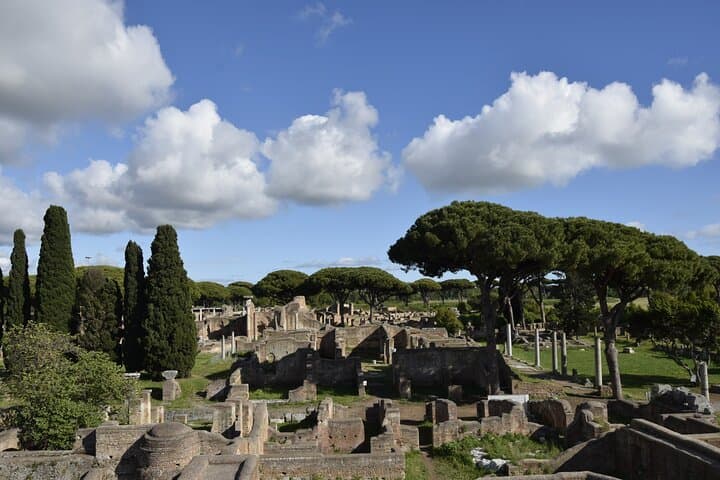


You step off a short commuter train and into the thin, salty air that still remembers the Tiber’s old course. Low stone streets open before you: mosaic thresholds, shop counters, and the dark mouths of storage rooms where grain and garum once kept Rome fed. The guide folds a map, points down the central cardo, and the town begins to move again—not a museum but a lived-in grid of public baths, taverns and warehouses.
You step off a short commuter train and into the thin, salty air that still remembers the Tiber’s old course. Low stone streets open before you: mosaic thresholds, shop counters, and the dark mouths of storage rooms where grain and garum once kept Rome fed. The guide folds a map, points down the central cardo, and the town begins to move again—not a museum but a lived-in grid of public baths, taverns and warehouses.
Founded around 335 B.C., Ostia Antica was Rome’s principal port before the river shifted course and the silted mud helped preserve whole neighborhoods. Geologically, the area sits on alluvial deposits of the Tiber and Tyrrhenian coastline—soft ground that buried wooden and masonry structures and kept frescoes and mosaics intact.
Culturally, Ostia reveals daily Roman life: the Thermopolium counters where fast food was sold, the House of Diana’s mythic frescoes, and long rows of horrea (warehouses) that handled grain and trade. Local insights include the military barracks, the theater, and the surprisingly modern feel of the marketplace.
Practical guidance: the 4-hour private tour typically includes train fare from Rome (Piramide), return ticket, entrance fee and a certified guide. Expect 1–2 miles of mostly level walking on packed earth and stone; wear supportive shoes and a sun hat. Mornings are cooler and less crowded; bring water and a light layer for coastal breezes. The site has uneven ground and limited shade in summer, so plan accordingly. Trains run frequently but check schedules and allow extra time for platform changes at Piramide.