THE ADVENTURE COLLECTIVE® · Independent discovery and booking for outdoor travel

Explore Bilbao’s Casco Viejo on a focused two-hour small-group walk—historic bridges, the Mercado de la Ribera, pintxo culture, and a local guide who connects the city’s industrial past to its modern food scene. Perfect for travelers who want context and practical tips in a compact tour.
Explore Bilbao’s Casco Viejo on a focused two-hour small-group walk—historic bridges, the Mercado de la Ribera, pintxo culture, and a local guide who connects the city’s industrial past to its modern food scene. Perfect for travelers who want context and practical tips in a compact tour.
The cobbles of Casco Viejo click underfoot as the Nervión slips past—its current a gray ribbon that once carried ships into Bilbao's industrial heart and now dares you to cross its oldest bridges to discover the city's compact medieval core.
Verified experiences and guided adventures in the surrounding area.
Operated by BilboTour · Bilbao, Biscay (Bizkaia)
The cobbles of Casco Viejo click underfoot as the Nervión slips past—its current a gray ribbon that once carried ships into Bilbao's industrial heart and now dares you to cross its oldest bridges to discover the city's compact medieval core.
On this two-hour small-group walk a local guide threads history and contemporary life: Roman-era foundations give way to 14th-century lanes, the Baroque flank of the Church of Santiago, and the stone ribs of the Puente de San Antón, Bilbao’s oldest crossing. Geology here is quiet but present—the estuary carved by glacial melt and human industry frames the town, while river silt and reclaimed docks tell a story of reinvention.
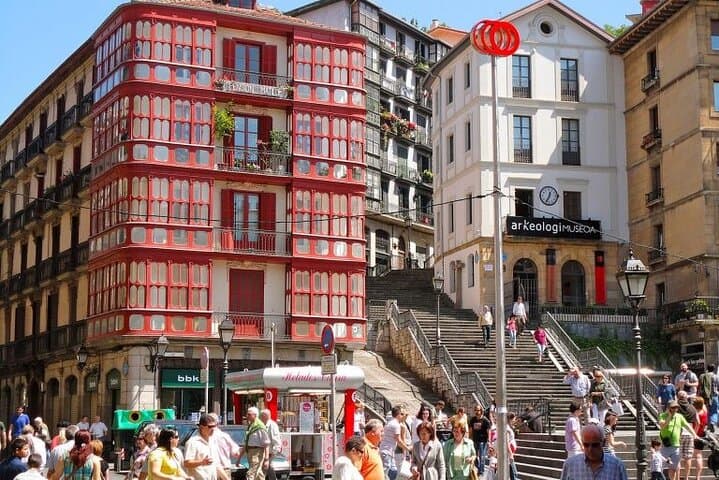
Culture is on every corner: pintxo bars at Plaza Nueva, the Mercado de la Ribera's stacked stalls of fish and produce, and the theatrical façade of Teatro Arriaga recalling Bilbao’s 19th-century civic ambitions. Your guide will unpack Basque culinary customs, local expressions, and how the city rebuilt itself after heavy industry.
Practical notes: the route is flat, mostly paved, and accessible, suitable for travelers of varied mobility. Mornings bring quieter streets and a livelier market; late afternoons offer glowing facades but more crowds. Wear sturdy shoes for uneven cobbles, carry a light layer against river breezes, and bring a small bottle of water—tasting stops may appear, but reservations for pintxo bars are helpful for larger groups.
This walk is efficient: two hours, local insight, and a concentrated introduction to Bilbao’s past and present—ideal for first-time visitors wanting texture, not a museum itinerary.
easy.
2 hours.
Suitable for most fitness levels; involves walking on paved and cobbled streets with short standing periods
Yes — the route is stroller-accessible and family-friendly, though some streets are narrow and can be busy during peak times.
No — the itinerary focuses on exteriors and public spaces; admissions to museums or paid sites are not included.
Groups are small, limited to around 10 people to keep the experience personal and mobile.
Tours are conducted by a local guide; confirm the language at booking, as English is commonly available but subject to availability.
Bilbao grew around its estuary from the 14th century; Casco Viejo is the medieval grid that housed merchants and shipworkers and later connected to the city’s industrial expansion.
Bilbao’s estuary underwent major cleanup and riverfront regeneration in recent decades; visitors are encouraged to support local businesses and minimize waste to help preserve public spaces.
BilboTour operates guided outdoor trips and adventures with an emphasis on safety, stewardship, and memorable experiences.
The cobbles of Casco Viejo click underfoot as the Nervión slips past—its current a gray ribbon that once carried ships into Bilbao's industrial heart and now dares you to cross its oldest bridges to discover the city's compact medieval core.
The cobbles of Casco Viejo click underfoot as the Nervión slips past—its current a gray ribbon that once carried ships into Bilbao's industrial heart and now dares you to cross its oldest bridges to discover the city's compact medieval core.
On this two-hour small-group walk a local guide threads history and contemporary life: Roman-era foundations give way to 14th-century lanes, the Baroque flank of the Church of Santiago, and the stone ribs of the Puente de San Antón, Bilbao’s oldest crossing. Geology here is quiet but present—the estuary carved by glacial melt and human industry frames the town, while river silt and reclaimed docks tell a story of reinvention.
Culture is on every corner: pintxo bars at Plaza Nueva, the Mercado de la Ribera's stacked stalls of fish and produce, and the theatrical façade of Teatro Arriaga recalling Bilbao’s 19th-century civic ambitions. Your guide will unpack Basque culinary customs, local expressions, and how the city rebuilt itself after heavy industry.
Practical notes: the route is flat, mostly paved, and accessible, suitable for travelers of varied mobility. Mornings bring quieter streets and a livelier market; late afternoons offer glowing facades but more crowds. Wear sturdy shoes for uneven cobbles, carry a light layer against river breezes, and bring a small bottle of water—tasting stops may appear, but reservations for pintxo bars are helpful for larger groups.
This walk is efficient: two hours, local insight, and a concentrated introduction to Bilbao’s past and present—ideal for first-time visitors wanting texture, not a museum itinerary.