THE ADVENTURE COLLECTIVE® · Independent discovery and booking for outdoor travel

Explore Puglia by buggy on a two-hour loop between Alberobello and Polignano a Mare. See trulli, masserie, and neviere up close while driving unpaved ridges through limestone countryside.
Explore Puglia by buggy on a two-hour loop between Alberobello and Polignano a Mare. See trulli, masserie, and neviere up close while driving unpaved ridges through limestone countryside.
The engine's hum recedes into a landscape of low stone walls, whitewashed trulli cones, and the open patchwork of olive groves. On a two-hour buggy loop between Alberobello and the Adriatic, the countryside moves around you—dust lifting, dry stone farms watching like slow companions.
Verified experiences and guided adventures in the surrounding area.
Operated by Buggy ADVENTURE Puglia · Alberobello, Puglia
The engine's hum recedes into a landscape of low stone walls, whitewashed trulli cones, and the open patchwork of olive groves. On a two-hour buggy loop between Alberobello and the Adriatic, the countryside moves around you—dust lifting, dry stone farms watching like slow companions.
This part of Puglia is shaped by limestone karst: shallow soils over porous bedrock that produced the trulli — dry-stone huts built without mortar — and the broad, sun-scorched masserie, fortified farmhouses that grew from medieval estate agriculture. Neviere, the old ice houses, mark pockets where people stored winter snow for summer use, a quiet reminder of pre-refrigeration ingenuity.
Culturally, the route crosses working farmland: farmers pruning almond and olive trees, herders moving goats in spring. Geology and human craft meet in drystone techniques that read like local grammar, and the buggies let small groups cover terrain that would be slow on foot while still feeling close to the land.
Practically, expect unpaved tracks, short rises, and occasional ruts; the ride is suitable for novices but requires steady footing when entering and exiting the buggy. Wear closed shoes, sun protection, and a light layer for coastal breezes. Hydrate before you go and keep cameras secure—views open suddenly across valleys and limestone gullies.
The tour is family-friendly, rich in photo stops at trulli clusters and a visit to a neviere. Respect private masserie and stick to the guide’s route to protect fragile dry-stone walls and cultivated fields. In a buggy the landscape feels kinetic: the land nudges and tells its own slow story, and the machine simply helps you listen.
easy.
2 hours.
Basic mobility recommended; no special fitness required but be able to climb in/out of a low buggy.
The standard tour runs about two hours with several short photo and explanation stops.
No—the tour is guided and designed for all levels; drivers receive basic instructions before departure.
Yes—families are welcome; infants typically must sit on a lap and operators set child-safety rules.
Operators monitor conditions and may alter or cancel routes if tracks become unsafe; check the cancellation policy for refunds.
Trulli are regional dry-stone dwellings that reflect centuries of local building technique; masserie evolved as fortified farming estates through the medieval and early modern periods.
Stick to designated tracks and avoid touching drystone structures; limiting off-route driving and litter preserves fragile soils and agricultural heritage.
Buggy ADVENTURE Puglia operates guided outdoor trips and adventures with an emphasis on safety, stewardship, and memorable experiences.

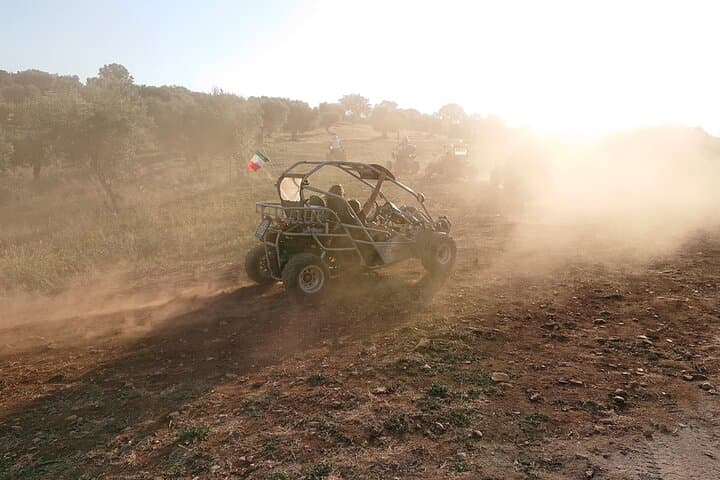
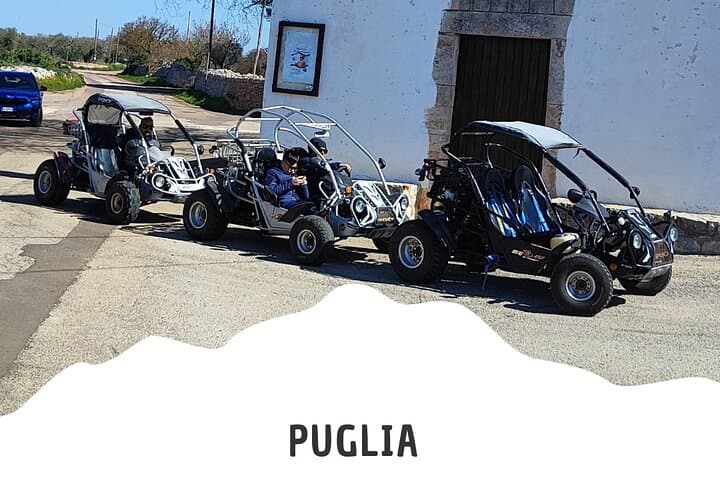
The engine's hum recedes into a landscape of low stone walls, whitewashed trulli cones, and the open patchwork of olive groves. On a two-hour buggy loop between Alberobello and the Adriatic, the countryside moves around you—dust lifting, dry stone farms watching like slow companions.
The engine's hum recedes into a landscape of low stone walls, whitewashed trulli cones, and the open patchwork of olive groves. On a two-hour buggy loop between Alberobello and the Adriatic, the countryside moves around you—dust lifting, dry stone farms watching like slow companions.
This part of Puglia is shaped by limestone karst: shallow soils over porous bedrock that produced the trulli — dry-stone huts built without mortar — and the broad, sun-scorched masserie, fortified farmhouses that grew from medieval estate agriculture. Neviere, the old ice houses, mark pockets where people stored winter snow for summer use, a quiet reminder of pre-refrigeration ingenuity.
Culturally, the route crosses working farmland: farmers pruning almond and olive trees, herders moving goats in spring. Geology and human craft meet in drystone techniques that read like local grammar, and the buggies let small groups cover terrain that would be slow on foot while still feeling close to the land.
Practically, expect unpaved tracks, short rises, and occasional ruts; the ride is suitable for novices but requires steady footing when entering and exiting the buggy. Wear closed shoes, sun protection, and a light layer for coastal breezes. Hydrate before you go and keep cameras secure—views open suddenly across valleys and limestone gullies.
The tour is family-friendly, rich in photo stops at trulli clusters and a visit to a neviere. Respect private masserie and stick to the guide’s route to protect fragile dry-stone walls and cultivated fields. In a buggy the landscape feels kinetic: the land nudges and tells its own slow story, and the machine simply helps you listen.