THE ADVENTURE COLLECTIVE® · Independent discovery and booking for outdoor travel

Trade the beach for brash coastal rock and salt flats on a 4‑hour, two‑seater UTV tour of Aruba’s north coast. Expect natural bridges, gold‑mill ruins, a cave pool dip and up‑close views of the island’s geology and street art.
Trade the beach for brash coastal rock and salt flats on a 4‑hour, two‑seater UTV tour of Aruba’s north coast. Expect natural bridges, gold‑mill ruins, a cave pool dip and up‑close views of the island’s geology and street art.
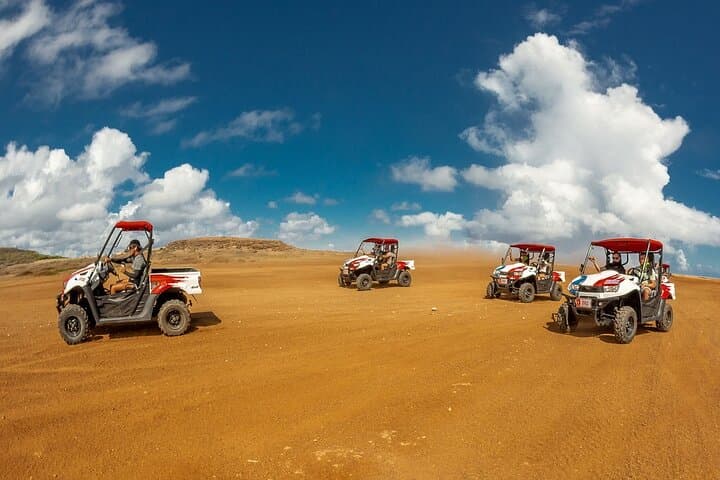
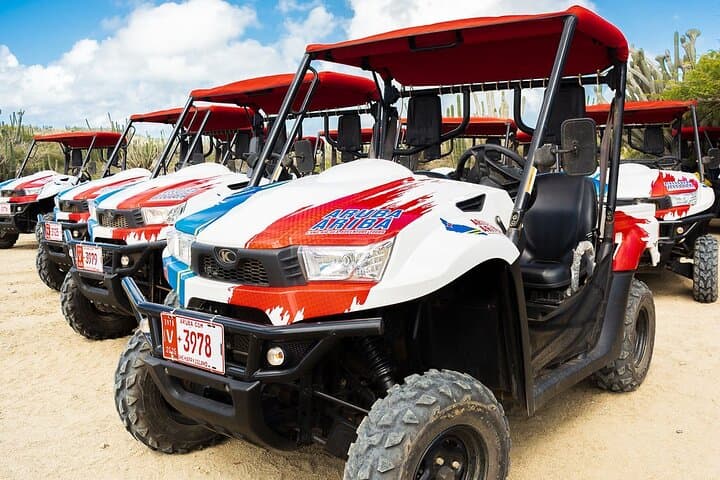
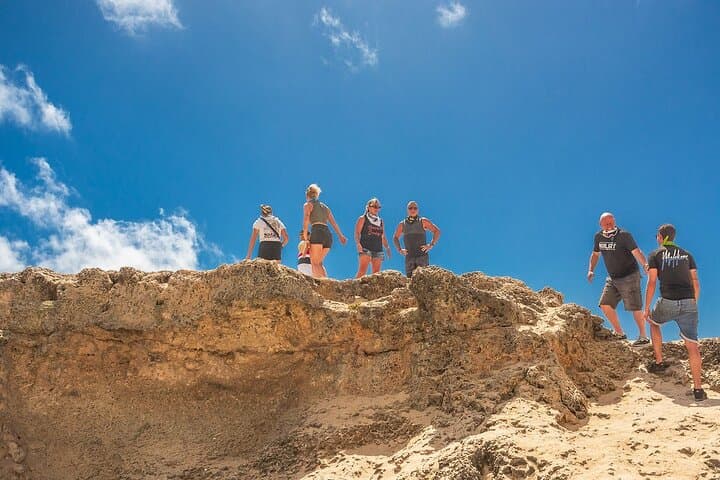
The engine growls, sand spits from the rear tires and the Atlantic air hits like a cold hand as the two‑seater UTV launches off the paved road. Within minutes you leave hotel blocks and manicured beaches behind for a landscape that behaves like two places at once — sunbaked desert flats give way to jagged limestone coast, and roads dissolve into tracks that the UTV eagerly eats. The guide checks your helmet, points toward a rocky rise and the small convoy threads a line of natural bridges, salt flats, and weathered outcrops carved by Atlantic wind.
Verified experiences and guided adventures in the surrounding area.
Operated by Aruba Ariba Tours · Oranjestad, Aruba
The engine growls, sand spits from the rear tires and the Atlantic air hits like a cold hand as the two‑seater UTV launches off the paved road. Within minutes you leave hotel blocks and manicured beaches behind for a landscape that behaves like two places at once — sunbaked desert flats give way to jagged limestone coast, and roads dissolve into tracks that the UTV eagerly eats. The guide checks your helmet, points toward a rocky rise and the small convoy threads a line of natural bridges, salt flats, and weathered outcrops carved by Atlantic wind.
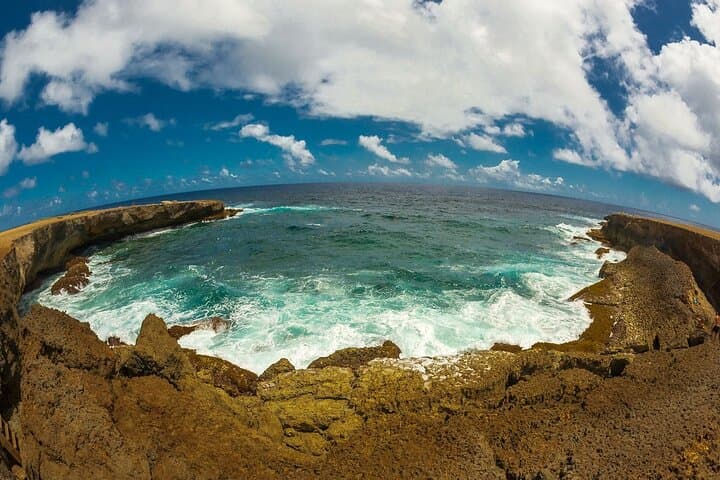
This four‑hour loop pulls in Aruba’s north coast highlights: the Chapel of Alto Vista perched on a low hill, the dramatic Baby Natural Bridge and 19th‑century Gold Mill ruins that recall an era of small‑scale mining and colonial trade. Geologically, Aruba is an uplifted limestone platform with pockets of volcanic rock along the north shore, which is why the coastline breaks into sculpted arches and tide‑cut pools. Culturally, the tour threads through neighborhoods where street art and local vendors offer quick windows into contemporary island life — a bright mural here, a vendor selling pastechi there — so the trip is equal parts terrain and texture.
The experience is as much about handling as scenery. Tracks vary from packed sand and salt flats to rock gardens that demand steady throttle and a passenger who braces. Guides are local and practical: they route you to hidden cave pools when the tides and light line up, and they point out divi‑divi trees that angle into the wind as visible wind gauges.
Practical side: expect roughly four hours behind the wheel, intermittent short hikes to viewpoints and pool edges, and minimal elevation change — Aruba’s rides are low and fast rather than alpine climbs. Bring sun protection, closed‑toe shoes, and a small dry bag for phone and camera. If you want photos, plan a stop at the Baby Bridge or the cave pool for cleaner light; the midday glare is brutal on reflective water. The tour is accessible to most people — no advanced off‑road license is required — but it does require attention, a firm grip, and the ability to climb in and out of a UTV several times.
Safety and stewardship are part of the ride. Guides enforce speed limits near fragile coastal formations and remind drivers not to leave tracks in sensitive scrub. That means you can push the machine in the right places and still leave the island the way you found it: windswept, weathered, and ready for the next rider.
moderate.
4 hours.
Suitable for most fitness levels; you should be able to climb in/out of a low UTV, brace through rough sections, and walk short distances to viewpoints.
Yes — drivers must present a valid driver’s license; passengers do not need one.
Children are allowed but age and height restrictions may apply for safety; check with the operator before booking.
Pick‑up is available from many hotels and the cruise port; confirm a specific pickup location during booking.
Yes — guides will indicate safe entry points at the cave pool, but conditions vary so follow their direction on when to swim.
Closed‑toe shoes, sunscreen, a hat and comfortable clothes that can handle dust and wind are recommended.
Tours may run in light rain; cancellation policies follow the supplier’s terms — cancel at least 24 hours for a full refund.
Stops like the Gold Mill Ruin recall 19th‑century small‑scale gold extraction that briefly shaped local settlements and coastal roads.
Operators emphasize staying on established tracks to protect fragile coastal scrub and avoid disturbing nesting seabirds, limiting group sizes to reduce impact.
Aruba Ariba Tours operates guided outdoor trips and adventures with an emphasis on safety, stewardship, and memorable experiences.
The engine growls, sand spits from the rear tires and the Atlantic air hits like a cold hand as the two‑seater UTV launches off the paved road. Within minutes you leave hotel blocks and manicured beaches behind for a landscape that behaves like two places at once — sunbaked desert flats give way to jagged limestone coast, and roads dissolve into tracks that the UTV eagerly eats. The guide checks your helmet, points toward a rocky rise and the small convoy threads a line of natural bridges, salt flats, and weathered outcrops carved by Atlantic wind.
The engine growls, sand spits from the rear tires and the Atlantic air hits like a cold hand as the two‑seater UTV launches off the paved road. Within minutes you leave hotel blocks and manicured beaches behind for a landscape that behaves like two places at once — sunbaked desert flats give way to jagged limestone coast, and roads dissolve into tracks that the UTV eagerly eats. The guide checks your helmet, points toward a rocky rise and the small convoy threads a line of natural bridges, salt flats, and weathered outcrops carved by Atlantic wind.
This four‑hour loop pulls in Aruba’s north coast highlights: the Chapel of Alto Vista perched on a low hill, the dramatic Baby Natural Bridge and 19th‑century Gold Mill ruins that recall an era of small‑scale mining and colonial trade. Geologically, Aruba is an uplifted limestone platform with pockets of volcanic rock along the north shore, which is why the coastline breaks into sculpted arches and tide‑cut pools. Culturally, the tour threads through neighborhoods where street art and local vendors offer quick windows into contemporary island life — a bright mural here, a vendor selling pastechi there — so the trip is equal parts terrain and texture.
The experience is as much about handling as scenery. Tracks vary from packed sand and salt flats to rock gardens that demand steady throttle and a passenger who braces. Guides are local and practical: they route you to hidden cave pools when the tides and light line up, and they point out divi‑divi trees that angle into the wind as visible wind gauges.
Practical side: expect roughly four hours behind the wheel, intermittent short hikes to viewpoints and pool edges, and minimal elevation change — Aruba’s rides are low and fast rather than alpine climbs. Bring sun protection, closed‑toe shoes, and a small dry bag for phone and camera. If you want photos, plan a stop at the Baby Bridge or the cave pool for cleaner light; the midday glare is brutal on reflective water. The tour is accessible to most people — no advanced off‑road license is required — but it does require attention, a firm grip, and the ability to climb in and out of a UTV several times.
Safety and stewardship are part of the ride. Guides enforce speed limits near fragile coastal formations and remind drivers not to leave tracks in sensitive scrub. That means you can push the machine in the right places and still leave the island the way you found it: windswept, weathered, and ready for the next rider.