THE ADVENTURE COLLECTIVE® · Independent discovery and booking for outdoor travel

Spend a long day driving through tea country to Nyungwe’s famous canopy walkway—an elevated bridge system through one of East Africa’s oldest montane rainforests. This private, one-day tour pairs rainforest hiking with bird and primate viewing and a stop at Kitabi Eco Lodge for lunch.
Spend a long day driving through tea country to Nyungwe’s famous canopy walkway—an elevated bridge system through one of East Africa’s oldest montane rainforests. This private, one-day tour pairs rainforest hiking with bird and primate viewing and a stop at Kitabi Eco Lodge for lunch.
Dawn settles on the high ridges above Nyungwe and the road out of Kigali unspools through tea terraces and green hills. By the time the van reaches Uwinka the forest is already breathing—mist sloughing from massive trunks, vines tugging at the understory. The canopy walkway hangs like a narrow passage through that breathing roof: a series of suspension bridges and platforms that let you move among giants and look down into a rainforest older than the Ice Age.
Verified experiences and guided adventures in the surrounding area.
Operated by Sahihi Africa Tours · Uwinka (Nyungwe National Park), Southern Province
Dawn settles on the high ridges above Nyungwe and the road out of Kigali unspools through tea terraces and green hills. By the time the van reaches Uwinka the forest is already breathing—mist sloughing from massive trunks, vines tugging at the understory. The canopy walkway hangs like a narrow passage through that breathing roof: a series of suspension bridges and platforms that let you move among giants and look down into a rainforest older than the Ice Age.
Nyungwe National Park covers roughly 1,016 km² of montane rainforest and supports some 1,025 plant species, more than 500 orchids and 13 primate species—from habituated chimpanzees to Black-and-White Colobus, mangabeys and blue monkeys. Geologically the park sits on ancient volcanic slopes; trails climb damp gullies, cross shallow ridgelines and expose volcanic soils that feed the thick, humid canopy.
Culturally, surrounding communities practice smallholder tea farming and maintain lodges like Kitabi, where lunch is often taken en route. The one-day private option typically involves a 4–5 hour drive from Kigali, a 1–2 hour canopy walk with hiking and bridge crossings, and the return trip.
Practically: expect uneven, sometimes slippery trails and short, steep pitches; bring a rain shell, stout footwear and water. The bridge experience is brief but vertiginous—those with spinal or serious cardiovascular issues should avoid it. Timing matters: mornings bring clearer views and more primate activity, afternoons can cloud over quickly. The route is straightforward for anyone with moderate fitness, rewarding hikers with treetop panoramas, close primate encounters and an intimate look at one of East Africa’s last large mountain rainforests.
moderate.
10–12 hours.
Suitable for travelers with moderate fitness: short steep sections and uneven terrain require steady footing and basic stamina.
The canopy section and associated hiking generally take 1–2 hours, depending on pace and wildlife stops.
Yes—Nyungwe hosts chimpanzees, colobus monkeys, mangabeys and blue monkeys; the canopy walk offers excellent views of arboreal species, though chimp tracking requires separate permits and treks.
Yes—the tour typically includes pickup from Kigali; expect a 4–5 hour drive to Uwinka each way with scenic stopovers.
This activity is not recommended for guests with serious back, heart or pregnancy-related conditions due to uneven terrain and the bridge experience.
Nyungwe is an ancient montane forest whose continuity predates the last ice age; it has long been a resource landscape for local Rwandan communities and a focus for conservation since the 20th century.
Visitor traffic is managed to limit impact; stick to trails, avoid feeding wildlife and support local guides and lodges that contribute to community-based conservation.
Sahihi Africa Tours operates guided outdoor trips and adventures with an emphasis on safety, stewardship, and memorable experiences.
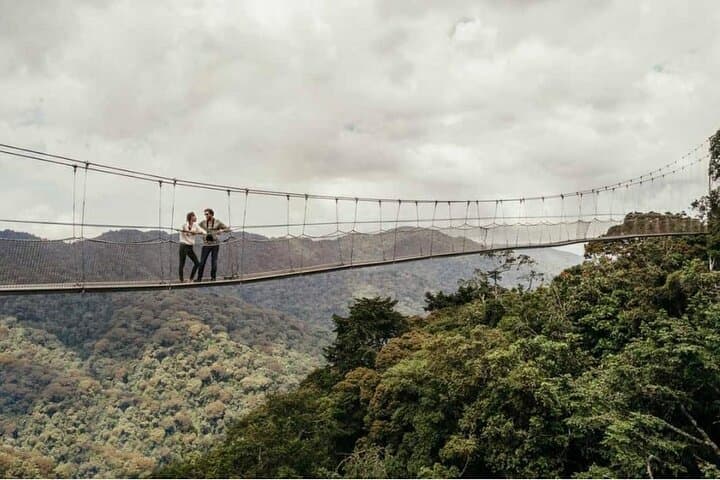
Dawn settles on the high ridges above Nyungwe and the road out of Kigali unspools through tea terraces and green hills. By the time the van reaches Uwinka the forest is already breathing—mist sloughing from massive trunks, vines tugging at the understory. The canopy walkway hangs like a narrow passage through that breathing roof: a series of suspension bridges and platforms that let you move among giants and look down into a rainforest older than the Ice Age.
Dawn settles on the high ridges above Nyungwe and the road out of Kigali unspools through tea terraces and green hills. By the time the van reaches Uwinka the forest is already breathing—mist sloughing from massive trunks, vines tugging at the understory. The canopy walkway hangs like a narrow passage through that breathing roof: a series of suspension bridges and platforms that let you move among giants and look down into a rainforest older than the Ice Age.
Nyungwe National Park covers roughly 1,016 km² of montane rainforest and supports some 1,025 plant species, more than 500 orchids and 13 primate species—from habituated chimpanzees to Black-and-White Colobus, mangabeys and blue monkeys. Geologically the park sits on ancient volcanic slopes; trails climb damp gullies, cross shallow ridgelines and expose volcanic soils that feed the thick, humid canopy.
Culturally, surrounding communities practice smallholder tea farming and maintain lodges like Kitabi, where lunch is often taken en route. The one-day private option typically involves a 4–5 hour drive from Kigali, a 1–2 hour canopy walk with hiking and bridge crossings, and the return trip.
Practically: expect uneven, sometimes slippery trails and short, steep pitches; bring a rain shell, stout footwear and water. The bridge experience is brief but vertiginous—those with spinal or serious cardiovascular issues should avoid it. Timing matters: mornings bring clearer views and more primate activity, afternoons can cloud over quickly. The route is straightforward for anyone with moderate fitness, rewarding hikers with treetop panoramas, close primate encounters and an intimate look at one of East Africa’s last large mountain rainforests.