THE ADVENTURE COLLECTIVE® · Independent discovery and booking for outdoor travel

A one-day loop from Hanoi that pairs Vietnam’s largest pagoda with a UNESCO-listed boat trip and a panoramic climb. Expect temple architecture, karst caves navigated by sampan, and a stair climb for sweeping views of Tam Coc.
A one-day loop from Hanoi that pairs Vietnam’s largest pagoda with a UNESCO-listed boat trip and a panoramic climb. Expect temple architecture, karst caves navigated by sampan, and a stair climb for sweeping views of Tam Coc.
You step off the minivan onto warm, flattened earth and the limestone karsts rise like slow-moving waves, each cliff face a patient shape in the rice fields. The commute from Hanoi gives way to soft green paddies, the smell of wet soil and incense from the gates of Bai Dinh Pagoda.
Verified experiences and guided adventures in the surrounding area.
Operated by Authentic NINH BINH · Ninh Binh, Ninh Binh Province
You step off the minivan onto warm, flattened earth and the limestone karsts rise like slow-moving waves, each cliff face a patient shape in the rice fields. The commute from Hanoi gives way to soft green paddies, the smell of wet soil and incense from the gates of Bai Dinh Pagoda.
Bai Dinh is Vietnam’s largest pagoda complex — a modern, monumental expression of Buddhist practice with rows of La Han statues and a ten-meter bronze Buddha that anchors the courtyard. The region’s geology is older than the temples: karst limestone, hollowed by water, created the caves and the sinuous waterways you’ll float through at Trang An, a UNESCO-listed landscape where boatmen guide narrow sampans through dark caverns and open canals.
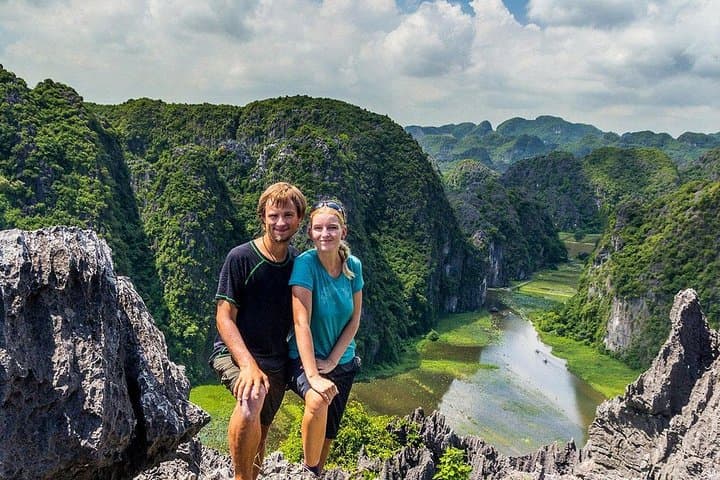
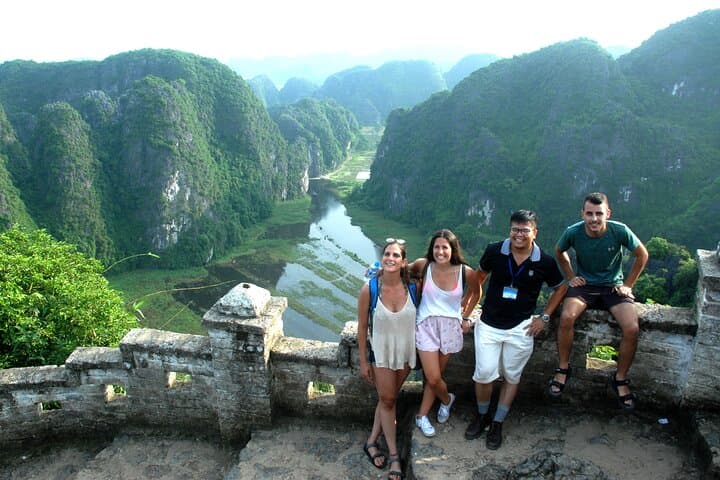
Lunch is local rice and grilled fish; the flavors are straightforward, built from the delta’s ingredients. A short drive and a climb follow at Mua Cave (Dancing Cave): nearly 500 stone steps that push you up a ridge to an expansive viewpoint over Tam Coc’s ribbon-like river and patchwork fields. Below, water dares the land to change course; above, wind moves quietly through the grass.
Expect a full, active day: temple walks, a 2.5-hour guided boat trip through multiple caves, and a stair climb requiring steady legs. Bring sun protection, a light rain layer, and water; wear shoes with good traction for steps and uneven paths. Aim for early departures to avoid crowds at Bai Dinh and late-afternoon light at Mua Cave. The route is practical, scenic, and paced for small groups — an efficient way to read Ninh Binh’s landscape in a single day.
moderate.
10–12 hours.
Moderate fitness: able to walk, stand, and climb ~500 steps; comfortable with multi-hour days.
Expect roughly 2–2.5 hours each way from Hanoi Old Quarter, depending on traffic and stops.
Yes — boatmen or guides pilot 2.5-hour sampan routes through Trang An’s caves; life jackets are typically available.
Mua Cave involves nearly 500 carved steps to the viewpoint, which makes it unsuitable for travelers with limited mobility; Bai Dinh has electric cart access to the main gate.
Most standard tours include transport, entrance fees, a 2.5-hour boat trip, lunch, bottled water, and an English-speaking guide; check the operator for private-transfer options.
The area served as an early center of Vietnamese polity (Hoa Lu Ancient Capital nearby) and shows layers of ritual practice alongside natural karst formations.
Trang An is a protected landscape; follow guides, avoid littering, and minimize plastic use—local tourism aims to balance visitation with habitat protection.
Authentic NINH BINH operates guided outdoor trips and adventures with an emphasis on safety, stewardship, and memorable experiences.


You step off the minivan onto warm, flattened earth and the limestone karsts rise like slow-moving waves, each cliff face a patient shape in the rice fields. The commute from Hanoi gives way to soft green paddies, the smell of wet soil and incense from the gates of Bai Dinh Pagoda.
You step off the minivan onto warm, flattened earth and the limestone karsts rise like slow-moving waves, each cliff face a patient shape in the rice fields. The commute from Hanoi gives way to soft green paddies, the smell of wet soil and incense from the gates of Bai Dinh Pagoda.
Bai Dinh is Vietnam’s largest pagoda complex — a modern, monumental expression of Buddhist practice with rows of La Han statues and a ten-meter bronze Buddha that anchors the courtyard. The region’s geology is older than the temples: karst limestone, hollowed by water, created the caves and the sinuous waterways you’ll float through at Trang An, a UNESCO-listed landscape where boatmen guide narrow sampans through dark caverns and open canals.
Lunch is local rice and grilled fish; the flavors are straightforward, built from the delta’s ingredients. A short drive and a climb follow at Mua Cave (Dancing Cave): nearly 500 stone steps that push you up a ridge to an expansive viewpoint over Tam Coc’s ribbon-like river and patchwork fields. Below, water dares the land to change course; above, wind moves quietly through the grass.
Expect a full, active day: temple walks, a 2.5-hour guided boat trip through multiple caves, and a stair climb requiring steady legs. Bring sun protection, a light rain layer, and water; wear shoes with good traction for steps and uneven paths. Aim for early departures to avoid crowds at Bai Dinh and late-afternoon light at Mua Cave. The route is practical, scenic, and paced for small groups — an efficient way to read Ninh Binh’s landscape in a single day.