THE ADVENTURE COLLECTIVE® · Independent discovery and booking for outdoor travel

Head out of Hanoi for a full-day loop through Ninh Binh’s limestone towers, a traditional sampan ride through Tam Coc’s grottoes, and a steep stair climb above Mua Cave for sweeping rice-valley views. This easily accessible day tour blends history, geology and rural life into a single active day trip.
Head out of Hanoi for a full-day loop through Ninh Binh’s limestone towers, a traditional sampan ride through Tam Coc’s grottoes, and a steep stair climb above Mua Cave for sweeping rice-valley views. This easily accessible day tour blends history, geology and rural life into a single active day trip.
The morning light thins as the limousine pulls out of Hanoi’s Old Quarter and the city noise slips away, replaced by roadside paddies and karst towers rising like irregular teeth. Two hours later the river narrows, and a local rower eases a slender sampan forward—rocking gently through three dark grottoes while limestone cliffs press close.
Verified experiences and guided adventures in the surrounding area.
Operated by Paradise Indochina Travel · Ninh Binh, Ninh Binh Province
The morning light thins as the limousine pulls out of Hanoi’s Old Quarter and the city noise slips away, replaced by roadside paddies and karst towers rising like irregular teeth. Two hours later the river narrows, and a local rower eases a slender sampan forward—rocking gently through three dark grottoes while limestone cliffs press close.
This single-day loop stitches together distinct threads of Ninh Binh: Hoa Lu’s 10th-century citadel and shrines to the Dinh and Le dynasties; Tam Coc’s inland bay of collapsed karst and slow water; and the forged stairway at Mua Cave that scales Ngoa Long (Lying Dragon) for a panorama of patchwork rice fields and the winding Ngo Dong River. Geologically the region is classic tropical karst—soluble limestone sculpted into caves, cliffs and blind valleys—where agriculture and ecosystem depend on seasonal water.
Culturally, villages along the route keep traditional rice farming and river transport alive; guides will point out goat pens, temple altars and rice-harvest patterns across seasons.
Practical notes: expect a 10–11 hour day with hotel pickup and drop-off in Hanoi, two hours each way, a sampan ride of roughly 45–60 minutes, and a steep 500-step climb at Mua. Bring sun protection, water, and a camera with a wide lens; wear grippy shoes for the stone stairs. The included buffet lunch showcases local goat dishes and rice specialties. If you’re prone to heat or limited mobility, skip the summit and enjoy the river views instead. With an English-speaking guide, this itinerary is best for travelers comfortable with a full day of walking, short rides and cultural stops.
moderate.
10–11 hours.
Moderate fitness—able to walk 1–3 miles across uneven ground, climb ~500 steps, and stand during a 45–60 minute boat ride.
The tour includes about a 2-hour drive each way in an air-conditioned vehicle, with a short rest stop en route.
Yes; the sampans are shallow, operated by experienced local rowers, and life jackets are available upon request—supervise young children closely.
Yes; the 30-minute village bike ride is optional, and guests with mobility issues can remain at ground level instead of climbing the 500 steps to the summit.
Yes; the buffet lunch and all entrance fees and boat trip fees are included in the tour price.
Hoa Lu served as Vietnam’s capital in the 10th and 11th centuries; its temples honor emperors of the Dinh and Le dynasties.
The karst and wetland systems are sensitive to tourism and seasonal farming—stay on paths, avoid littering, and use local guides to support sustainable practices.
Paradise Indochina Travel operates guided outdoor trips and adventures with an emphasis on safety, stewardship, and memorable experiences.



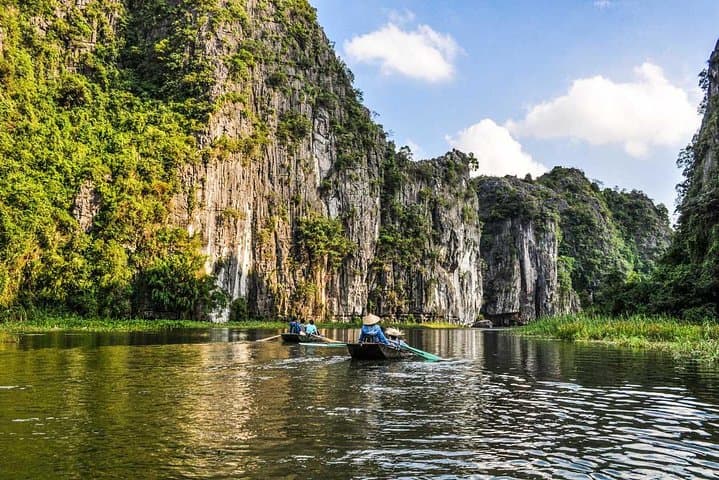
The morning light thins as the limousine pulls out of Hanoi’s Old Quarter and the city noise slips away, replaced by roadside paddies and karst towers rising like irregular teeth. Two hours later the river narrows, and a local rower eases a slender sampan forward—rocking gently through three dark grottoes while limestone cliffs press close.
The morning light thins as the limousine pulls out of Hanoi’s Old Quarter and the city noise slips away, replaced by roadside paddies and karst towers rising like irregular teeth. Two hours later the river narrows, and a local rower eases a slender sampan forward—rocking gently through three dark grottoes while limestone cliffs press close.
This single-day loop stitches together distinct threads of Ninh Binh: Hoa Lu’s 10th-century citadel and shrines to the Dinh and Le dynasties; Tam Coc’s inland bay of collapsed karst and slow water; and the forged stairway at Mua Cave that scales Ngoa Long (Lying Dragon) for a panorama of patchwork rice fields and the winding Ngo Dong River. Geologically the region is classic tropical karst—soluble limestone sculpted into caves, cliffs and blind valleys—where agriculture and ecosystem depend on seasonal water.
Culturally, villages along the route keep traditional rice farming and river transport alive; guides will point out goat pens, temple altars and rice-harvest patterns across seasons.
Practical notes: expect a 10–11 hour day with hotel pickup and drop-off in Hanoi, two hours each way, a sampan ride of roughly 45–60 minutes, and a steep 500-step climb at Mua. Bring sun protection, water, and a camera with a wide lens; wear grippy shoes for the stone stairs. The included buffet lunch showcases local goat dishes and rice specialties. If you’re prone to heat or limited mobility, skip the summit and enjoy the river views instead. With an English-speaking guide, this itinerary is best for travelers comfortable with a full day of walking, short rides and cultural stops.