THE ADVENTURE COLLECTIVE® · Independent discovery and booking for outdoor travel

Play mini golf under ultraviolet light in central Budapest. Chromadepth 3D glasses turn painted walls into layered worlds — Aquarium, History of Hungary, and Space — for a lively 60–120 minute indoor experience.
Play mini golf under ultraviolet light in central Budapest. Chromadepth 3D glasses turn painted walls into layered worlds — Aquarium, History of Hungary, and Space — for a lively 60–120 minute indoor experience.
You step from the grey of a Budapest street into a low-lit room that hums with color; blacklight paints the walls, and distant neon reefs and planets peek between obstacles. Putting here feels theatrical: the Chromadepth 3D glasses lift flat paint into layered scenes, and each hole becomes a short, tactile story — an undersea swim, a sweep through Hungarian history, a brief spin past stars.
Verified experiences and guided adventures in the surrounding area.
You step from the grey of a Budapest street into a low-lit room that hums with color; blacklight paints the walls, and distant neon reefs and planets peek between obstacles. Putting here feels theatrical: the Chromadepth 3D glasses lift flat paint into layered scenes, and each hole becomes a short, tactile story — an undersea swim, a sweep through Hungarian history, a brief spin past stars.
The three themed worlds — Aquarium, History of Hungary, and Space — lean on bold visuals rather than historical interpretation, but they sit in a city where past and present collide. Budapest’s urban geology (the Danube cutting the city in two, the thermal springs under Buda) shaped its public life; venues like this are part of the city’s modern entertainment fabric that grew from post-socialist creativity and a thriving design scene.
Culturally it’s short, social, and visual: families, groups of friends, and tourists mix with locals looking for something different between museums and ruin bars. The setting in central Pest makes it an easy addition to an evening itinerary.
Practical guidance: book a slot for 60–120 minutes to avoid lines, expect low-light conditions (flash photography may be discouraged), and plan for standing and walking between holes. Glasses are typically provided; bring comfortable shoes, and leave large backpacks at your accommodation. Peak times are evenings and weekends — go early for a quieter game. This is low-impact fun that gives a playful, sensory take on mini golf rather than a traditional course challenge.
easy.
1–2 hours.
Minimal fitness required — mostly standing and short walks between holes.
Allow 60–120 minutes for a single visit; groups and inexperienced players should budget toward the higher end.
Most venues provide Chromadepth 3D glasses per player and sanitize them between sessions — confirm on booking if you need extras.
Yes — the attraction is family-friendly, but very young children may need help with some obstacles and should be supervised.
Yes, but avoid using flash: it washes out the blacklight effects and may be discouraged by staff.
The attraction sits in a city shaped by the Danube and layered history — Ottoman, Habsburg, and modern Hungarian eras — and reflects Budapest’s recent boom in creative leisure venues.
Indoor attractions can consume significant lighting energy; support venues that practice glass sanitization and reduced single-use plastics, and follow venue guidance on recycling and care of provided gear.
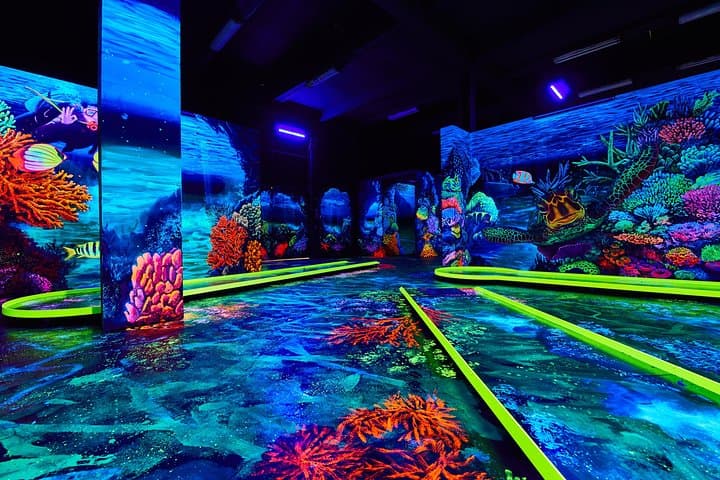
You step from the grey of a Budapest street into a low-lit room that hums with color; blacklight paints the walls, and distant neon reefs and planets peek between obstacles. Putting here feels theatrical: the Chromadepth 3D glasses lift flat paint into layered scenes, and each hole becomes a short, tactile story — an undersea swim, a sweep through Hungarian history, a brief spin past stars.
You step from the grey of a Budapest street into a low-lit room that hums with color; blacklight paints the walls, and distant neon reefs and planets peek between obstacles. Putting here feels theatrical: the Chromadepth 3D glasses lift flat paint into layered scenes, and each hole becomes a short, tactile story — an undersea swim, a sweep through Hungarian history, a brief spin past stars.
The three themed worlds — Aquarium, History of Hungary, and Space — lean on bold visuals rather than historical interpretation, but they sit in a city where past and present collide. Budapest’s urban geology (the Danube cutting the city in two, the thermal springs under Buda) shaped its public life; venues like this are part of the city’s modern entertainment fabric that grew from post-socialist creativity and a thriving design scene.
Culturally it’s short, social, and visual: families, groups of friends, and tourists mix with locals looking for something different between museums and ruin bars. The setting in central Pest makes it an easy addition to an evening itinerary.
Practical guidance: book a slot for 60–120 minutes to avoid lines, expect low-light conditions (flash photography may be discouraged), and plan for standing and walking between holes. Glasses are typically provided; bring comfortable shoes, and leave large backpacks at your accommodation. Peak times are evenings and weekends — go early for a quieter game. This is low-impact fun that gives a playful, sensory take on mini golf rather than a traditional course challenge.