THE ADVENTURE COLLECTIVE® · Independent discovery and booking for outdoor travel

Explore Nairobi on foot with a local guide for a five-hour run through archives, the KICC rooftop and the Railway Museum. This guided walk pairs historical context with practical city navigation—ideal for first-time visitors who want an efficient city primer.
Explore Nairobi on foot with a local guide for a five-hour run through archives, the KICC rooftop and the Railway Museum. This guided walk pairs historical context with practical city navigation—ideal for first-time visitors who want an efficient city primer.
Morning in downtown Nairobi begins with the city waking up around Kimathi Street: vendors arranging fruit, matatu drivers warming engines and a guide waiting by the Kimathi statue to lead you into the urban maze.
Verified experiences and guided adventures in the surrounding area.
Operated by Maasai mara safaris tours and travel · Nairobi, Nairobi County
Morning in downtown Nairobi begins with the city waking up around Kimathi Street: vendors arranging fruit, matatu drivers warming engines and a guide waiting by the Kimathi statue to lead you into the urban maze.
The five-hour walk threads through government squares, parks and colonial-era architecture—Kenya National Archives offers a look at independence paperwork while the Kenyatta International Convention Centre lifts you above the skyline for a 360° view of the city and distant Ngong Hills.
Nairobi's streets are younger than the landscapes that surround it: founded as a railway depot in the late 19th century, the city grew alongside the Uganda Railway, which the Nairobi Railway Museum preserves in rusted steam and diesel stock. Geologically the region sits on the East African Rift’s periphery—hills and ridges visible to the west are remnants of rift-related uplift.
Culturally the tour moves between government plazas where public life and protest mix, to Uhuru Park where Nairobians gather for recreation and politics. Local guides narrate stories of urban growth, the railway’s role in commerce, and how markets shaped neighborhoods.
Practical guidance: wear sturdy walking shoes and bring sun protection; Nairobi’s altitude (about 1,795 m) makes the sun strong but temperatures moderate. Expect paved streets, occasional dust, and crowded sidewalks—keep valuables secure and pace yourself with water breaks. The route includes short stops at archives, KICC rooftop and the Railway Museum; some sites may require timed entry.
A guided walking tour is the most direct way to decode Nairobi’s layered history while moving at a manageable city pace.
easy.
4–5 hours.
Suitable for most fitness levels; requires steady walking on paved city streets for several hours.
The tour starts on Kimathi Street in front of the Kimathi statue beside the Hilton Hotel; arrive 10 minutes early to meet your guide.
Yes—it's rated easy and suitable for most ages, but participants should be able to walk for several hours with short breaks.
The itinerary notes admission is included for listed stops, but check with the operator if special exhibitions require separate tickets.
Standard cancellation policy applies; minor rain usually means the tour continues with umbrellas or a shorter outdoor portion—confirm with the operator if conditions are severe.
Nairobi grew from a late-19th-century railway depot into Kenya’s capital; many central civic buildings date to the colonial and early-independence eras.
Urban green spaces like Uhuru Park are community-managed and face pressure from development; visitors should avoid littering and support local conservation initiatives.
Maasai mara safaris tours and travel operates guided outdoor trips and adventures with an emphasis on safety, stewardship, and memorable experiences.

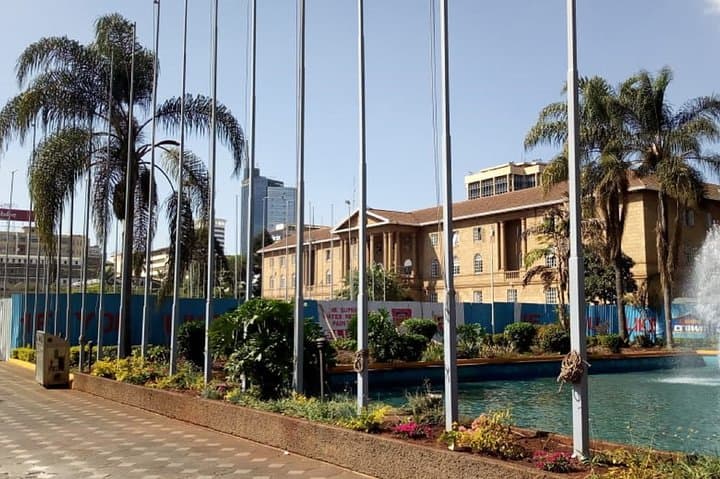


Morning in downtown Nairobi begins with the city waking up around Kimathi Street: vendors arranging fruit, matatu drivers warming engines and a guide waiting by the Kimathi statue to lead you into the urban maze.
Morning in downtown Nairobi begins with the city waking up around Kimathi Street: vendors arranging fruit, matatu drivers warming engines and a guide waiting by the Kimathi statue to lead you into the urban maze.
The five-hour walk threads through government squares, parks and colonial-era architecture—Kenya National Archives offers a look at independence paperwork while the Kenyatta International Convention Centre lifts you above the skyline for a 360° view of the city and distant Ngong Hills.
Nairobi's streets are younger than the landscapes that surround it: founded as a railway depot in the late 19th century, the city grew alongside the Uganda Railway, which the Nairobi Railway Museum preserves in rusted steam and diesel stock. Geologically the region sits on the East African Rift’s periphery—hills and ridges visible to the west are remnants of rift-related uplift.
Culturally the tour moves between government plazas where public life and protest mix, to Uhuru Park where Nairobians gather for recreation and politics. Local guides narrate stories of urban growth, the railway’s role in commerce, and how markets shaped neighborhoods.
Practical guidance: wear sturdy walking shoes and bring sun protection; Nairobi’s altitude (about 1,795 m) makes the sun strong but temperatures moderate. Expect paved streets, occasional dust, and crowded sidewalks—keep valuables secure and pace yourself with water breaks. The route includes short stops at archives, KICC rooftop and the Railway Museum; some sites may require timed entry.
A guided walking tour is the most direct way to decode Nairobi’s layered history while moving at a manageable city pace.