THE ADVENTURE COLLECTIVE® · Independent discovery and booking for outdoor travel

A concise, guided introduction to Nairobi that pairs rooftop panoramas with museum history and a local market stop. Small groups and a steady pace make this an accessible urban adventure for first-time visitors.
A concise, guided introduction to Nairobi that pairs rooftop panoramas with museum history and a local market stop. Small groups and a steady pace make this an accessible urban adventure for first-time visitors.
You step out of the vehicle onto a rooftop terrace and the city opens: concrete streets threaded with jacaranda shadows, a cool wind pushing across the skyline and the distant silhouette of the Ngong Hills. The guide points out neighborhoods, the railway line that once stitched Nairobi to the coast, and the neat square where matatus queue — the city talks in motion.
Verified experiences and guided adventures in the surrounding area.
Operated by offroad unbounded excursions · Nairobi, Nairobi County
You step out of the vehicle onto a rooftop terrace and the city opens: concrete streets threaded with jacaranda shadows, a cool wind pushing across the skyline and the distant silhouette of the Ngong Hills. The guide points out neighborhoods, the railway line that once stitched Nairobi to the coast, and the neat square where matatus queue — the city talks in motion.
This three-and-a-half hour tour threads history and everyday life. At the National Museum you’ll find exhibits on human origins and Kenya’s pre‑colonial and colonial transitions; geology fans will notice how the city sits at roughly 1,795 m on the eastern rim of the Rift Valley, a landscape shaped by uplift and volcanic activity. The drive past informal settlements is observational — a window into urban pressures and resilient communities — followed by a stop at a bustling market where local fabrics, farm produce and household goods are traded with practiced speed.
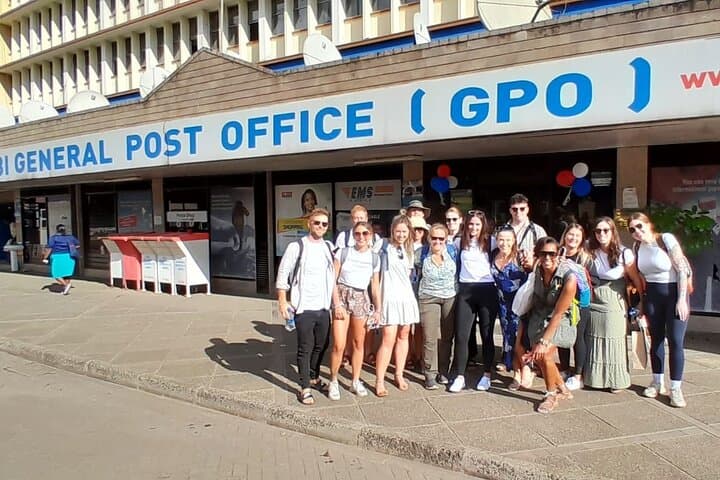
Expect practical city rhythms: traffic pulses at peak hours, cameras attract smiles and questions, and photography in vulnerable neighborhoods should be discreet and consensual. The tour includes bottled water and access to a high rooftop for panoramic photos; groups are small (max 7), so the pace is steady and accessible to most.
Plan for light urban walking, bring sun protection and a small amount of cash for market purchases, and schedule the tour in the morning to avoid late‑afternoon congestion. The experience blends city perspective with cultural context — a compact, grounded introduction to Nairobi’s streets, stories and skyline.
easy.
3–3.5 hours.
Light urban walking; suitable for most fitness levels but requires standing and short walks between stops.
The guided tour lasts about 3–3.5 hours and includes rooftop access, museum entry, bottled water and a market stop; transport between stops is provided.
The drive-through is observational only; guides frame the visit with context and respect for residents and do not stop inside unless organized with community consent.
There are restroom facilities at museum stops and rooftop venues; the tour is suitable for most mobility levels but may include stairs at some viewpoints — notify the operator for specific accessibility needs.
Guides typically speak English and Swahili; tipping is customary for good service — small cash tips are appreciated but not mandatory.
Nairobi grew rapidly after the late 19th‑century Uganda Railway made it a regional hub; colonial-era administration and post‑independence growth shaped its mixed urban fabric.
Urban expansion pressures local green spaces; support local vendors and avoid single‑use plastics to reduce environmental impact during visits.
offroad unbounded excursions operates guided outdoor trips and adventures with an emphasis on safety, stewardship, and memorable experiences.



You step out of the vehicle onto a rooftop terrace and the city opens: concrete streets threaded with jacaranda shadows, a cool wind pushing across the skyline and the distant silhouette of the Ngong Hills. The guide points out neighborhoods, the railway line that once stitched Nairobi to the coast, and the neat square where matatus queue — the city talks in motion.
You step out of the vehicle onto a rooftop terrace and the city opens: concrete streets threaded with jacaranda shadows, a cool wind pushing across the skyline and the distant silhouette of the Ngong Hills. The guide points out neighborhoods, the railway line that once stitched Nairobi to the coast, and the neat square where matatus queue — the city talks in motion.
This three-and-a-half hour tour threads history and everyday life. At the National Museum you’ll find exhibits on human origins and Kenya’s pre‑colonial and colonial transitions; geology fans will notice how the city sits at roughly 1,795 m on the eastern rim of the Rift Valley, a landscape shaped by uplift and volcanic activity. The drive past informal settlements is observational — a window into urban pressures and resilient communities — followed by a stop at a bustling market where local fabrics, farm produce and household goods are traded with practiced speed.
Expect practical city rhythms: traffic pulses at peak hours, cameras attract smiles and questions, and photography in vulnerable neighborhoods should be discreet and consensual. The tour includes bottled water and access to a high rooftop for panoramic photos; groups are small (max 7), so the pace is steady and accessible to most.
Plan for light urban walking, bring sun protection and a small amount of cash for market purchases, and schedule the tour in the morning to avoid late‑afternoon congestion. The experience blends city perspective with cultural context — a compact, grounded introduction to Nairobi’s streets, stories and skyline.