THE ADVENTURE COLLECTIVE® · Independent discovery and booking for outdoor travel

Explore Champa temples at My Son, climb the caverns of Marble Mountains and take in the sweeping coastal views from Son Tra’s Lady Buddha on a private full-day trip from Hoi An or Da Nang. Expect uneven steps, cultural sites, and artisan workshops.
Explore Champa temples at My Son, climb the caverns of Marble Mountains and take in the sweeping coastal views from Son Tra’s Lady Buddha on a private full-day trip from Hoi An or Da Nang. Expect uneven steps, cultural sites, and artisan workshops.
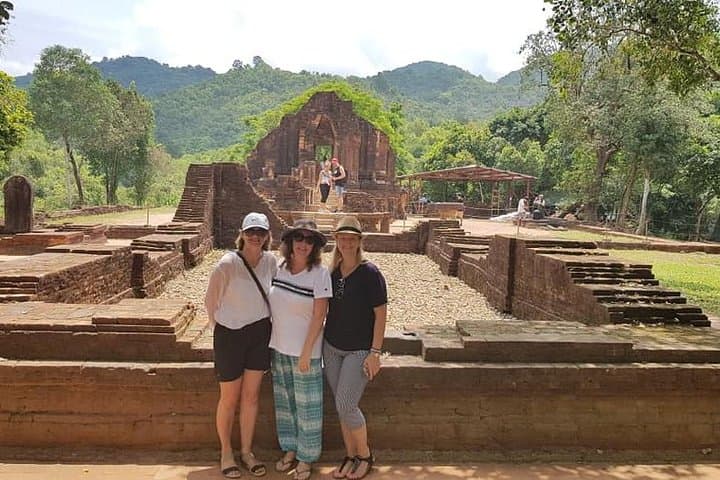
You step out of a minivan as humid air parts to reveal a low valley of crumbling red-brick towers — My Son’s ruined sanctuaries rising like relics of another map. A licensed guide walks you between carved lintels and collapsed sanctuaries, pointing to bas-reliefs and the weathered fingerprints of the Champa kings.
Verified experiences and guided adventures in the surrounding area.
Operated by Da Nang Hoi An Private Shore Excursion & Local Tours · Da Nang, Quảng Nam Province
You step out of a minivan as humid air parts to reveal a low valley of crumbling red-brick towers — My Son’s ruined sanctuaries rising like relics of another map. A licensed guide walks you between carved lintels and collapsed sanctuaries, pointing to bas-reliefs and the weathered fingerprints of the Champa kings.
The route moves from lowland temple ruins to the sharp karst of Marble Mountains, where five limestone-and-marble peaks named for the elements hold hidden caves, Buddhist pagodas and stone workshops. Marble’s stairways lift you into breezy outlooks; caves once used as field hospitals and shrines give the place a layered past. The day finishes on Son Tra (Monkey) Mountain, where the Lady Buddha statue keeps a silent watch over Da Nang’s bay and the trade winds push cool air down the slopes.
History here is tactile — My Son speaks to the Champa kingdom’s Hindu-influenced architecture from the 4th–13th centuries; Marble Mountains reveal both colonial-era quarrying and craftsmen who still carve local stone. Culture is present in pagoda protocol: modest dress and quiet respect. Geology alternates between red lateritic soil in the valley and limestone karst rising abruptly toward the sea.
Practical edge: plan for an 8-hour day, bring a hat, sturdy shoes for stairs and uneven cave floors, and cash for small handicraft purchases. Start early to beat mid-day heat and use sunscreen — both ruins and viewpoints offer minimal shade. If you have moderate fitness and a curiosity for history, this private loop gives concentrated exposure to Central Vietnam’s geology, religion and living craft traditions.
moderate.
6–8 hours.
Suitable for travelers with moderate fitness — comfortable walking on stairs and uneven ground for several hours.
The private day trip is about 8 hours and typically includes pickup from Hoi An or Da Nang, entrance tickets, lunch (local noodle), bottled water, a private vehicle and an English-speaking guide.
Yes, children can join but must be accompanied; the tour involves stairs and some walking — those with limited mobility should check specifics and consider shorter stops.
Pagodas require modest dress (shoulders and knees covered) and quiet behavior; guides will advise and some sites may provide wraps if needed.
Yes — the itinerary includes visits to marble-carving workshops and local vendors; bring cash for purchases and be prepared to negotiate politely.
My Son was the religious center of the Champa Kingdom (4th–13th centuries) and preserves Hindu-style tower-temples built without mortar; Marble Mountains are a mix of geological karst and centuries of stone craft.
Sites are managed for preservation; stay on marked paths, avoid touching fragile carvings, and support local conservation by using licensed guides and minimizing single-use plastics.
Da Nang Hoi An Private Shore Excursion & Local Tours operates guided outdoor trips and adventures with an emphasis on safety, stewardship, and memorable experiences.
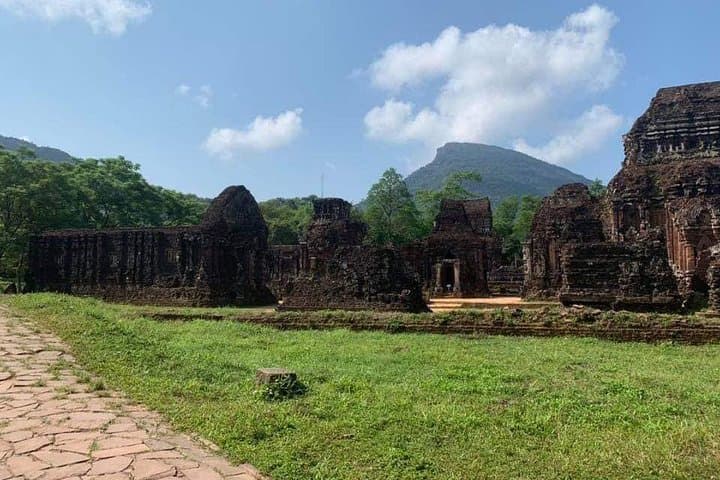
You step out of a minivan as humid air parts to reveal a low valley of crumbling red-brick towers — My Son’s ruined sanctuaries rising like relics of another map. A licensed guide walks you between carved lintels and collapsed sanctuaries, pointing to bas-reliefs and the weathered fingerprints of the Champa kings.
You step out of a minivan as humid air parts to reveal a low valley of crumbling red-brick towers — My Son’s ruined sanctuaries rising like relics of another map. A licensed guide walks you between carved lintels and collapsed sanctuaries, pointing to bas-reliefs and the weathered fingerprints of the Champa kings.
The route moves from lowland temple ruins to the sharp karst of Marble Mountains, where five limestone-and-marble peaks named for the elements hold hidden caves, Buddhist pagodas and stone workshops. Marble’s stairways lift you into breezy outlooks; caves once used as field hospitals and shrines give the place a layered past. The day finishes on Son Tra (Monkey) Mountain, where the Lady Buddha statue keeps a silent watch over Da Nang’s bay and the trade winds push cool air down the slopes.
History here is tactile — My Son speaks to the Champa kingdom’s Hindu-influenced architecture from the 4th–13th centuries; Marble Mountains reveal both colonial-era quarrying and craftsmen who still carve local stone. Culture is present in pagoda protocol: modest dress and quiet respect. Geology alternates between red lateritic soil in the valley and limestone karst rising abruptly toward the sea.
Practical edge: plan for an 8-hour day, bring a hat, sturdy shoes for stairs and uneven cave floors, and cash for small handicraft purchases. Start early to beat mid-day heat and use sunscreen — both ruins and viewpoints offer minimal shade. If you have moderate fitness and a curiosity for history, this private loop gives concentrated exposure to Central Vietnam’s geology, religion and living craft traditions.