THE ADVENTURE COLLECTIVE® · Independent discovery and booking for outdoor travel

Visit My Son at first light to see Champa temple-towers in near-silence, then swap ruins for the kitchen in Tra Que Village with an organic cooking class and herbal foot massage. This full-day cultural combination balances history, hands-on food, and rural farming traditions.
Visit My Son at first light to see Champa temple-towers in near-silence, then swap ruins for the kitchen in Tra Que Village with an organic cooking class and herbal foot massage. This full-day cultural combination balances history, hands-on food, and rural farming traditions.
Dawn breaks over a low green valley as your minivan climbs toward the ruined towers of My Son. Morning light slices through the jungle; stone silhouettes emerge—tower-temples decorated with bas-relief and the echo of centuries. The site is quiet before the crowds, and the guide’s voice threads history into the hush: temple complexes built by the Champa Kingdom between the 4th and 13th centuries, raised without mortar and carved with Hindu iconography.
Verified experiences and guided adventures in the surrounding area.
Operated by My Son Tours · Hoi An, Quang Nam
Dawn breaks over a low green valley as your minivan climbs toward the ruined towers of My Son. Morning light slices through the jungle; stone silhouettes emerge—tower-temples decorated with bas-relief and the echo of centuries. The site is quiet before the crowds, and the guide’s voice threads history into the hush: temple complexes built by the Champa Kingdom between the 4th and 13th centuries, raised without mortar and carved with Hindu iconography.
Geology and geography shape the visit: My Son sits in a fertile, river-fed basin whose sandstone and laterite blocks have weathered into the rounded forms you’ll trace with your eyes. Nearby Tra Que Village, three kilometers north of Hoi An, is a low, irrigated plain famous for aromatic herbs and organic vegetable beds fed by river weeds—small-scale farming that elevates local dishes like Cao Lau and Mi Quang.
After the temple tour and a local noodle stop, the day shifts tone to hands-on culture: a Tra Que cooking class where you learn to make rice pancakes, fried spring rolls, fish wrapped in banana leaves, and a mango salad, then eat what you’ve cooked. Expect a short herbal foot massage and an easy, tactile introduction to working the fields.
Practical guidance: start early to avoid heat and crowds, wear grippy walking shoes for uneven temple paths, bring sun protection and insect repellent, and carry cash for souvenirs. Respect the sacred ruins—no climbing on the towers—and allow extra time for photography; the valley rewards slow observation.
moderate.
8–10 hours (full day).
Good for travelers with moderate fitness: involves walking on uneven ground and light farm activities.
The program is a full-day experience typically beginning around 6:00 a.m. for the My Son visit, with Tra Que activities scheduled later the same day; expect 8–10 hours door-to-door.
Yes—entrance to My Son and private vehicle transfer from Hoi An/Da Nang are included, along with an English-speaking guide and cooking-class materials.
Yes—the menu can be adjusted for vegetarians; notify the operator when booking so ingredients and recipes can be adapted.
My Son and Tra Que involve uneven paths and steps; travelers should have moderate mobility. Wheelchair access is limited—contact the operator to discuss accommodations.
My Son is a UNESCO World Heritage site composed of Hindu-Buddhist temple towers built by the Champa Kingdom between the 4th and 13th centuries; the complex demonstrates regional trade and cultural links with India and Southeast Asia.
My Son is managed with restoration and visitor controls to protect fragile masonry; Tra Que promotes organic farming—visitors should avoid touching carvings and follow local guidance to minimize impact.
My Son Tours operates guided outdoor trips and adventures with an emphasis on safety, stewardship, and memorable experiences.


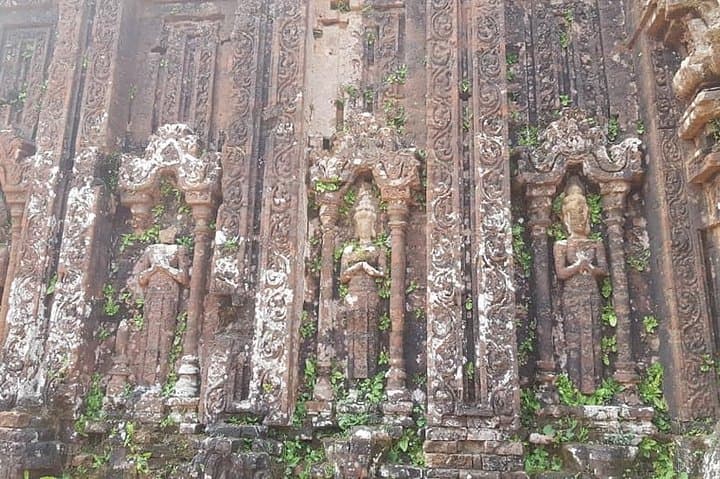
Dawn breaks over a low green valley as your minivan climbs toward the ruined towers of My Son. Morning light slices through the jungle; stone silhouettes emerge—tower-temples decorated with bas-relief and the echo of centuries. The site is quiet before the crowds, and the guide’s voice threads history into the hush: temple complexes built by the Champa Kingdom between the 4th and 13th centuries, raised without mortar and carved with Hindu iconography.
Dawn breaks over a low green valley as your minivan climbs toward the ruined towers of My Son. Morning light slices through the jungle; stone silhouettes emerge—tower-temples decorated with bas-relief and the echo of centuries. The site is quiet before the crowds, and the guide’s voice threads history into the hush: temple complexes built by the Champa Kingdom between the 4th and 13th centuries, raised without mortar and carved with Hindu iconography.
Geology and geography shape the visit: My Son sits in a fertile, river-fed basin whose sandstone and laterite blocks have weathered into the rounded forms you’ll trace with your eyes. Nearby Tra Que Village, three kilometers north of Hoi An, is a low, irrigated plain famous for aromatic herbs and organic vegetable beds fed by river weeds—small-scale farming that elevates local dishes like Cao Lau and Mi Quang.
After the temple tour and a local noodle stop, the day shifts tone to hands-on culture: a Tra Que cooking class where you learn to make rice pancakes, fried spring rolls, fish wrapped in banana leaves, and a mango salad, then eat what you’ve cooked. Expect a short herbal foot massage and an easy, tactile introduction to working the fields.
Practical guidance: start early to avoid heat and crowds, wear grippy walking shoes for uneven temple paths, bring sun protection and insect repellent, and carry cash for souvenirs. Respect the sacred ruins—no climbing on the towers—and allow extra time for photography; the valley rewards slow observation.