THE ADVENTURE COLLECTIVE® · Independent discovery and booking for outdoor travel

Walk Wilshire Boulevard from tar pits to movie treasures on a 90‑minute guided tour that pairs Ice Age fossils with automotive and cinematic history. Expect outdoor stops, accessible routes, and plenty of photo ops at LACMA, the Petersen, and the Academy Museum.
Walk Wilshire Boulevard from tar pits to movie treasures on a 90‑minute guided tour that pairs Ice Age fossils with automotive and cinematic history. Expect outdoor stops, accessible routes, and plenty of photo ops at LACMA, the Petersen, and the Academy Museum.
A low winter sun falls across cracked pavement and restored streetlamps as the group assembles by the La Brea Tar Pits sign — a cityscape where Ice Age bones meet chrome and celluloid.
Verified experiences and guided adventures in the surrounding area.
Operated by igniTours · Los Angeles, California
A low winter sun falls across cracked pavement and restored streetlamps as the group assembles by the La Brea Tar Pits sign — a cityscape where Ice Age bones meet chrome and celluloid.
The tour moves with brisk, urban cadence: first through the tar pits’ open-air excavation sites where natural asphalt pushed to the surface trapped mammoths and saber-toothed cats, preserving a geological record of Southern California’s Pleistocene past. From there it crosses to LACMA’s outer galleries; “Urban Light” stands like a field of antique sentries, inviting photographs and conversation about public art’s role in civic life.
Next, the Petersen Automotive Museum showcases transportation’s cultural weight — prototypes, race cars, and film-famous vehicles that trace design, engineering, and social change. The route finishes outside the Academy Museum, its Streamline Moderne facade and glass dome signaling Hollywood’s continuous reinvention.
Historically this stretch of Wilshire — the Miracle Mile — was planned in the 1920s to pull commerce westward, creating a dense corridor of museums and mid-century architecture. Geology meets culture here: tar seeps and fossil beds beneath asphalt roads, galleries and auto shows above.
Practical guidance: the walk is short (about 1–2 hours) and mostly flat on paved sidewalks. Bring comfortable shoes, sun protection, and a charged camera; mornings and late afternoons offer better light and smaller crowds. Public transit and metered parking are available; the route is wheelchair accessible. Expect an interpretive pace with frequent stops outdoors — ideal for curious visitors who want context as well as images.
easy.
1–2 hours.
Suitable for most fitness levels; involves short periods of standing and walking on flat pavement
No — this tour covers outdoor spaces and exterior exhibits; admission to indoor galleries is not included.
The tour is approximately 90 minutes, meeting at the La Brea Tar Pits sign (Wilshire & S Curson) and ending outside the Academy Museum of Motion Pictures.
Yes. The route and outdoor surfaces are wheelchair accessible; notify the operator of any special requirements when booking.
Yes — the tour is stroller friendly and suitable for families, though some areas may be crowded during peak times.
Wilshire’s Miracle Mile was developed in the 1920s as a linear, auto‑oriented commercial corridor; the La Brea Tar Pits preserve Pleistocene fossils deposited over tens of thousands of years.
Respect excavation and museum boundaries: fossils are protected and streetlamps and installations are maintained by conservation teams; use public transit when possible to reduce local traffic impact.
igniTours operates guided outdoor trips and adventures with an emphasis on safety, stewardship, and memorable experiences.


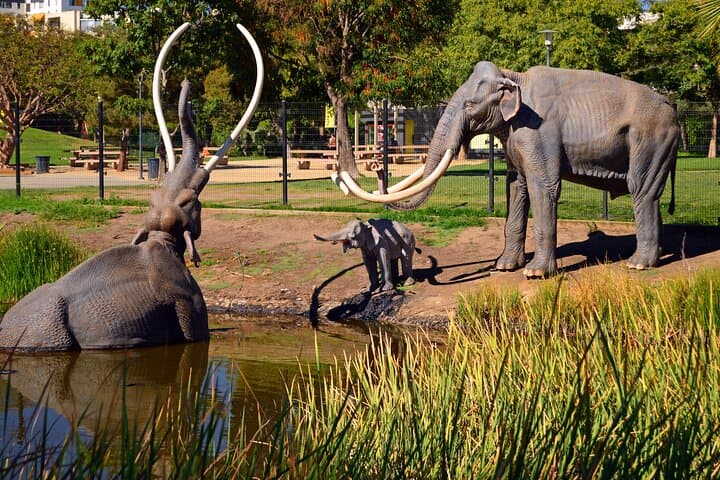
A low winter sun falls across cracked pavement and restored streetlamps as the group assembles by the La Brea Tar Pits sign — a cityscape where Ice Age bones meet chrome and celluloid.
A low winter sun falls across cracked pavement and restored streetlamps as the group assembles by the La Brea Tar Pits sign — a cityscape where Ice Age bones meet chrome and celluloid.
The tour moves with brisk, urban cadence: first through the tar pits’ open-air excavation sites where natural asphalt pushed to the surface trapped mammoths and saber-toothed cats, preserving a geological record of Southern California’s Pleistocene past. From there it crosses to LACMA’s outer galleries; “Urban Light” stands like a field of antique sentries, inviting photographs and conversation about public art’s role in civic life.
Next, the Petersen Automotive Museum showcases transportation’s cultural weight — prototypes, race cars, and film-famous vehicles that trace design, engineering, and social change. The route finishes outside the Academy Museum, its Streamline Moderne facade and glass dome signaling Hollywood’s continuous reinvention.
Historically this stretch of Wilshire — the Miracle Mile — was planned in the 1920s to pull commerce westward, creating a dense corridor of museums and mid-century architecture. Geology meets culture here: tar seeps and fossil beds beneath asphalt roads, galleries and auto shows above.
Practical guidance: the walk is short (about 1–2 hours) and mostly flat on paved sidewalks. Bring comfortable shoes, sun protection, and a charged camera; mornings and late afternoons offer better light and smaller crowds. Public transit and metered parking are available; the route is wheelchair accessible. Expect an interpretive pace with frequent stops outdoors — ideal for curious visitors who want context as well as images.