THE ADVENTURE COLLECTIVE® · Independent discovery and booking for outdoor travel

Spend two days on Mount Emei ascending forested trails to the Golden Summit and sleeping in monastery-style lodging. This tour blends steep granite ridges and centuries of Buddhist culture with practical hiking challenges and unforgettable sunrise views.
Spend two days on Mount Emei ascending forested trails to the Golden Summit and sleeping in monastery-style lodging. This tour blends steep granite ridges and centuries of Buddhist culture with practical hiking challenges and unforgettable sunrise views.
You step from the bus into a cool, fragrant forest and the mountain immediately feels alive — mist threading between ancient pines, a trail that climbs and tightens like a drawn breath. Over two days on Mount Emei you trade city noise for the rhythm of footfalls, temple bells and the occasional chatter of macaques that patrol the lower slopes.
Verified experiences and guided adventures in the surrounding area.
You step from the bus into a cool, fragrant forest and the mountain immediately feels alive — mist threading between ancient pines, a trail that climbs and tightens like a drawn breath. Over two days on Mount Emei you trade city noise for the rhythm of footfalls, temple bells and the occasional chatter of macaques that patrol the lower slopes.
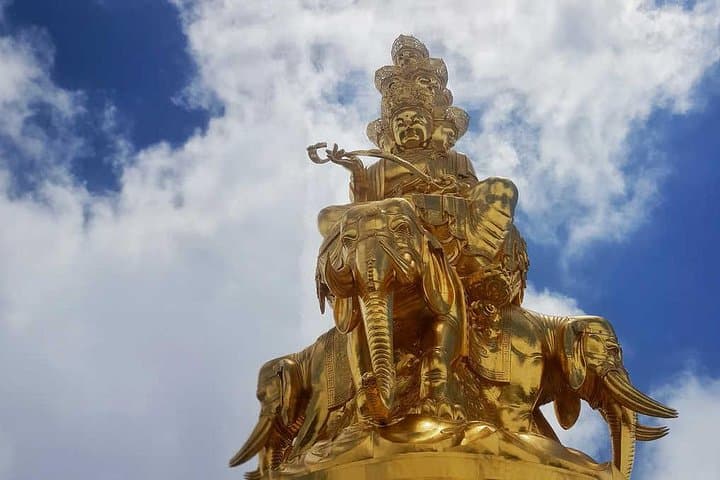
Geologically, Emei rises from Sichuan's red-bed basins to a granite peak at 3,099 m; its steep, weathered ridges and deep gullies have formed over millions of years. Culturally the mountain is a major Buddhist site: temples, prayer flags and monasteries have drawn pilgrims for centuries. The Golden Summit (Jinding) crowns the experience — a broad, windswept plateau with statues and views that spread toward the Minjiang valley and, on a clear day, the distant Sichuan plain.
Expect a mixture of well-built stone stairways, forested singletrack and paved sections around temples. One night is spent in a monastery-style lodgings, giving direct exposure to monastic life and guided talks from resident monks.
Practical guidance: start early to avoid crowds at the summit, carry layers for rapid temperature swings, and plan for steep sections where steps are long and uneven. Hydrate before and during the hike; altitude is modest but noticeable. Transportation is typically from Chengdu or Emeishan city; advance booking for monastery accommodation and permits is recommended during high season. Leave no trace, respect temple rules, and be mindful around macaques — secure food and cameras. This two-day loop balances strenuous climbs, cultural immersion, and sweeping alpine views.
moderate.
2 days (approx. 48 hours).
Moderate fitness; expect sustained uphill walking on stone steps and uneven trail sections, with short steep pitches.
Expect sustained uphill walking on stone steps and trails; overall difficulty is moderate — good for hikers who can handle 6–8 hours of mixed uphill and level walking in a day.
No special government permit is normally required, but monastery accommodation and guided tours are limited in high season so book in advance.
Some visitors feel mild effects (headache, shortness of breath); ascend at a moderate pace, stay hydrated, and avoid overexertion.
Most visitors travel by road — shared coach or private transfer to Emeishan city or the mountain’s parking areas; the trip is roughly 2–3 hours depending on traffic.
Mount Emei is one of China’s Four Sacred Buddhist Mountains; temples on its slopes date back over a millennium, and the site is a UNESCO World Heritage component alongside the Leshan Giant Buddha.
Heavy visitation strains fragile alpine vegetation; stay on marked paths, avoid feeding wildlife, and support local conservation fees and monastery-run waste programs.
You step from the bus into a cool, fragrant forest and the mountain immediately feels alive — mist threading between ancient pines, a trail that climbs and tightens like a drawn breath. Over two days on Mount Emei you trade city noise for the rhythm of footfalls, temple bells and the occasional chatter of macaques that patrol the lower slopes.
You step from the bus into a cool, fragrant forest and the mountain immediately feels alive — mist threading between ancient pines, a trail that climbs and tightens like a drawn breath. Over two days on Mount Emei you trade city noise for the rhythm of footfalls, temple bells and the occasional chatter of macaques that patrol the lower slopes.
Geologically, Emei rises from Sichuan's red-bed basins to a granite peak at 3,099 m; its steep, weathered ridges and deep gullies have formed over millions of years. Culturally the mountain is a major Buddhist site: temples, prayer flags and monasteries have drawn pilgrims for centuries. The Golden Summit (Jinding) crowns the experience — a broad, windswept plateau with statues and views that spread toward the Minjiang valley and, on a clear day, the distant Sichuan plain.
Expect a mixture of well-built stone stairways, forested singletrack and paved sections around temples. One night is spent in a monastery-style lodgings, giving direct exposure to monastic life and guided talks from resident monks.
Practical guidance: start early to avoid crowds at the summit, carry layers for rapid temperature swings, and plan for steep sections where steps are long and uneven. Hydrate before and during the hike; altitude is modest but noticeable. Transportation is typically from Chengdu or Emeishan city; advance booking for monastery accommodation and permits is recommended during high season. Leave no trace, respect temple rules, and be mindful around macaques — secure food and cameras. This two-day loop balances strenuous climbs, cultural immersion, and sweeping alpine views.