THE ADVENTURE COLLECTIVE® · Independent discovery and booking for outdoor travel

Two days of cultural trekking from Chengdu to the Leshan Giant Buddha and Mt. Emei combine light hikes, temple visits, and an overnight in Emei—ideal for travelers who want history, viewpoints, and accessible mountain walking.
Two days of cultural trekking from Chengdu to the Leshan Giant Buddha and Mt. Emei combine light hikes, temple visits, and an overnight in Emei—ideal for travelers who want history, viewpoints, and accessible mountain walking.
On the first morning the road dissolves into Sichuan farmland and the Leshan gorge appears ahead—red clay terraces, a river that seems to dare you to keep pace, and the hulking profile of the Giant Buddha carved into the cliff. Visitors move along stone steps and viewing platforms, hearing the boat horns on the Min River and the murmur of pilgrims.
Verified experiences and guided adventures in the surrounding area.
Operated by U2Panda · Chengdu, Sichuan
On the first morning the road dissolves into Sichuan farmland and the Leshan gorge appears ahead—red clay terraces, a river that seems to dare you to keep pace, and the hulking profile of the Giant Buddha carved into the cliff. Visitors move along stone steps and viewing platforms, hearing the boat horns on the Min River and the murmur of pilgrims.
The route pairs two UNESCO-rich sites: the 8th-century Leshan Giant Buddha, hewn during the Tang dynasty to calm river currents, and Mount Emei, one of China’s four sacred Buddhist mountains with temples, dense fir forests, and endemic species shaped by million-year geologic uplift. Cultural layers are tangible—monks' chanting, monastery courtyards, and inscriptions on worn stone. Geologically, Emei’s slopes are steep, often terraced, with granite outcrops and mist that collects in gullies.
Practically, the tour is an accessible overnight cultural trek: daytime drives from Chengdu, a hotel or monastery overnight in Emeishan, and 3–4 hours of easy-to-moderate walking on day two through Wannian Temple, Qingyin Pavilion and the monkey area. Optional early starts take you to Jinding (Golden Summit) via green bus and cable car.
Expect stone steps, occasional slick moss, and crowds at main viewpoints; weather shifts quickly so layer up. Bring cash for optional cable car tickets and be prepared to give wildlife space—monkeys are opportunistic. The itinerary balances guided interpretation with free time to explore local markets and temple precincts, making it a practical cultural-hiking experience for travelers based in Chengdu.
moderate.
2 days (approx. 8–10 hours per day including transfers).
Suitable for travelers who can manage multiple hours of walking on uneven stone steps and short uphill sections.
Most tours provide hotel pickup in central Chengdu; confirm your pickup point and time when booking.
Jinding (Golden Summit) is optional—it requires an early start and extra fees for green bus and cable car not included in base price.
The walking is generally light-to-moderate: several hours on stone steps and paved paths; no technical climbing required.
Yes, children can join but must be accompanied by an adult and supervise them around steep steps and monkeys.
Leshan’s cliff Buddha began in 713 CE during the Tang dynasty to calm river currents; Mt. Emei has been a Buddhist pilgrimage site for over a millennium with temples scattered along its slopes.
Stay on designated trails and avoid feeding wildlife—crowds and litter can strain fragile forest ecosystems, so pack out waste and follow local guidance.
U2Panda operates guided outdoor trips and adventures with an emphasis on safety, stewardship, and memorable experiences.
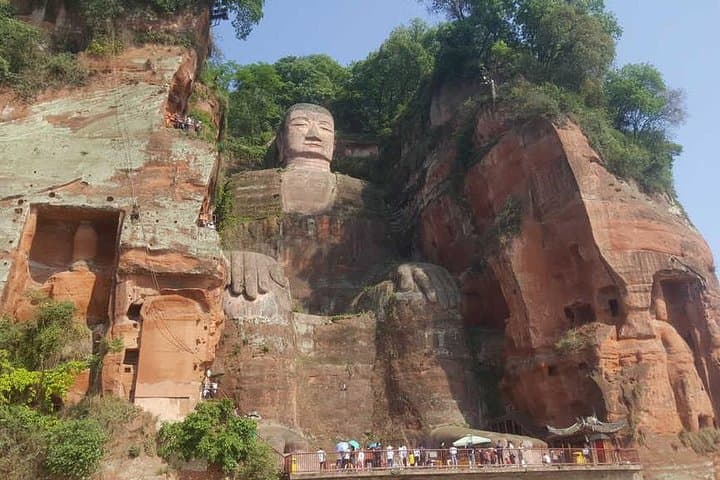


On the first morning the road dissolves into Sichuan farmland and the Leshan gorge appears ahead—red clay terraces, a river that seems to dare you to keep pace, and the hulking profile of the Giant Buddha carved into the cliff. Visitors move along stone steps and viewing platforms, hearing the boat horns on the Min River and the murmur of pilgrims.
On the first morning the road dissolves into Sichuan farmland and the Leshan gorge appears ahead—red clay terraces, a river that seems to dare you to keep pace, and the hulking profile of the Giant Buddha carved into the cliff. Visitors move along stone steps and viewing platforms, hearing the boat horns on the Min River and the murmur of pilgrims.
The route pairs two UNESCO-rich sites: the 8th-century Leshan Giant Buddha, hewn during the Tang dynasty to calm river currents, and Mount Emei, one of China’s four sacred Buddhist mountains with temples, dense fir forests, and endemic species shaped by million-year geologic uplift. Cultural layers are tangible—monks' chanting, monastery courtyards, and inscriptions on worn stone. Geologically, Emei’s slopes are steep, often terraced, with granite outcrops and mist that collects in gullies.
Practically, the tour is an accessible overnight cultural trek: daytime drives from Chengdu, a hotel or monastery overnight in Emeishan, and 3–4 hours of easy-to-moderate walking on day two through Wannian Temple, Qingyin Pavilion and the monkey area. Optional early starts take you to Jinding (Golden Summit) via green bus and cable car.
Expect stone steps, occasional slick moss, and crowds at main viewpoints; weather shifts quickly so layer up. Bring cash for optional cable car tickets and be prepared to give wildlife space—monkeys are opportunistic. The itinerary balances guided interpretation with free time to explore local markets and temple precincts, making it a practical cultural-hiking experience for travelers based in Chengdu.