THE ADVENTURE COLLECTIVE® · Independent discovery and booking for outdoor travel

A three-hour guided stroll from Gatlinburg that follows old homesteads, cemeteries, and cold mountain streams. This hike pairs approachable terrain with interpretive stories about early settlers and the Smokies’ deep geological history.
A three-hour guided stroll from Gatlinburg that follows old homesteads, cemeteries, and cold mountain streams. This hike pairs approachable terrain with interpretive stories about early settlers and the Smokies’ deep geological history.
You step off the narrow forest road and the mountain exhales: a cool, pine-sap scent and the steady murmur of a stream pushing downhill. The guide leads a small group down a well-worn track where sunlight slants between tulip poplars and the trail curves past low stone walls and the weathered timbers of old farm foundations.
Verified experiences and guided adventures in the surrounding area.
Operated by Smoky Mountain Guides · Gatlinburg, TN
You step off the narrow forest road and the mountain exhales: a cool, pine-sap scent and the steady murmur of a stream pushing downhill. The guide leads a small group down a well-worn track where sunlight slants between tulip poplars and the trail curves past low stone walls and the weathered timbers of old farm foundations.
This route traces a living history of the southern Appalachians — early settler homesteads, small cemeteries, and traces of Native American use in the wider valley. Geologically the Smokies are ancient, rounded ridges of Precambrian sandstone and schist; expect gentle grades broken by short, rocky steps and creek crossings that reveal the park’s fast-moving, cold-water hydrology. Culturally, the corridor reflects a mountain community shaped by small-scale farming and Appalachian craft, with interpretive stories your guide will layer into the walk.
Practical guidance: the hike runs about three hours round-trip over uneven, often root-strewn terrain with modest elevation change — suitable for hikers with a moderate fitness base. Wear sturdy trail shoes, bring 1–2 liters of water, and tide your pace to creek crossings that can be slick after rain. A park parking pass is required; the guide will meet you in Gatlinburg and you’ll caravan to the trailhead (roughly a 30-minute scenic drive). Carry basic layers — mornings can be cool and the understory traps moisture — and pack snacks for energy on steeper sections. Expect interpretive stops at homestead remnants and a chance to listen for warblers and the occasional wood thrush. The Mountaineer’s Way balances accessible outdoor rhythm with tangible history — a short, immersive jump into the Smokies’ landscape and stories.
moderate.
2–3 hours.
Moderate; able to hike uneven terrain and handle short elevation gains without extended rest
The guided outing is about three hours with modest elevation changes; terrain is uneven but manageable for those with moderate fitness.
Yes — a Great Smoky Mountains National Park parking pass is required. Purchase online in advance to expedite arrival.
Facilities are available at trailhead or nearby parking areas but not along the forest sections; plan accordingly before the hike.
Families and older adults who are comfortable with a casual but uneven 2–3 hour hike can do this; disclose mobility issues when booking so guides can advise.
The corridor preserves evidence of 19th–20th century mountain farming and small homesteads; guides recount settler families and earlier Cherokee presence in the region.
Visitors are asked to stay on trail to protect fragile understory and to pack out all trash; the park actively manages invasive species and relies on low-impact recreation to preserve archaeological sites.
Smoky Mountain Guides operates guided outdoor trips and adventures with an emphasis on safety, stewardship, and memorable experiences.



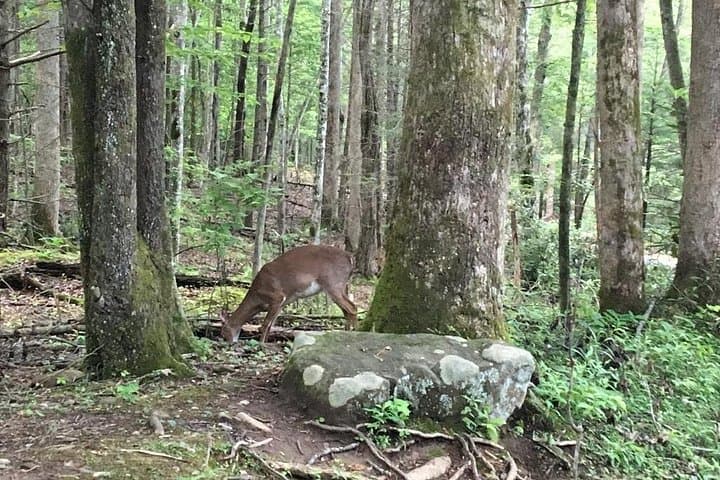
You step off the narrow forest road and the mountain exhales: a cool, pine-sap scent and the steady murmur of a stream pushing downhill. The guide leads a small group down a well-worn track where sunlight slants between tulip poplars and the trail curves past low stone walls and the weathered timbers of old farm foundations.
You step off the narrow forest road and the mountain exhales: a cool, pine-sap scent and the steady murmur of a stream pushing downhill. The guide leads a small group down a well-worn track where sunlight slants between tulip poplars and the trail curves past low stone walls and the weathered timbers of old farm foundations.
This route traces a living history of the southern Appalachians — early settler homesteads, small cemeteries, and traces of Native American use in the wider valley. Geologically the Smokies are ancient, rounded ridges of Precambrian sandstone and schist; expect gentle grades broken by short, rocky steps and creek crossings that reveal the park’s fast-moving, cold-water hydrology. Culturally, the corridor reflects a mountain community shaped by small-scale farming and Appalachian craft, with interpretive stories your guide will layer into the walk.
Practical guidance: the hike runs about three hours round-trip over uneven, often root-strewn terrain with modest elevation change — suitable for hikers with a moderate fitness base. Wear sturdy trail shoes, bring 1–2 liters of water, and tide your pace to creek crossings that can be slick after rain. A park parking pass is required; the guide will meet you in Gatlinburg and you’ll caravan to the trailhead (roughly a 30-minute scenic drive). Carry basic layers — mornings can be cool and the understory traps moisture — and pack snacks for energy on steeper sections. Expect interpretive stops at homestead remnants and a chance to listen for warblers and the occasional wood thrush. The Mountaineer’s Way balances accessible outdoor rhythm with tangible history — a short, immersive jump into the Smokies’ landscape and stories.