THE ADVENTURE COLLECTIVE® · Independent discovery and booking for outdoor travel

Climb Mount Pico at night to stand above the Azores as the sun rises over the Atlantic. This guided, small-group route is physically demanding but highly rewarding for prepared hikers.
Climb Mount Pico at night to stand above the Azores as the sun rises over the Atlantic. This guided, small-group route is physically demanding but highly rewarding for prepared hikers.
You set off in the dark with headlamps cutting cones through the Azores night, the island’s silhouette a low ridge against star-slit sky. The trail climbs from the basalt fields into lunar scree; each step lifts you farther from the villages below and closer to a horizon that will, by dawn, unroll in every direction.
Verified experiences and guided adventures in the surrounding area.
Operated by Tripix Azores · Madalena, Azores
You set off in the dark with headlamps cutting cones through the Azores night, the island’s silhouette a low ridge against star-slit sky. The trail climbs from the basalt fields into lunar scree; each step lifts you farther from the villages below and closer to a horizon that will, by dawn, unroll in every direction.
Geology here is blunt and recent — Pico is a stratovolcano that rises to 2,351 m, shaped by successive lava flows and sharp ash beds. The island’s human story is intimate: vineyard terraces clinging to rock and a culture forged by fishing and volcanic soils. Guides from the Azores Mountain Guides Association (AGMA) run small, safety-focused teams and carry the local knowledge that turns hard ground into a manageable route.
Expect 8–10 hours round-trip on rocky, often loose volcanic terrain, with steep sections and short rock scrambling. Night climbs add navigation and pacing challenges; weather changes quickly above 1,500 m. Practical planning matters: layered insulation for pre-dawn cold, a high-quality headlamp, and boots with firm ankle support will keep you moving.
Leave no trace: the fragile alpine soils and lichens recover slowly from scuffs and campfires are prohibited. Time your ascent to reach the summit 30–60 minutes before sunrise for the full effect — light washes the Atlantic and neighboring islands while the mountain holds its silence. With preparation and respect for the mountain, a night climb on Pico is a demanding but unforgettable summit experience.
challenging.
8–10 hours.
Requires very good cardiovascular fitness, leg strength, and experience with sustained uphill hiking; not recommended for sedentary travelers.
Expect 8–10 hours round-trip with sustained steep sections; the night element raises difficulty—good fitness and prior long-hike experience are recommended.
You don’t need technical rope skills, but experience with steep, scree-filled trails and night navigation is important.
Operators may cancel or postpone for safety; the trail becomes hazardous in high winds, heavy rain, or poor visibility.
Guides usually provide headlamps, basic first aid, and sometimes poles, but you must bring suitable boots and personal layering; check the tour’s inclusions.
Pico is the highest point in Portugal and was built by repeated volcanic eruptions; nearby vineyard culture dates back centuries and is UNESCO-listed for its lava stone walls.
The alpine flora and volcanic soils are fragile—stick to the official trail, pack out all waste, and follow guide instructions to minimize erosion and impact.
Tripix Azores operates guided outdoor trips and adventures with an emphasis on safety, stewardship, and memorable experiences.
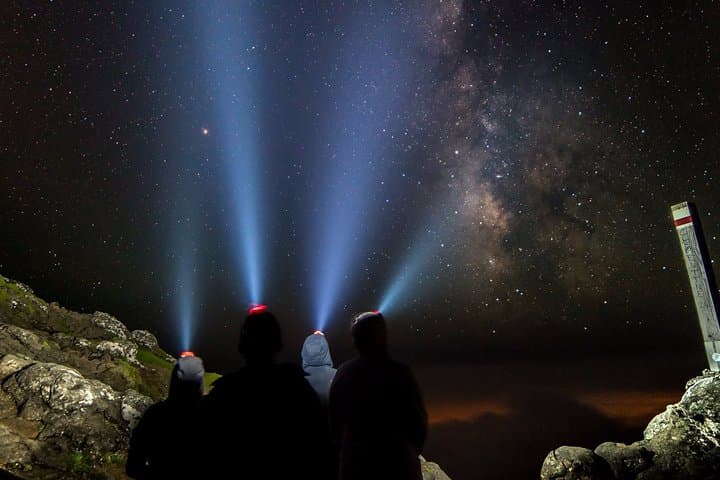


You set off in the dark with headlamps cutting cones through the Azores night, the island’s silhouette a low ridge against star-slit sky. The trail climbs from the basalt fields into lunar scree; each step lifts you farther from the villages below and closer to a horizon that will, by dawn, unroll in every direction.
You set off in the dark with headlamps cutting cones through the Azores night, the island’s silhouette a low ridge against star-slit sky. The trail climbs from the basalt fields into lunar scree; each step lifts you farther from the villages below and closer to a horizon that will, by dawn, unroll in every direction.
Geology here is blunt and recent — Pico is a stratovolcano that rises to 2,351 m, shaped by successive lava flows and sharp ash beds. The island’s human story is intimate: vineyard terraces clinging to rock and a culture forged by fishing and volcanic soils. Guides from the Azores Mountain Guides Association (AGMA) run small, safety-focused teams and carry the local knowledge that turns hard ground into a manageable route.
Expect 8–10 hours round-trip on rocky, often loose volcanic terrain, with steep sections and short rock scrambling. Night climbs add navigation and pacing challenges; weather changes quickly above 1,500 m. Practical planning matters: layered insulation for pre-dawn cold, a high-quality headlamp, and boots with firm ankle support will keep you moving.
Leave no trace: the fragile alpine soils and lichens recover slowly from scuffs and campfires are prohibited. Time your ascent to reach the summit 30–60 minutes before sunrise for the full effect — light washes the Atlantic and neighboring islands while the mountain holds its silence. With preparation and respect for the mountain, a night climb on Pico is a demanding but unforgettable summit experience.