THE ADVENTURE COLLECTIVE® · Independent discovery and booking for outdoor travel

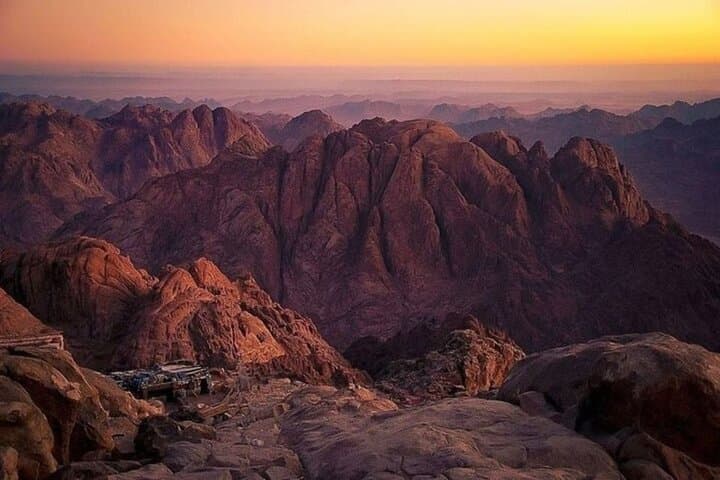
Start before dawn and hike Jabal Musa for a sunrise that redraws Sinai’s ridgelines, then visit the 6th-century St. Catherine’s Monastery. This overnight combines rugged granite terrain, Bedouin culture, and coastal Dahab for a full Sinai day.
Start before dawn and hike Jabal Musa for a sunrise that redraws Sinai’s ridgelines, then visit the 6th-century St. Catherine’s Monastery. This overnight combines rugged granite terrain, Bedouin culture, and coastal Dahab for a full Sinai day.
Night air bites at the bus windows as the desert slides past—black ridgelines, a single headlamp tracing a path up the granite spine of Mount Moses (Jabal Musa). By 3 a.m. the group leaves the parked van and begins the climb: stone steps underfoot, wind sharpening the world, and the promise of sunrise pulling you forward.
Verified experiences and guided adventures in the surrounding area.
Operated by ToBadaa · St. Catherine, South Sinai Governorate
Night air bites at the bus windows as the desert slides past—black ridgelines, a single headlamp tracing a path up the granite spine of Mount Moses (Jabal Musa). By 3 a.m. the group leaves the parked van and begins the climb: stone steps underfoot, wind sharpening the world, and the promise of sunrise pulling you forward.
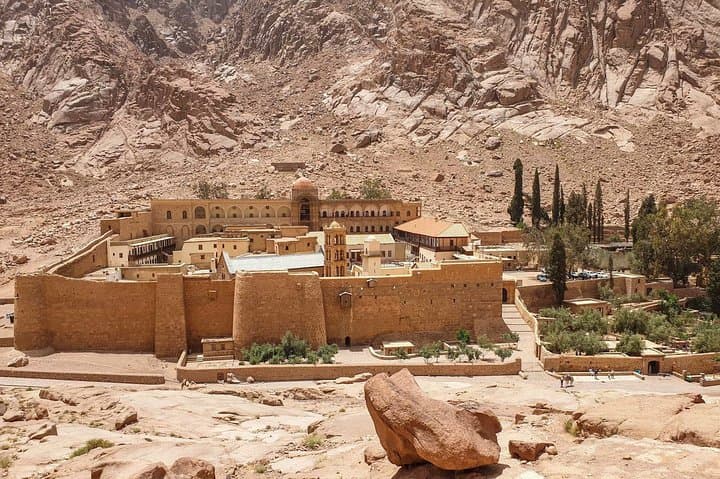
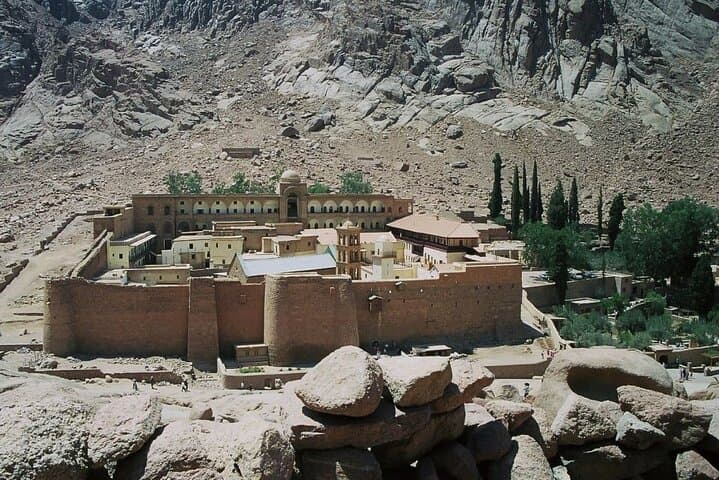
This route threads through Sinai’s ancient granite, formed from an uplifted pluton that sculpts steep faces and scree gullies. At the foot of the peak sits St. Catherine’s Monastery, founded in the 6th century under Emperor Justinian and still home to Byzantine icons, a rare library, and the site venerated as the Burning Bush.
Culturally the area is lived in by Bedouin communities; Dahab—once a fishing village—is a short coastal contrast where tours often stop for fresh seafood and a swim after the hike. Geologically the range is rugged and dry, with little soil to repair footprints: the landscape keeps its scars.
Practical guide: expect roughly 6–8 km of walking to the summit with ~600–700 m of elevation gain, mostly on rocky trails and many stone steps near the top. The overnight format means a very early summit; temperatures can drop near freezing, even when the coast is warm. The trip commonly includes hotel pick-up in Sharm El Sheikh and an English-speaking guide.
Bring a headlamp, layered insulation, 2–3 L of water, and sturdy boots. Respect monastery rules: modest clothing and quiet inside buildings. Move slowly on steep sections, watch loose rock, and leave no trace—water is scarce and the desert is fragile.
moderate.
18–22 hours (overnight).
Suitable for hikers with good basic fitness able to sustain 6–8 km and 600–700 m elevation gain; comfortable with night walking.
The trail is mainly non-technical but sustained: expect 6–8 km one-way with roughly 600–700 m of elevation gain; pace matters more than speed.
Yes—most tours include a guided visit to the monastery; observe modest dress codes and quiet inside the complex.
No special hiking permit is typically required for tourist groups; the monastery may have an entrance fee and operating hours—your guide will handle logistics.
Yes—many itineraries stop in Dahab after the mountain visit for a coastal lunch or optional snorkeling at sites like the Blue Hole.
St. Catherine’s Monastery dates to the 6th century (Justinian era) and retains early Byzantine icons and manuscripts, anchored around a shrub venerated as the Burning Bush.
Sinai’s soils recover slowly—stay on established paths, pack out waste, and respect water scarcity by minimizing consumption and avoiding litter.
ToBadaa operates guided outdoor trips and adventures with an emphasis on safety, stewardship, and memorable experiences.
Night air bites at the bus windows as the desert slides past—black ridgelines, a single headlamp tracing a path up the granite spine of Mount Moses (Jabal Musa). By 3 a.m. the group leaves the parked van and begins the climb: stone steps underfoot, wind sharpening the world, and the promise of sunrise pulling you forward.
Night air bites at the bus windows as the desert slides past—black ridgelines, a single headlamp tracing a path up the granite spine of Mount Moses (Jabal Musa). By 3 a.m. the group leaves the parked van and begins the climb: stone steps underfoot, wind sharpening the world, and the promise of sunrise pulling you forward.
This route threads through Sinai’s ancient granite, formed from an uplifted pluton that sculpts steep faces and scree gullies. At the foot of the peak sits St. Catherine’s Monastery, founded in the 6th century under Emperor Justinian and still home to Byzantine icons, a rare library, and the site venerated as the Burning Bush.
Culturally the area is lived in by Bedouin communities; Dahab—once a fishing village—is a short coastal contrast where tours often stop for fresh seafood and a swim after the hike. Geologically the range is rugged and dry, with little soil to repair footprints: the landscape keeps its scars.
Practical guide: expect roughly 6–8 km of walking to the summit with ~600–700 m of elevation gain, mostly on rocky trails and many stone steps near the top. The overnight format means a very early summit; temperatures can drop near freezing, even when the coast is warm. The trip commonly includes hotel pick-up in Sharm El Sheikh and an English-speaking guide.
Bring a headlamp, layered insulation, 2–3 L of water, and sturdy boots. Respect monastery rules: modest clothing and quiet inside buildings. Move slowly on steep sections, watch loose rock, and leave no trace—water is scarce and the desert is fragile.