THE ADVENTURE COLLECTIVE® · Independent discovery and booking for outdoor travel

A six‑day, hut‑based ascent that balances comfort and acclimatization, the Marangu Route takes you from rainforest to glacier rim with local guides and a team of porters. Expect long days, exposed summit sections, and a sunrise at Uhuru Peak.
A six‑day, hut‑based ascent that balances comfort and acclimatization, the Marangu Route takes you from rainforest to glacier rim with local guides and a team of porters. Expect long days, exposed summit sections, and a sunrise at Uhuru Peak.
The headlamp cones multiply into a chain of steady lights as the team files out of Kibo Hut at midnight. Cold air bites the exposed saddle and the stars sit low and bright, indifferent to the thinness of the air. Step by step, the trail climbs into a different world: the moorland gives way to a gravelly arena where the wind shapes the snow and the sky starts to pale. By sunrise, Gillman’s Point throws a silhouette against a burning horizon — the payoff of six days of walking, acclimatizing and trust.
Verified experiences and guided adventures in the surrounding area.
Operated by Maua Adventures · Moshi, Kilimanjaro Region
The headlamp cones multiply into a chain of steady lights as the team files out of Kibo Hut at midnight. Cold air bites the exposed saddle and the stars sit low and bright, indifferent to the thinness of the air. Step by step, the trail climbs into a different world: the moorland gives way to a gravelly arena where the wind shapes the snow and the sky starts to pale. By sunrise, Gillman’s Point throws a silhouette against a burning horizon — the payoff of six days of walking, acclimatizing and trust.
The Marangu Route is the oldest and most social line up Kilimanjaro’s flanks. Known locally as the “Coca‑Cola” route for its relative comfort, Marangu follows paths first used by hunters and later formalized for porters and early climbers like Hans Meyer, who made the first recorded ascent of Kibo’s rim in 1889. Geologically, Kibo is a dormant stratovolcano: its outer slopes host rainforest, heath and moor, alpine desert and finally a glaciated crater that cedes slowly to climate change — a visible archive of the mountain’s environmental shifts.
Culturally, Moshi and the Chagga towns around Marangu are the human frame for this climb. Guides and porters are often from nearby communities; their knowledge of weather, water points and the mountain’s moods is as crucial as any map. The huts along this route — Mandara, Horombo, Kibo — provide wooden beds and hot meals, trading wilderness purity for practical comfort.
Practicalities matter here. The itinerary is six days (five nights) and deliberately paced for acclimatization: a long day to Kibo, a midnight summit push, and a careful descent. Altitude, not technical difficulty, is the main challenge: expect long hours on varied terrain, from muddy rainforest switchbacks to the gypsum and scree of the crater zone. Trip inclusions typically cover park fees, hut accommodation, meals on the mountain, and the crew.
Aim to train with long hikes and altitude where possible; focus on aerobic fitness and steady, pole‑assisted hiking. Bring layered insulation for sub‑zero summit temps, a reliable headlamp for the night ascent, and a water system with purification—hydration is your simple altitude defense. Time your summit for a new moon if you want darker, colder skies; choose the dry months (June–October) for the most stable conditions. Above all, pace yourself: slow, consistent steps increase your odds of reaching Uhuru Peak at 5,895 m.
The Marangu Route is not the fastest nor the hardest, but it is an intimate, communal way to meet Kilimanjaro — with the comfort of huts, the company of porters, and the undeniable, uncompromising summit sunrise that makes the effort count.
challenging.
6 days.
Good aerobic fitness with experience on multi‑day hikes; practice long days with a loaded pack and include stair or hill repeats.
No technical climbing skills are required—the Marangu Route is a high‑altitude trek rather than a technical climb, but you must be prepared for steep, icy and exposed sections near the summit.
The driest and most stable window is June through October; late January to February is also commonly used. Expect heavier rains during March–May (long rains).
The summit push starts around midnight and can take 6–8 hours roundtrip from Kibo Hut; summit temperatures can drop well below -10°C with wind chill, so substantial insulation is needed.
Huts provide basic wooden bunks, mattresses and communal dining; they are warmer and more sheltered than tents but still rustic—bring a warm sleeping liner for comfort.
Acclimatize by following the itinerary, avoid alcohol, stay hydrated, and know symptoms of AMS; quick descent is the primary treatment—notify guides if symptoms arise.
Park and rescue fees are normally included in guided packages and are paid at registration; confirm inclusion with your operator before travel.
The Marangu route has long been a Chagga access path and became a formal mountaineering route after 19th‑century European exploration; Hans Meyer and Ludwig Purtscheller opened the mountain to regular summit attempts.
Kilimanjaro National Park uses park fees to fund ranger patrols and rescue services; trekkers are expected to follow strict waste and fire rules to protect fragile alpine ecosystems.
Maua Adventures operates guided outdoor trips and adventures with an emphasis on safety, stewardship, and memorable experiences.
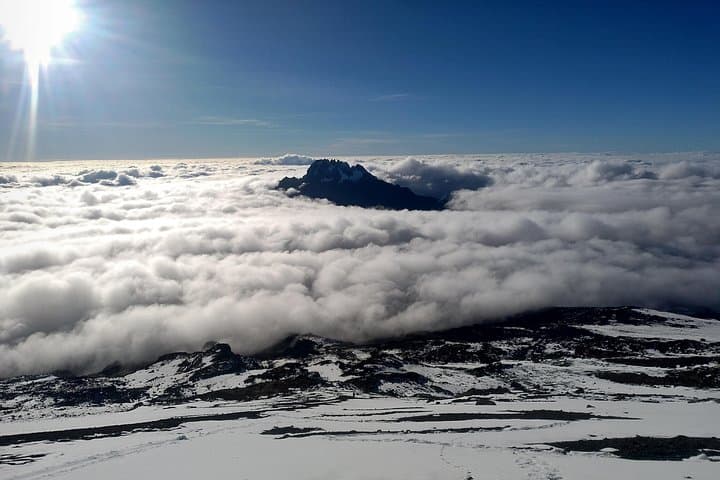
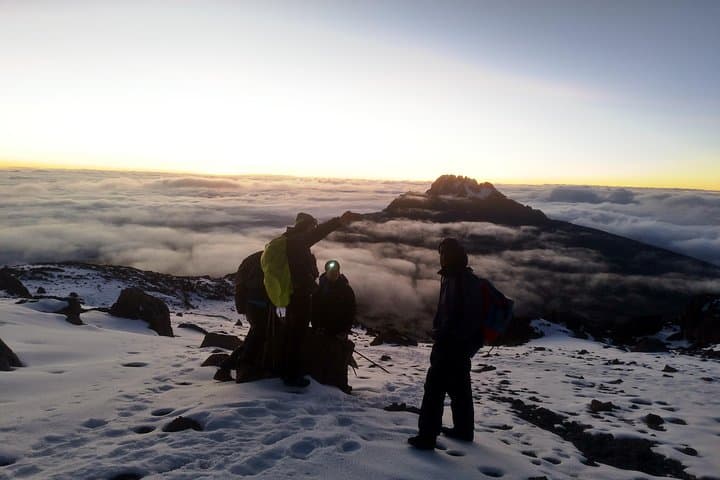
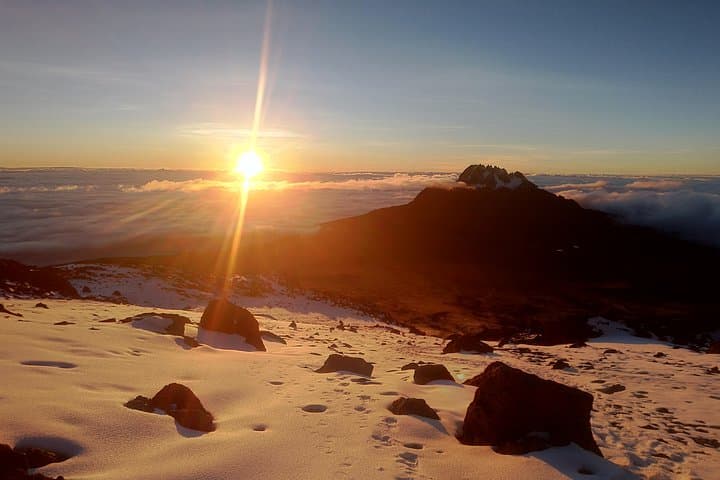
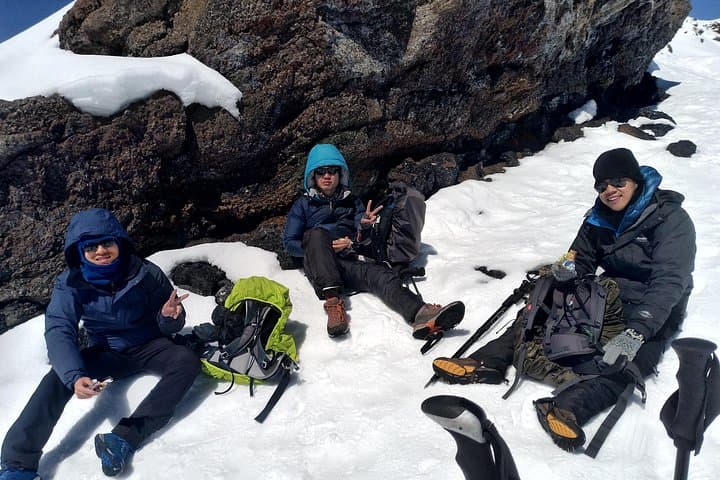
The headlamp cones multiply into a chain of steady lights as the team files out of Kibo Hut at midnight. Cold air bites the exposed saddle and the stars sit low and bright, indifferent to the thinness of the air. Step by step, the trail climbs into a different world: the moorland gives way to a gravelly arena where the wind shapes the snow and the sky starts to pale. By sunrise, Gillman’s Point throws a silhouette against a burning horizon — the payoff of six days of walking, acclimatizing and trust.
The headlamp cones multiply into a chain of steady lights as the team files out of Kibo Hut at midnight. Cold air bites the exposed saddle and the stars sit low and bright, indifferent to the thinness of the air. Step by step, the trail climbs into a different world: the moorland gives way to a gravelly arena where the wind shapes the snow and the sky starts to pale. By sunrise, Gillman’s Point throws a silhouette against a burning horizon — the payoff of six days of walking, acclimatizing and trust.
The Marangu Route is the oldest and most social line up Kilimanjaro’s flanks. Known locally as the “Coca‑Cola” route for its relative comfort, Marangu follows paths first used by hunters and later formalized for porters and early climbers like Hans Meyer, who made the first recorded ascent of Kibo’s rim in 1889. Geologically, Kibo is a dormant stratovolcano: its outer slopes host rainforest, heath and moor, alpine desert and finally a glaciated crater that cedes slowly to climate change — a visible archive of the mountain’s environmental shifts.
Culturally, Moshi and the Chagga towns around Marangu are the human frame for this climb. Guides and porters are often from nearby communities; their knowledge of weather, water points and the mountain’s moods is as crucial as any map. The huts along this route — Mandara, Horombo, Kibo — provide wooden beds and hot meals, trading wilderness purity for practical comfort.
Practicalities matter here. The itinerary is six days (five nights) and deliberately paced for acclimatization: a long day to Kibo, a midnight summit push, and a careful descent. Altitude, not technical difficulty, is the main challenge: expect long hours on varied terrain, from muddy rainforest switchbacks to the gypsum and scree of the crater zone. Trip inclusions typically cover park fees, hut accommodation, meals on the mountain, and the crew.
Aim to train with long hikes and altitude where possible; focus on aerobic fitness and steady, pole‑assisted hiking. Bring layered insulation for sub‑zero summit temps, a reliable headlamp for the night ascent, and a water system with purification—hydration is your simple altitude defense. Time your summit for a new moon if you want darker, colder skies; choose the dry months (June–October) for the most stable conditions. Above all, pace yourself: slow, consistent steps increase your odds of reaching Uhuru Peak at 5,895 m.
The Marangu Route is not the fastest nor the hardest, but it is an intimate, communal way to meet Kilimanjaro — with the comfort of huts, the company of porters, and the undeniable, uncompromising summit sunrise that makes the effort count.