THE ADVENTURE COLLECTIVE® · Independent discovery and booking for outdoor travel

A full-day guided trek from Piano Provenzana to Mount Etna’s summit craters, covering ~12–13 km with a 500 m ascent and a demanding 1,580 m descent. Designed for experienced hikers ready for loose volcanic scree, high altitude, and variable weather.
A full-day guided trek from Piano Provenzana to Mount Etna’s summit craters, covering ~12–13 km with a 500 m ascent and a demanding 1,580 m descent. Designed for experienced hikers ready for loose volcanic scree, high altitude, and variable weather.
A cold wind skims the black slope as hikers gather at Piano Provenzana, the north-side gateway to Europe's most active volcano. Guides check boots and distribute poles while the café empties — steam from espresso mixing with the distant sulphur breath of Etna's craters.
Verified experiences and guided adventures in the surrounding area.
Operated by Guide Vulcanologiche Etna Nord · Linguaglossa, Sicily
A cold wind skims the black slope as hikers gather at Piano Provenzana, the north-side gateway to Europe's most active volcano. Guides check boots and distribute poles while the café empties — steam from espresso mixing with the distant sulphur breath of Etna's craters.
This route climbs from 1,800 m to a rooftop of Sicily at 3,380 m. The day mixes forested tracks, recent lava fields, and loose scoria: a 4×4 ride to ~2,960 m followed by a steep 500 m ascent across sharp bombs and volcanic sand to the central crater rims. The 12–13 km round trip finishes with a long, technical descent of roughly 1,580 m to the valley.
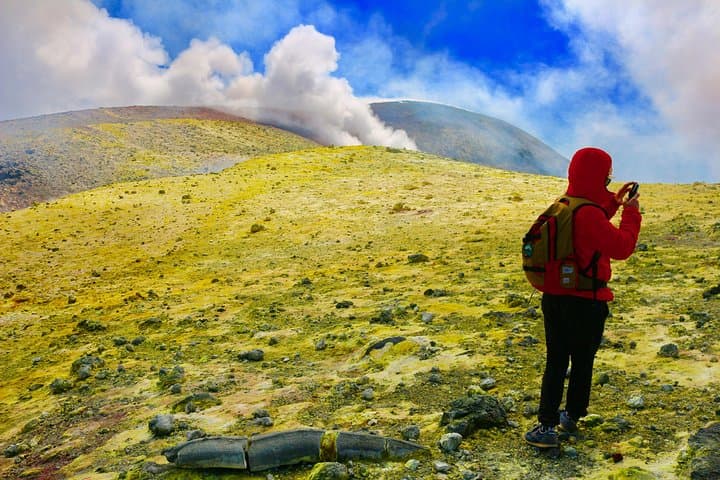
Etna’s profile is written in layers of basalt and ash; lateral craters and the 2002 flows at Piano Provenzana are recent pages. The north slope offers quieter views of the Aeolian Islands and the Strait of Messina, and local shepherding and small villages speak to long human ties to these slopes.
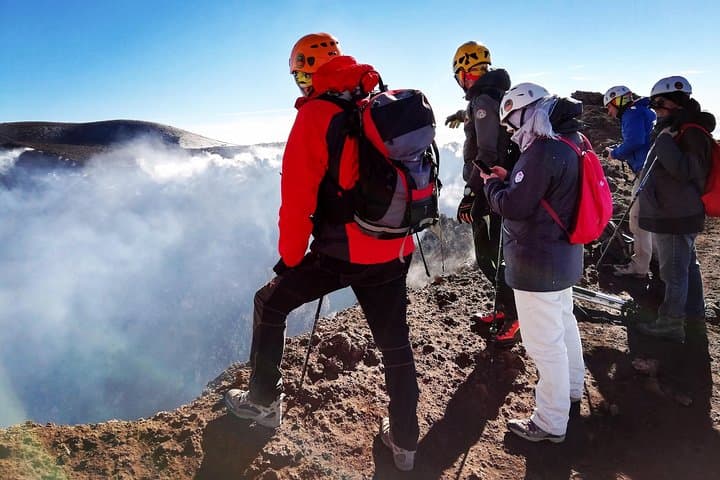
Practical notes: this itinerary suits experienced, high‑altitude hikers. Expect unstable footing, variable weather, and occasional volcanic gases — guides alter routes as needed. Wear stiff boots, layered insulation, eye protection, and bring 2–3 L of water. Take time to descend carefully: the long negative elevation change is often harder on knees than the climb.
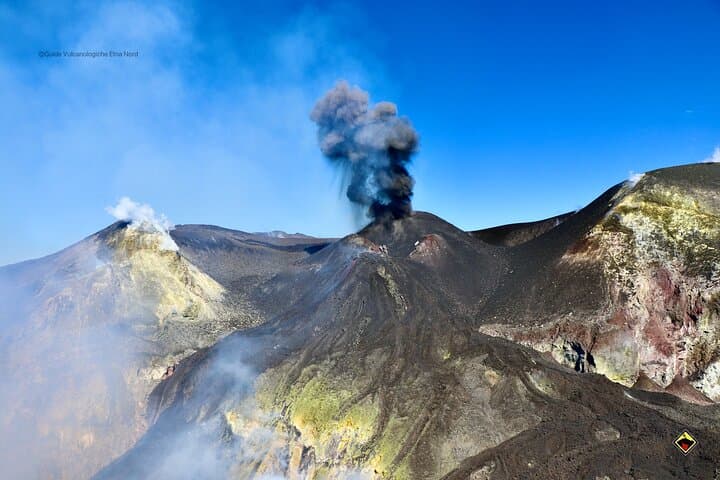
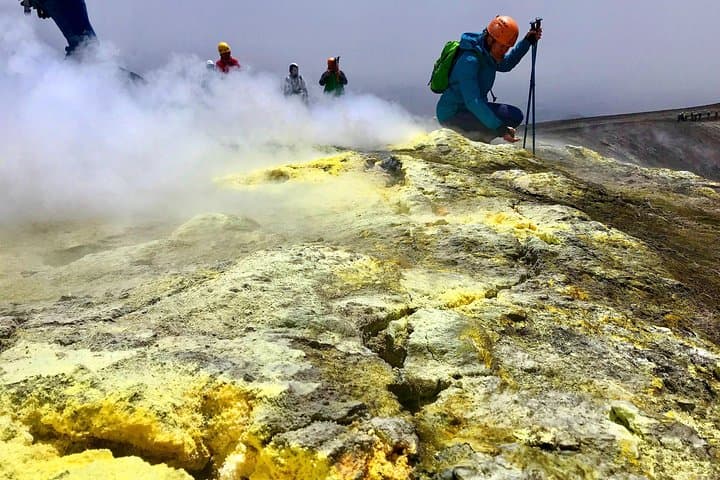
Timing matters — mornings are clearer and wind calmer. Follow guides’ instructions about gas exposure, avoid contact lenses, and carry any medications for altitude or respiratory sensitivity. When conditions are safe, the summit rim rewards with raw, immediate geology: hissing vents, jagged lava, and an enormous sense of scale.
expert.
5–6 hours.
High level of aerobic fitness and strong legs/knees; accustomed to sustained uphill and long technical downhill on loose volcanic terrain.
Participants should be experienced hikers with good aerobic fitness and strong knees; the itinerary includes steep ascents and a long, technical descent on loose volcanic material.
Guides monitor conditions and will alter, stop, or cancel the hike if gas, heat, or eruptions create unsafe conditions; refunds or rescheduling follow the operator’s cancellation policy.
Yes — returning by authorized vehicle from ~2,850 m to 1,800 m is possible but carries a different fee (operators cite a higher charge if chosen during the excursion).
Meet at Piano Provenzana’s parking area by the "Chiosco Bar Mareneve" (not "Chiosco Bar Etna Nord"); facilities include restrooms and a café before departure.
Piano Provenzana and its facilities were reshaped by the October 2002 eruption; the scars and lava fields are recent geological records visible along the route.
Stay on the guide‑directed path and avoid collecting rock samples; volcanic soils and pioneer plants are fragile and groups are kept small to limit impact.
Guide Vulcanologiche Etna Nord operates guided outdoor trips and adventures with an emphasis on safety, stewardship, and memorable experiences.
A cold wind skims the black slope as hikers gather at Piano Provenzana, the north-side gateway to Europe's most active volcano. Guides check boots and distribute poles while the café empties — steam from espresso mixing with the distant sulphur breath of Etna's craters.
A cold wind skims the black slope as hikers gather at Piano Provenzana, the north-side gateway to Europe's most active volcano. Guides check boots and distribute poles while the café empties — steam from espresso mixing with the distant sulphur breath of Etna's craters.
This route climbs from 1,800 m to a rooftop of Sicily at 3,380 m. The day mixes forested tracks, recent lava fields, and loose scoria: a 4×4 ride to ~2,960 m followed by a steep 500 m ascent across sharp bombs and volcanic sand to the central crater rims. The 12–13 km round trip finishes with a long, technical descent of roughly 1,580 m to the valley.
Etna’s profile is written in layers of basalt and ash; lateral craters and the 2002 flows at Piano Provenzana are recent pages. The north slope offers quieter views of the Aeolian Islands and the Strait of Messina, and local shepherding and small villages speak to long human ties to these slopes.
Practical notes: this itinerary suits experienced, high‑altitude hikers. Expect unstable footing, variable weather, and occasional volcanic gases — guides alter routes as needed. Wear stiff boots, layered insulation, eye protection, and bring 2–3 L of water. Take time to descend carefully: the long negative elevation change is often harder on knees than the climb.
Timing matters — mornings are clearer and wind calmer. Follow guides’ instructions about gas exposure, avoid contact lenses, and carry any medications for altitude or respiratory sensitivity. When conditions are safe, the summit rim rewards with raw, immediate geology: hissing vents, jagged lava, and an enormous sense of scale.