THE ADVENTURE COLLECTIVE® · Independent discovery and booking for outdoor travel

A day that pairs Mostar’s Ottoman-era Old Bridge and riverside streets with the travertine plunge of Kravice Falls. Expect a full day of driving, border formalities, short walks, and memorable river views.
A day that pairs Mostar’s Ottoman-era Old Bridge and riverside streets with the travertine plunge of Kravice Falls. Expect a full day of driving, border formalities, short walks, and memorable river views.
You step into the valley where the Neretva cuts a cool green ribbon through limestone slopes, the Old Bridge’s white arch appearing around a bend of cobbled streets and minarets. The air carries the low hum of markets and the river’s insistence, and the day stretches ahead — a cultural cross-section of Ottoman Bosnia and raw karst scenery.
Verified experiences and guided adventures in the surrounding area.
Operated by Select Dubrovnik d.o.o · Mostar, Herzegovina-Neretva
You step into the valley where the Neretva cuts a cool green ribbon through limestone slopes, the Old Bridge’s white arch appearing around a bend of cobbled streets and minarets. The air carries the low hum of markets and the river’s insistence, and the day stretches ahead — a cultural cross-section of Ottoman Bosnia and raw karst scenery.
Mostar grew where empires met; Stari Most (the Old Bridge) was built by Ottoman hands in the 16th century and rebuilt after wartime destruction in 2004. The Neretva’s turquoise channel flows through a narrow, tectonically carved valley, while Kravice Falls — a semicircular travertine curtain roughly 25 meters high and more than 100 meters across — spills into a shallow pool below.
Expect a mix of urban wandering and short nature stops: 2–3 hours’ driving each way from Dubrovnik, passport checks at the Bosnia-Herzegovina border, roughly 45 minutes at Kravice for photos and a quick walk, plus time to explore Mostar’s Old Town, bazaars, and river viewpoints. The experience pairs history—Ottoman architecture, Austro-Hungarian influences—with accessible geology: karst limestone, travertine formations and the active Neretva river system.
Practical notes: carry your passport and local currency (BAM), wear sturdy shoes for cobbles and wet paths, and bring a refillable water bottle. Start early to avoid midday crowds and allow extra time at the border. The tour is wheelchair-accessible for main meeting and vehicle pickup, but expect uneven surfaces in Old Town and at the waterfall edges. In short: a full, straightforward day that mixes cultural history with one of the region’s most photogenic cascades.
easy.
10 hours.
Suitable for most fitness levels; minimal walking is required but involves cobbled streets and short stair sections.
The full excursion is about 10 hours, including roughly 2–3 hours driving each way, border formalities, and stops in Mostar and Kravice.
Yes — a valid passport is mandatory for the border crossing; visa requirements depend on your nationality and must be checked in advance.
Swimming is often possible in summer when water levels and park rules permit; check local guidance on the day as conditions and access can change.
The vehicle and pickup are wheelchair-accessible, but expect uneven surfaces in Mostar Old Town and at the waterfall edges that may limit mobility on-site.
Mostar developed as an Ottoman frontier town in the 16th century; Stari Most was engineered by Mimar Hayruddin and became a powerful symbol of the city’s cultural mix.
Kravice is managed to balance tourism and river health; visitors should stick to marked paths, avoid littering, and respect seasonal protection signage to protect travertine growth.
Select Dubrovnik d.o.o operates guided outdoor trips and adventures with an emphasis on safety, stewardship, and memorable experiences.


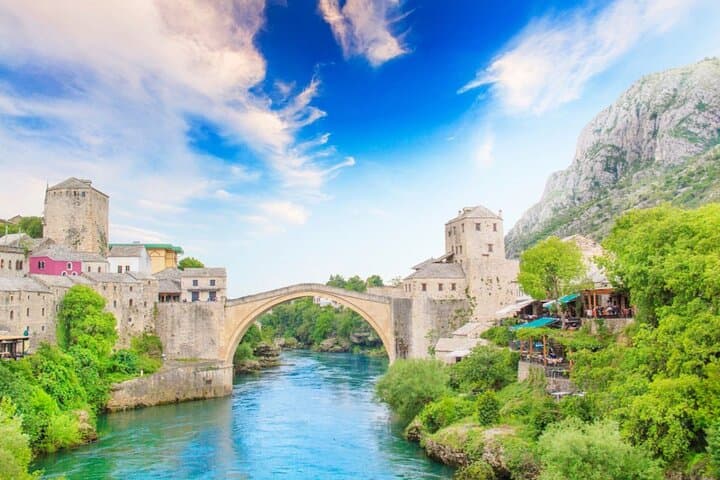
You step into the valley where the Neretva cuts a cool green ribbon through limestone slopes, the Old Bridge’s white arch appearing around a bend of cobbled streets and minarets. The air carries the low hum of markets and the river’s insistence, and the day stretches ahead — a cultural cross-section of Ottoman Bosnia and raw karst scenery.
You step into the valley where the Neretva cuts a cool green ribbon through limestone slopes, the Old Bridge’s white arch appearing around a bend of cobbled streets and minarets. The air carries the low hum of markets and the river’s insistence, and the day stretches ahead — a cultural cross-section of Ottoman Bosnia and raw karst scenery.
Mostar grew where empires met; Stari Most (the Old Bridge) was built by Ottoman hands in the 16th century and rebuilt after wartime destruction in 2004. The Neretva’s turquoise channel flows through a narrow, tectonically carved valley, while Kravice Falls — a semicircular travertine curtain roughly 25 meters high and more than 100 meters across — spills into a shallow pool below.
Expect a mix of urban wandering and short nature stops: 2–3 hours’ driving each way from Dubrovnik, passport checks at the Bosnia-Herzegovina border, roughly 45 minutes at Kravice for photos and a quick walk, plus time to explore Mostar’s Old Town, bazaars, and river viewpoints. The experience pairs history—Ottoman architecture, Austro-Hungarian influences—with accessible geology: karst limestone, travertine formations and the active Neretva river system.
Practical notes: carry your passport and local currency (BAM), wear sturdy shoes for cobbles and wet paths, and bring a refillable water bottle. Start early to avoid midday crowds and allow extra time at the border. The tour is wheelchair-accessible for main meeting and vehicle pickup, but expect uneven surfaces in Old Town and at the waterfall edges. In short: a full, straightforward day that mixes cultural history with one of the region’s most photogenic cascades.