THE ADVENTURE COLLECTIVE® · Independent discovery and booking for outdoor travel

Visit the UNESCO-listed My Son Sanctuary on a morning private tour—ancient Cham temples set in a humid valley of forest and low volcanics. This four-hour trip includes hotel pickup, a local English guide, entrance tickets and a close look at brickwork techniques that defied mortar.
Visit the UNESCO-listed My Son Sanctuary on a morning private tour—ancient Cham temples set in a humid valley of forest and low volcanics. This four-hour trip includes hotel pickup, a local English guide, entrance tickets and a close look at brickwork techniques that defied mortar.
You arrive before the heat, the minivan pulling off a narrow road and the valley opening like a map. Early light catches red-brick towers rising from tall grasses; the jungle breathes around stone lintels and carved deities. A short buggy ride drops you at the entrance, and the walk through My Son’s ruined groups feels like moving through a slow conversation between builders and stones.
Verified experiences and guided adventures in the surrounding area.
Operated by Golden Bridge Tour Da Nang · Duy Phu, Quang Nam Province
You arrive before the heat, the minivan pulling off a narrow road and the valley opening like a map. Early light catches red-brick towers rising from tall grasses; the jungle breathes around stone lintels and carved deities. A short buggy ride drops you at the entrance, and the walk through My Son’s ruined groups feels like moving through a slow conversation between builders and stones.
My Son was the religious heart of the Champa Kingdom from roughly the 4th to 13th centuries. The temples were built from locally fired bricks bonded without mortar, using a clay mix that hardened into near-imperceptible joints. Geologically the site sits in a sheltered trough surrounded by low volcanic ridges—the valley funnels humidity and nourishes dense secondary forest that now frames the monuments.
Culturally, the complex reflects Hindu cosmology adapted by Cham sculptors; look for Shiva lingas and reliefs that speak to Indianized Southeast Asian exchange. Local guides link motifs to trade networks that once tied this coast to Java and India.
Practical guidance: expect about 60–90 minutes of on-site walking over uneven paths and some steps. Wear grippy shoes, bring sun protection and a light rain layer during monsoon months, and carry your camera—temple portals make strong silhouettes at low sun. The tour includes hotel pickup from Hoi An or Da Nang, bottled water, and entrance tickets; photography is allowed but treat fragile carvings with distance. Aim to go early to avoid midday crowds and to see the valley light at its most expressive.
easy.
3–4 hours.
Suitable for most fitness levels; requires short walks and standing during explanations
Yes, entrance tickets to My Son are included in the tour price.
Pickup is provided from hotels in Hoi An and Da Nang as stated in the itinerary.
The guided visit at My Son typically lasts 60–90 minutes, within a 3–4 hour total tour window including transport.
Parts of the site are uneven with steps; the operator notes stroller access but full wheelchair accessibility is limited—check specific needs with the provider before booking.
My Son was a ceremonial centre for the Champa kings; its temples record centuries of Hindu worship and maritime trade influences from the 4th–13th centuries.
The site has been partially reconstructed after wartime damage; visitors should avoid touching brickwork and follow established paths to reduce erosion and wear.
Golden Bridge Tour Da Nang operates guided outdoor trips and adventures with an emphasis on safety, stewardship, and memorable experiences.
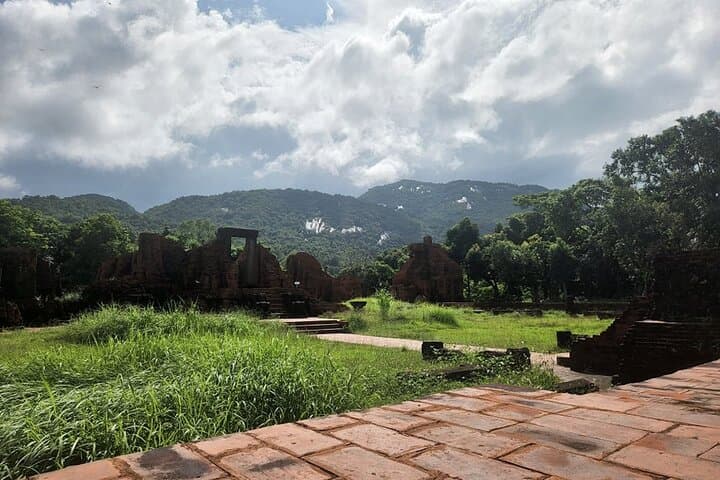


You arrive before the heat, the minivan pulling off a narrow road and the valley opening like a map. Early light catches red-brick towers rising from tall grasses; the jungle breathes around stone lintels and carved deities. A short buggy ride drops you at the entrance, and the walk through My Son’s ruined groups feels like moving through a slow conversation between builders and stones.
You arrive before the heat, the minivan pulling off a narrow road and the valley opening like a map. Early light catches red-brick towers rising from tall grasses; the jungle breathes around stone lintels and carved deities. A short buggy ride drops you at the entrance, and the walk through My Son’s ruined groups feels like moving through a slow conversation between builders and stones.
My Son was the religious heart of the Champa Kingdom from roughly the 4th to 13th centuries. The temples were built from locally fired bricks bonded without mortar, using a clay mix that hardened into near-imperceptible joints. Geologically the site sits in a sheltered trough surrounded by low volcanic ridges—the valley funnels humidity and nourishes dense secondary forest that now frames the monuments.
Culturally, the complex reflects Hindu cosmology adapted by Cham sculptors; look for Shiva lingas and reliefs that speak to Indianized Southeast Asian exchange. Local guides link motifs to trade networks that once tied this coast to Java and India.
Practical guidance: expect about 60–90 minutes of on-site walking over uneven paths and some steps. Wear grippy shoes, bring sun protection and a light rain layer during monsoon months, and carry your camera—temple portals make strong silhouettes at low sun. The tour includes hotel pickup from Hoi An or Da Nang, bottled water, and entrance tickets; photography is allowed but treat fragile carvings with distance. Aim to go early to avoid midday crowds and to see the valley light at its most expressive.