THE ADVENTURE COLLECTIVE® · Independent discovery and booking for outdoor travel

Take a relaxed, sustainable day trip from Barcelona to Montserrat by train, cable car and cogwheel train. This guided small-group tour includes expert commentary plus 2.5 hours of free time to explore the abbey, viewpoints and short trails at your own pace.
Take a relaxed, sustainable day trip from Barcelona to Montserrat by train, cable car and cogwheel train. This guided small-group tour includes expert commentary plus 2.5 hours of free time to explore the abbey, viewpoints and short trails at your own pace.
You step off the train and the mountain greets you with tooth-like ridges and wind that pushes at your jacket as if testing your intent.
Verified experiences and guided adventures in the surrounding area.
You step off the train and the mountain greets you with tooth-like ridges and wind that pushes at your jacket as if testing your intent.
Montserrat’s jagged limestone—actually a conglomerate of pebbles and sand compressed over millennia—rises abruptly above the Catalan plain. Centuries of pilgrims have threaded these slopes to reach the Benedictine abbey of Santa Maria de Montserrat and its famous Black Madonna. The small-group format lets you move with a local guide through the busiest points, then gives 2.5 hours to press your own pace into the stone: a quick basilica visit, a clifftop viewpoint, or a short trail where gulls wheel and the wind dares you to stay still.
Geology shapes the route: steep, rocky outcrops, narrow paths, and viewpoints carved by erosion. Culture is close at hand—traditional Catalan devotion, a boys’ choir at the basilica on select mornings, and small craft shops selling local honey and herbal liqueurs. Transport is part of the experience: the cable car lifts you over pine and cliff; the cogwheel climbs the final slope with a mechanical, reassuring grind.
Practicalities: trains from Barcelona’s Plaça d’Espanya and both the Aeri cable car and the Cremallera (rack) railway connect the valley to the monastery, minimizing road driving. Wear grippy shoes for uneven stone, bring layers (weather changes fast at elevation), and carry water—shade is sparse on ridgelines. Aim for an early slot to avoid peak crowds and to have sunlight on the ridges for the best photos.
easy.
6–7 hours.
Light fitness—able to walk on uneven paths and climb short flights of steps; no sustained hiking required.
The tour uses regional trains from Plaça d’Espanya combined with either the Aeri cable car or the Cremallera cogwheel railway to climb to the monastery, avoiding long bus transfers.
This tour typically includes around 2.5 hours of free time to visit the basilica, viewpoints, museum or take short walks on marked paths.
Yes—most itineraries include time to enter the basilica where the Black Madonna (La Moreneta) is housed; expect queues during peak season.
Yes—access via train, cable car and cogwheel makes it family-friendly; however, mobility issues may make some viewpoints and steps difficult.
Montserrat’s abbey dates back to the medieval period and has been a pilgrimage center for Catalan culture and religion for centuries, housing the venerated Black Madonna.
The massif is a protected natural park; visitors are encouraged to stay on marked paths, pack out waste, and respect quiet zones around the monastery to limit erosion and disturbance.
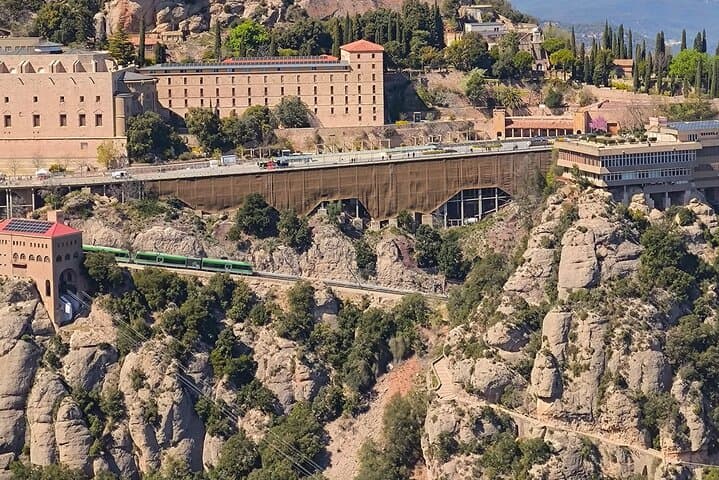
You step off the train and the mountain greets you with tooth-like ridges and wind that pushes at your jacket as if testing your intent.
You step off the train and the mountain greets you with tooth-like ridges and wind that pushes at your jacket as if testing your intent.
Montserrat’s jagged limestone—actually a conglomerate of pebbles and sand compressed over millennia—rises abruptly above the Catalan plain. Centuries of pilgrims have threaded these slopes to reach the Benedictine abbey of Santa Maria de Montserrat and its famous Black Madonna. The small-group format lets you move with a local guide through the busiest points, then gives 2.5 hours to press your own pace into the stone: a quick basilica visit, a clifftop viewpoint, or a short trail where gulls wheel and the wind dares you to stay still.
Geology shapes the route: steep, rocky outcrops, narrow paths, and viewpoints carved by erosion. Culture is close at hand—traditional Catalan devotion, a boys’ choir at the basilica on select mornings, and small craft shops selling local honey and herbal liqueurs. Transport is part of the experience: the cable car lifts you over pine and cliff; the cogwheel climbs the final slope with a mechanical, reassuring grind.
Practicalities: trains from Barcelona’s Plaça d’Espanya and both the Aeri cable car and the Cremallera (rack) railway connect the valley to the monastery, minimizing road driving. Wear grippy shoes for uneven stone, bring layers (weather changes fast at elevation), and carry water—shade is sparse on ridgelines. Aim for an early slot to avoid peak crowds and to have sunlight on the ridges for the best photos.