THE ADVENTURE COLLECTIVE® · Independent discovery and booking for outdoor travel

Spend a full day moving through Monteverde’s cloud forest by gondola, hanging bridge, and zip line. This guided adventure pairs adrenaline with close-up nature viewing and local conservation insight.
Spend a full day moving through Monteverde’s cloud forest by gondola, hanging bridge, and zip line. This guided adventure pairs adrenaline with close-up nature viewing and local conservation insight.
Fog drifts through the trees like a slow-moving sea; you step onto a metal platform and the forest exhales around you. The day at Monteverde unfolds as a sequence of vertical experiences—gondola glides that raise you into mist, hanging bridges that tilt beneath your feet, and zip lines that push you forward over a living canopy.
Verified experiences and guided adventures in the surrounding area.
Fog drifts through the trees like a slow-moving sea; you step onto a metal platform and the forest exhales around you. The day at Monteverde unfolds as a sequence of vertical experiences—gondola glides that raise you into mist, hanging bridges that tilt beneath your feet, and zip lines that push you forward over a living canopy.
This part of Costa Rica sits on a ridge where Pacific and Caribbean weather meet, creating persistent cloud cover and an ecosystem prized by scientists since the 1970s. The reserve grew from small, community-led conservation efforts and the arrival of Quaker settlers mid-20th century; now its trails support research, orchids, and migratory birds. Geologically, the terrain is steep volcanic rock drained by rapid creeks, which carve gullies beneath the bridges.
Expect quick changes in light, damp air that clings to gear, and birds that treat the canopy as a highway. Local guides point out epiphytes and explain how the cloud forest captures moisture; culture here is a mix of rural Costa Rican farming and eco-tourism entrepreneurship centered in nearby Santa Elena.
Practical guidance: arrive early to avoid afternoon winds, wear a water-resistant layer and closed-toe shoes with good grip, and bring small binocs for birding from the bridges. Hydrate before and during the day—altitude and activity combine to sap energy—and follow guide instructions on ziplines; they manage harnessing and safety checks. The experience is a full-day commitment: plan transport and a recovery meal in Santa Elena afterward.
moderate.
10–13 hours.
Moderate fitness: comfortable walking on uneven ground, stair climbs to platforms, and short bursts of exertion for ziplines.
The program runs as a full-day activity—expect roughly 10–13 hours including transfers, with about 6–8 hours of guided on-forest activities.
Yes—guides handle harnessing and provide a safety briefing; no prior zipline experience is required, though you should be comfortable with heights.
Many operators offer pickup from Santa Elena; confirm when booking as return times can vary depending on group size and road conditions.
Quetzals are present but unpredictable; early morning birding increases chances, and guides know the best seasonal viewing spots but sightings cannot be guaranteed.
Conservation in Monteverde grew from small, community-led efforts and Quaker settlers in the 1950s; the area became internationally important for cloud-forest research by the 1970s.
Visitor numbers support local protection programs—stay on designated paths, follow guide rules, and avoid feeding wildlife to minimize ecosystem disruption.
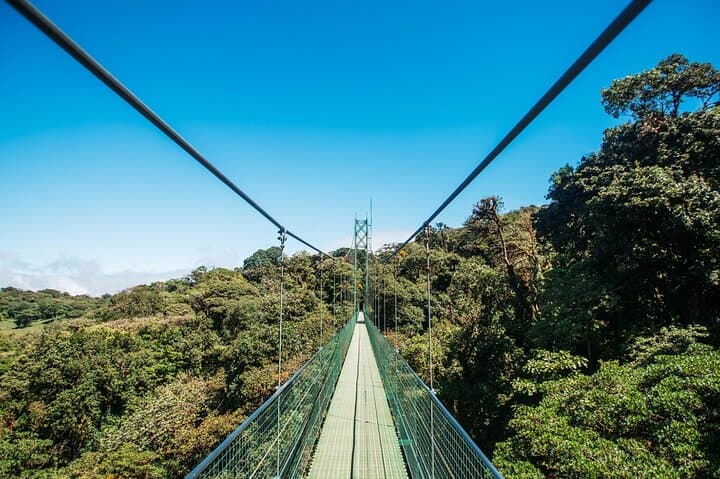
Fog drifts through the trees like a slow-moving sea; you step onto a metal platform and the forest exhales around you. The day at Monteverde unfolds as a sequence of vertical experiences—gondola glides that raise you into mist, hanging bridges that tilt beneath your feet, and zip lines that push you forward over a living canopy.
Fog drifts through the trees like a slow-moving sea; you step onto a metal platform and the forest exhales around you. The day at Monteverde unfolds as a sequence of vertical experiences—gondola glides that raise you into mist, hanging bridges that tilt beneath your feet, and zip lines that push you forward over a living canopy.
This part of Costa Rica sits on a ridge where Pacific and Caribbean weather meet, creating persistent cloud cover and an ecosystem prized by scientists since the 1970s. The reserve grew from small, community-led conservation efforts and the arrival of Quaker settlers mid-20th century; now its trails support research, orchids, and migratory birds. Geologically, the terrain is steep volcanic rock drained by rapid creeks, which carve gullies beneath the bridges.
Expect quick changes in light, damp air that clings to gear, and birds that treat the canopy as a highway. Local guides point out epiphytes and explain how the cloud forest captures moisture; culture here is a mix of rural Costa Rican farming and eco-tourism entrepreneurship centered in nearby Santa Elena.
Practical guidance: arrive early to avoid afternoon winds, wear a water-resistant layer and closed-toe shoes with good grip, and bring small binocs for birding from the bridges. Hydrate before and during the day—altitude and activity combine to sap energy—and follow guide instructions on ziplines; they manage harnessing and safety checks. The experience is a full-day commitment: plan transport and a recovery meal in Santa Elena afterward.