THE ADVENTURE COLLECTIVE® · Independent discovery and booking for outdoor travel

Walk ridge trails above terraced farms, stay in Magar-operated homestays, and watch sunrise over the Annapurna arc on a 4–5 day community trek focused on sustainability and local benefit. Practical, cultural, and scenic — ideal for trekkers who value purpose with their panorama.
Walk ridge trails above terraced farms, stay in Magar-operated homestays, and watch sunrise over the Annapurna arc on a 4–5 day community trek focused on sustainability and local benefit. Practical, cultural, and scenic — ideal for trekkers who value purpose with their panorama.
Morning light strips across oak and rhododendron as you climb from a stone-paved lane, the Annapurna range suddenly stepping into view — peaks carving the horizon while terraced farms hold the slopes like stacked pages. Mohare Danda’s ridge rewards early risers with a broad sunrise panorama; the wind seems to push you forward, and the valley below answers with patchwork fields and wandering water.
Verified experiences and guided adventures in the surrounding area.
Morning light strips across oak and rhododendron as you climb from a stone-paved lane, the Annapurna range suddenly stepping into view — peaks carving the horizon while terraced farms hold the slopes like stacked pages. Mohare Danda’s ridge rewards early risers with a broad sunrise panorama; the wind seems to push you forward, and the valley below answers with patchwork fields and wandering water.
The route sits inside the Annapurna Conservation Area, an early model of community-led conservation in Nepal. Villages along the trail belong largely to Magar communities whose homestays operate under a sustainable tourism model: income supports schools, clinics, and local water projects. Geologically, the trail threads between river valleys and uplifted Himalayan limestone and schist, alternating steep stone steps with gentler forested stretches.
Expect 4–5 days on trail, roughly 40–50 km total, with daily walking of 4–6 hours and the highest sleeping/ viewpoint altitude around 2,900–3,200 m. Terrain varies from packed dirt and stone steps to narrow ridgelines and terraced farm tracks; cumulative elevation gain is typically 1,200–1,600 m. Trails are well-marked locally but can be slippery after monsoon.
Practical edge: schedule mornings for viewpoints, carry a layered shell for cold ridge winds, and bring small-denomination Nepali rupees — homestays are cash-forward. Allow an extra day in Pokhara before or after for acclimatization and to arrange permits. Respect household routines inside homestays: shoes off, modest clothing, and an openness to simple, hearty Dal-Bhat meals. The route offers a tight mix of culture, purposeful conservation, and mountain exposure — accessible for steady trekkers who want meaningful contact with local life rather than remote wilderness solitude.
moderate.
4–5 days.
Suitable for hikers who regularly do 4–6 hour days with steady uphill; basic cardio and leg strength recommended
Yes — the Annapurna Conservation Area requires a TIMS/Annapurna Conservation Area permit; guides or local operators usually arrange this in Pokhara.
Highest points are around 2,900–3,200 m; allow at least a day in Pokhara and moderate pacing on the trail to reduce altitude risk.
Homestays typically offer simple private or shared rooms with community-run facilities and communal dining; private amenities vary by village.
Spring and autumn offer the clearest mountain views and stable weather; monsoon brings green valleys but wetter trails and limited visibility.
The trek runs inside the Annapurna Conservation Area, Nepal’s first and largest conservation project that blends biodiversity protection with community-managed tourism.
Community homestays on this route channel income into local development and waste-management efforts, supporting water projects and reducing reliance on external resources.
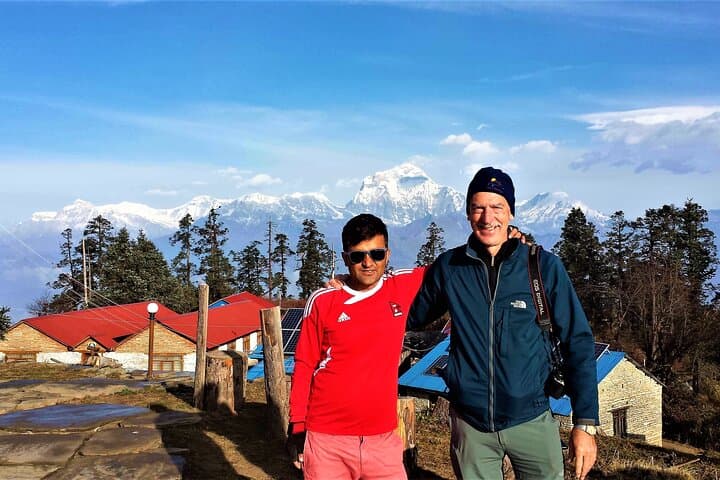
Morning light strips across oak and rhododendron as you climb from a stone-paved lane, the Annapurna range suddenly stepping into view — peaks carving the horizon while terraced farms hold the slopes like stacked pages. Mohare Danda’s ridge rewards early risers with a broad sunrise panorama; the wind seems to push you forward, and the valley below answers with patchwork fields and wandering water.
Morning light strips across oak and rhododendron as you climb from a stone-paved lane, the Annapurna range suddenly stepping into view — peaks carving the horizon while terraced farms hold the slopes like stacked pages. Mohare Danda’s ridge rewards early risers with a broad sunrise panorama; the wind seems to push you forward, and the valley below answers with patchwork fields and wandering water.
The route sits inside the Annapurna Conservation Area, an early model of community-led conservation in Nepal. Villages along the trail belong largely to Magar communities whose homestays operate under a sustainable tourism model: income supports schools, clinics, and local water projects. Geologically, the trail threads between river valleys and uplifted Himalayan limestone and schist, alternating steep stone steps with gentler forested stretches.
Expect 4–5 days on trail, roughly 40–50 km total, with daily walking of 4–6 hours and the highest sleeping/ viewpoint altitude around 2,900–3,200 m. Terrain varies from packed dirt and stone steps to narrow ridgelines and terraced farm tracks; cumulative elevation gain is typically 1,200–1,600 m. Trails are well-marked locally but can be slippery after monsoon.
Practical edge: schedule mornings for viewpoints, carry a layered shell for cold ridge winds, and bring small-denomination Nepali rupees — homestays are cash-forward. Allow an extra day in Pokhara before or after for acclimatization and to arrange permits. Respect household routines inside homestays: shoes off, modest clothing, and an openness to simple, hearty Dal-Bhat meals. The route offers a tight mix of culture, purposeful conservation, and mountain exposure — accessible for steady trekkers who want meaningful contact with local life rather than remote wilderness solitude.