THE ADVENTURE COLLECTIVE® · Independent discovery and booking for outdoor travel

Explore Milos’s volcanic underbelly on a compact half-day tour that visits Aggeria mine, sulfur fields at Kalamos and the ghostly ruins of Paliorema before ending at Provatas beach. Ideal for anyone curious about geology, mining history and dramatic island landscapes.
Explore Milos’s volcanic underbelly on a compact half-day tour that visits Aggeria mine, sulfur fields at Kalamos and the ghostly ruins of Paliorema before ending at Provatas beach. Ideal for anyone curious about geology, mining history and dramatic island landscapes.
You arrive on a wind-scoured lane, salt on the air and raw cliffs hemming a quiet bay; the guide slips the van into low gear and the island opens like a folded map. The first stop — the Aggeria mine — exposes layered subsoil in bands of red, ochre and ash-grey, a chromatic record of Milos’s volcanic past.
Verified experiences and guided adventures in the surrounding area.
Operated by Milos Experience · Adamas, South Aegean
You arrive on a wind-scoured lane, salt on the air and raw cliffs hemming a quiet bay; the guide slips the van into low gear and the island opens like a folded map. The first stop — the Aggeria mine — exposes layered subsoil in bands of red, ochre and ash-grey, a chromatic record of Milos’s volcanic past.
Geology is the narrative here: Milos is a collapsed volcanic complex in the southern Aegean whose eruptions left trachyte flows, pumice beds and mineral-rich seams. Sulfur mining shaped local life from Ottoman times through the 20th century; at Paliorema (Theiorichia) the rusted wagons and abandoned offices read like an open-air industrial museum. The route arcs south to Kalamos, where fumaroles still scent the air and the terrain hints at an eruption roughly 90,000 years ago.
Culturally, the island balances fishing villages and mining heritage — you’ll pass Zephyrion village and small chapels that punctuate the route. The tour finishes at Provatas beach: a cooling contrast of black pebbles and bright sea.
Practical guidance: expect mostly vehicle travel with short on-foot inspections on uneven ground; sturdy shoes and sun protection are essential. The sulfur vents can sting sensitive throats — carry water and step back if the smell is strong. Photography is rewarding in sharp mid-day light; aim for morning or late afternoon for softer shadows. Travelers with cardiovascular issues should consult a physician before booking. This half-day itinerary is compact but sensory: color, scent and industrial relics combined with Aegean surf make it a concentrated primer on Milos’s volcanic soul.
easy.
5 hours.
Light fitness — primarily vehicle-based with brief on-foot stops; able to walk on uneven terrain for short periods.
The excursion runs about five hours total, including transport and three main stopovers.
No — walking is limited to short inspections at mine sites, ruins and viewpoints; some surfaces are uneven.
Stops include places with basic facilities; the tour provides snacks and bottled drinks in the vehicle.
The trip is family-friendly but not recommended for travelers with serious cardiovascular problems; some sites have uneven ground and may be difficult with limited mobility.
Milos’s mining economy — especially sulfur and obsidian extraction — shaped local settlements; mining activity continued into the mid-20th century and left visible industrial ruins.
Fragile volcanic soils and archaeological remnants require staying on paths and not collecting mineral specimens; tours aim to minimize vehicle impact and respect cultural sites.
Milos Experience operates guided outdoor trips and adventures with an emphasis on safety, stewardship, and memorable experiences.


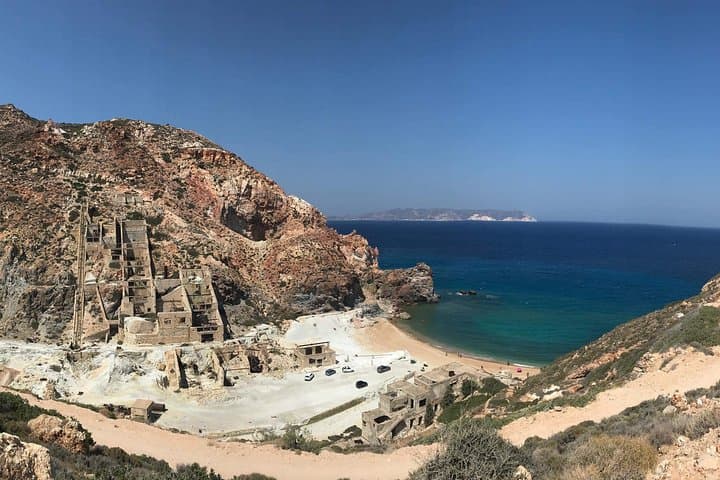

You arrive on a wind-scoured lane, salt on the air and raw cliffs hemming a quiet bay; the guide slips the van into low gear and the island opens like a folded map. The first stop — the Aggeria mine — exposes layered subsoil in bands of red, ochre and ash-grey, a chromatic record of Milos’s volcanic past.
You arrive on a wind-scoured lane, salt on the air and raw cliffs hemming a quiet bay; the guide slips the van into low gear and the island opens like a folded map. The first stop — the Aggeria mine — exposes layered subsoil in bands of red, ochre and ash-grey, a chromatic record of Milos’s volcanic past.
Geology is the narrative here: Milos is a collapsed volcanic complex in the southern Aegean whose eruptions left trachyte flows, pumice beds and mineral-rich seams. Sulfur mining shaped local life from Ottoman times through the 20th century; at Paliorema (Theiorichia) the rusted wagons and abandoned offices read like an open-air industrial museum. The route arcs south to Kalamos, where fumaroles still scent the air and the terrain hints at an eruption roughly 90,000 years ago.
Culturally, the island balances fishing villages and mining heritage — you’ll pass Zephyrion village and small chapels that punctuate the route. The tour finishes at Provatas beach: a cooling contrast of black pebbles and bright sea.
Practical guidance: expect mostly vehicle travel with short on-foot inspections on uneven ground; sturdy shoes and sun protection are essential. The sulfur vents can sting sensitive throats — carry water and step back if the smell is strong. Photography is rewarding in sharp mid-day light; aim for morning or late afternoon for softer shadows. Travelers with cardiovascular issues should consult a physician before booking. This half-day itinerary is compact but sensory: color, scent and industrial relics combined with Aegean surf make it a concentrated primer on Milos’s volcanic soul.