THE ADVENTURE COLLECTIVE® · Independent discovery and booking for outdoor travel

A private day trip from Corfu that places you among Meteora’s gravity-defying sandstone pillars and clifftop monasteries. Expect dramatic overlooks, stone stairways, and a mix of geology, medieval history and living religious culture.
A private day trip from Corfu that places you among Meteora’s gravity-defying sandstone pillars and clifftop monasteries. Expect dramatic overlooks, stone stairways, and a mix of geology, medieval history and living religious culture.
You arrive to a horizon of stone columns that rise like unfinished towers, light sliding down vertical faces while gulls wheel above the plain. The road from the Ionian coast unwinds into Thessaly; at the top of a hairpin turn, the monasteries appear—perched, severe, and stubborn against gravity.
Verified experiences and guided adventures in the surrounding area.
Operated by Corfu Union transfers & tours IKE · Kalambaka, Thessaly
You arrive to a horizon of stone columns that rise like unfinished towers, light sliding down vertical faces while gulls wheel above the plain. The road from the Ionian coast unwinds into Thessaly; at the top of a hairpin turn, the monasteries appear—perched, severe, and stubborn against gravity.
Meteora’s pillars are sandstone and conglomerate sculpted by millions of years of uplift, earthquakes and erosion. Medieval monks saw refuge in the thin crowns of rock and, beginning in the 11th century, hauled building materials up by rope and ladder to found hermitages and monasteries. Today 24 religious sites once crowned the cliffs; six remain active and open to visitors, each offering Byzantine frescoes, simple courtyards and a view that reads like geological history.
The route between lookouts and monasteries alternates paved switchbacks, stone steps and short gravel paths; elevations reach roughly 600 m above the valley floor, but walking between sites is mostly short, steep bursts rather than long ascents. Expect stairways and narrow passages—modest mobility is required.
Practical essentials: plan a full day (this itinerary runs about 12 hours), arrive early to beat peak crowds and heat, and respect dress codes—shoulders and knees covered in monastery chapels. Bring water, sturdy shoes, sun protection and a light layer for breezy ridge-top conditions. Photography is welcome in most public areas but restricted inside some chapels. A private tour from Corfu offers the convenience of door-to-door travel and local knowledge to access the best overlooks and lesser-known hermit caves, making a long day of travel feel purposeful and efficient.
moderate.
12 hours.
Suitable for travellers who can manage multiple short, steep stair climbs and brief walks; not recommended for those with serious mobility limitations.
Not always—many operators exclude individual monastery entrance fees; confirm in advance and carry small cash for admissions and donations.
Typically 3–4 active monasteries are feasible on a full-day itinerary, depending on opening hours, crowding and travel time between sites.
Yes for short visits, but expect stairs and narrow walkways; those with limited mobility may find access to some sites difficult.
Yes—private tours and monastery access can be limited, especially in high season; book early and confirm pickup logistics from Corfu.
Meteora became a center of monastic life from the 11th century onward; the monasteries were built by ascetics seeking isolation and safety from political turmoil.
The region is a Natura 2000 ecological zone protecting rare flora and raptors; visitors are asked to stay on trails and avoid disturbing nesting birds.
Corfu Union transfers & tours IKE operates guided outdoor trips and adventures with an emphasis on safety, stewardship, and memorable experiences.
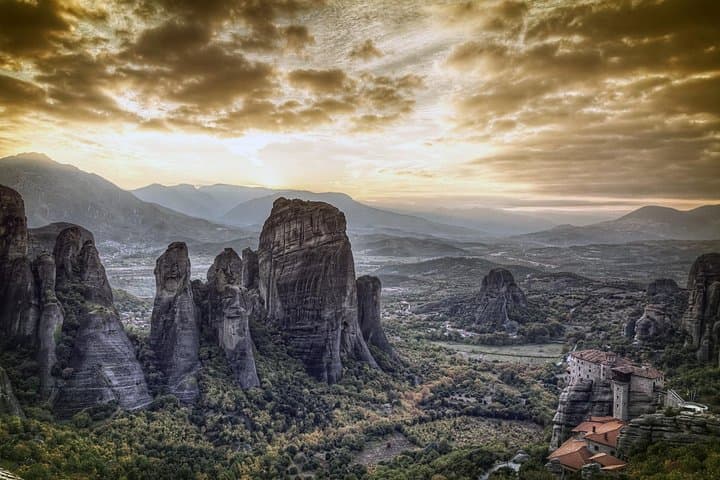



You arrive to a horizon of stone columns that rise like unfinished towers, light sliding down vertical faces while gulls wheel above the plain. The road from the Ionian coast unwinds into Thessaly; at the top of a hairpin turn, the monasteries appear—perched, severe, and stubborn against gravity.
You arrive to a horizon of stone columns that rise like unfinished towers, light sliding down vertical faces while gulls wheel above the plain. The road from the Ionian coast unwinds into Thessaly; at the top of a hairpin turn, the monasteries appear—perched, severe, and stubborn against gravity.
Meteora’s pillars are sandstone and conglomerate sculpted by millions of years of uplift, earthquakes and erosion. Medieval monks saw refuge in the thin crowns of rock and, beginning in the 11th century, hauled building materials up by rope and ladder to found hermitages and monasteries. Today 24 religious sites once crowned the cliffs; six remain active and open to visitors, each offering Byzantine frescoes, simple courtyards and a view that reads like geological history.
The route between lookouts and monasteries alternates paved switchbacks, stone steps and short gravel paths; elevations reach roughly 600 m above the valley floor, but walking between sites is mostly short, steep bursts rather than long ascents. Expect stairways and narrow passages—modest mobility is required.
Practical essentials: plan a full day (this itinerary runs about 12 hours), arrive early to beat peak crowds and heat, and respect dress codes—shoulders and knees covered in monastery chapels. Bring water, sturdy shoes, sun protection and a light layer for breezy ridge-top conditions. Photography is welcome in most public areas but restricted inside some chapels. A private tour from Corfu offers the convenience of door-to-door travel and local knowledge to access the best overlooks and lesser-known hermit caves, making a long day of travel feel purposeful and efficient.